China's Export Growth
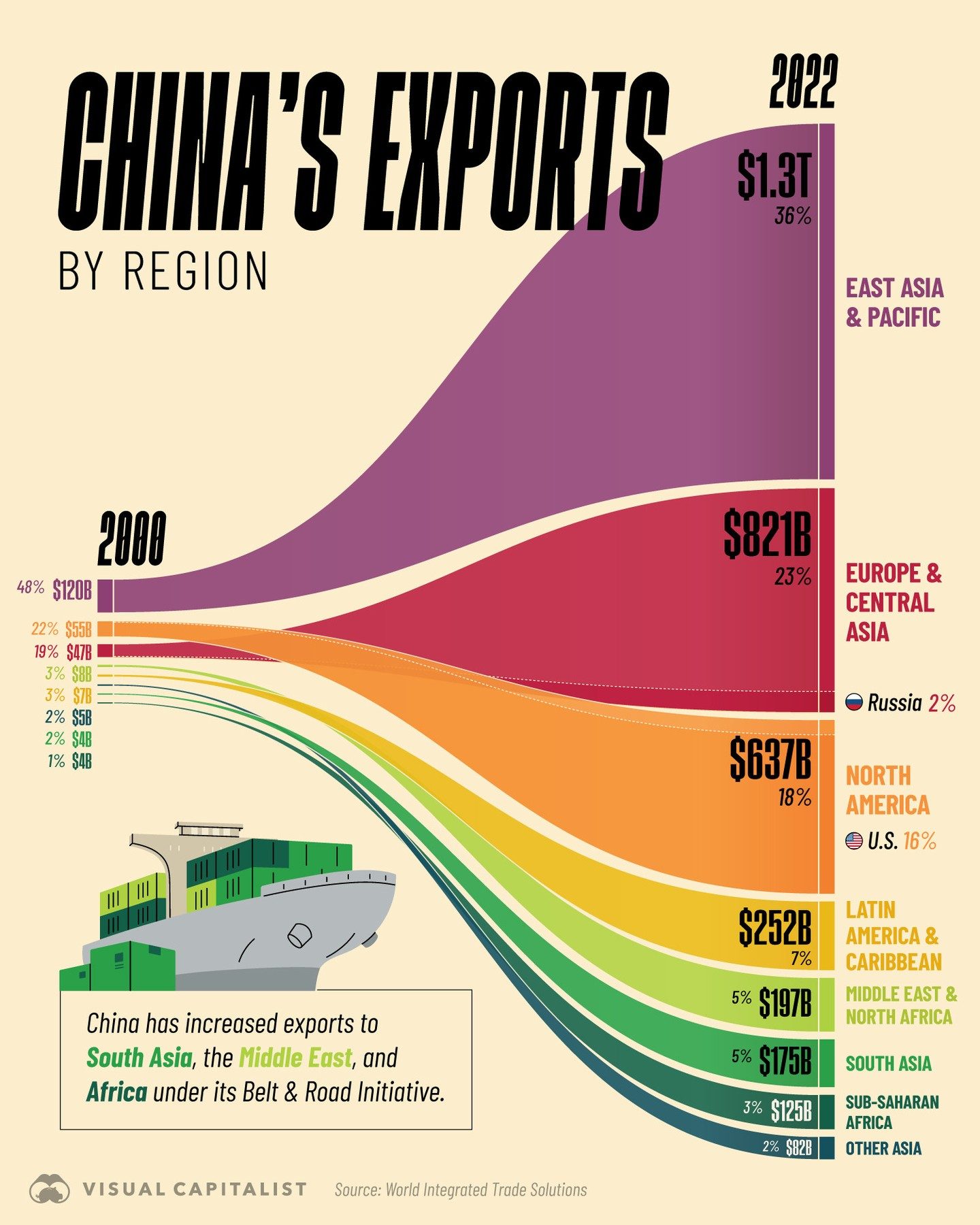
China's export landscape has dramatically shifted since the turn of the millennium. From 2000 to 2022, China's trade dynamics have undergone significant transformations, with notable increases in exports to certain regions and a decline in others.
Context / Why This Matters
Understanding China's export trends is crucial for grasping the broader implications of global trade dynamics. The shifts in export destinations reflect China's strategic economic initiatives and the evolving geopolitical landscape. These changes influence not only China's economy but also the economic trajectories of trading partners worldwide.
Main Discussion
Export Growth by Region
China's export growth from 2000 to 2022 reveals a fascinating story of diversification and strategic focus. In 2000, China's exports to the United States accounted for 21% of its total exports. By 2023, this share had declined to 14.8%. This reduction highlights a strategic pivot away from over-reliance on a single market, particularly the U.S., towards a more diversified export strategy.
The data shows a significant increase in exports to Latin America and the Caribbean, more than doubling in this period. This region has become an increasingly important market for China, reflecting the country's efforts to expand its economic influence globally.
East Asia and the Pacific
East Asia and the Pacific remain a critical region for China's exports. This region is pivotal for China's trade, comprising a substantial portion of its total exports. The region's proximity and historical economic ties make it a natural trading partner, and China has leveraged these relationships to sustain robust export volumes.
Europe and Central Asia
Exports to Europe and Central Asia are another significant component of China's trade. This region has seen steady growth, reflecting China's strategic investments and trade agreements. The Belt and Road Initiative, for instance, has played a crucial role in enhancing trade with countries like Russia, which is a significant export destination.
The Middle East and North Africa, as well as Africa, are regions where China has shown significant growth. The Belt and Road Initiative (BRI) has been instrumental in boosting exports to these regions. The BRI has facilitated infrastructure development and enhanced trade corridors, making it easier for Chinese goods to reach new markets. The increase in exports to South Asia and Africa underscores the strategic importance of these regions in China's global trade strategy.
North America
North America, particularly the United States, has traditionally been a major export destination for China. However, the data reveals a declining trend in China's reliance on the U.S. market. While North America remains important, China's diversified export strategy aims to reduce dependence on any single market, thereby mitigating risks associated with geopolitical tensions or economic fluctuations.
Practical Tips
For businesses looking to understand and capitalize on China's export trends, several practical tips can be beneficial:
- Diversify Export Markets: Businesses should consider diversifying their export markets to reduce reliance on any single region. This strategy can help mitigate risks associated with economic fluctuations or geopolitical events.
- Leverage Trade Agreements: Utilize existing trade agreements and initiatives, such as the Belt and Road Initiative, to explore new markets and enhance trade opportunities. These initiatives often provide infrastructure support and streamlined trade processes.
- Invest in Emerging Regions: Consider investing in emerging regions like Latin America, Africa, and South Asia. These regions offer significant growth potential and are increasingly important in China's trade strategy.
Important Takeaways
The shifts in China's export landscape reveal several key takeaways:
- China has strategically pivoted away from over-reliance on the U.S. market, diversifying its export destinations to include regions like Latin America, Africa, and South Asia.
- The Belt and Road Initiative has played a crucial role in enhancing trade with regions like Africa and South Asia, facilitating infrastructure development and trade corridors.
- East Asia and the Pacific, along with Europe and Central Asia, remain critical regions for China's exports, reflecting the strategic importance of these areas in global trade.
Conclusion
China's export growth from 2000 to 2022 highlights a strategic shift towards a more diversified export landscape. This pivot is driven by economic initiatives like the Belt and Road Initiative and a recognition of the need to reduce reliance on single markets. By understanding these trends, businesses and policymakers can better navigate the evolving global trade dynamics and capitalize on emerging opportunities.
Watch the Reel
Questions readers ask
Which regions have seen the most significant growth in exports from China between 2000 and 2022?
The regions that have experienced the most notable growth in exports from China are Latin America and the Caribbean, East Asia, and Europe. These areas have seen substantial increases in trade, reflecting China's strategic efforts to diversify its export markets.
How have China's exports to the U.S. changed over the past two decades?
China's exports to the U.S. have seen a shift in their proportion of total Chinese exports. Initially, the U.S. was a dominant market, but from 2000 to 2022, China has strategically reduced its reliance on the U.S. by increasing exports to other regions, thus diversifying its trade partners.
What are some of the key geopolitical factors driving China's export growth by region?
China's export growth by region is influenced by several geopolitical factors, including trade agreements, diplomatic relations, and regional economic initiatives. For instance, China has leveraged its Belt and Road Initiative to enhance trade with Southeast Asia, Africa and Europe.
Why is understanding China's export trends important for global trade?
Understanding China's export trends is important for global trade as they provide insights into shifting trade dynamics, identifying emerging markets, and predicting future economic trends. These trends also highlight the evolving geopolitical strategies that influence international trade policies and partnerships.
How have China's trade initiatives impacted its export growth to Africa?
China's trade initiatives, such as the Forum on China-Africa Cooperation, have significantly boosted its export growth to Africa. These initiatives have led to increased infrastructure investments, resource trade, and economic cooperation, fostering a robust trade relationship between the two regions.
What role do strategic economic initiatives play in China's export growth by region?
Strategic economic initiatives, such as the Belt and Road Initiative, have significantly influenced China's export growth by region. These initiatives facilitate infrastructure development, enhance trade routes, and promote economic cooperation with partner countries, leading to increased trade and investment opportunities.
Recent articles
Fresh deep dives from the latest Reels we unpacked.




Comments
Be the first to comment.