Critical Minerals Production
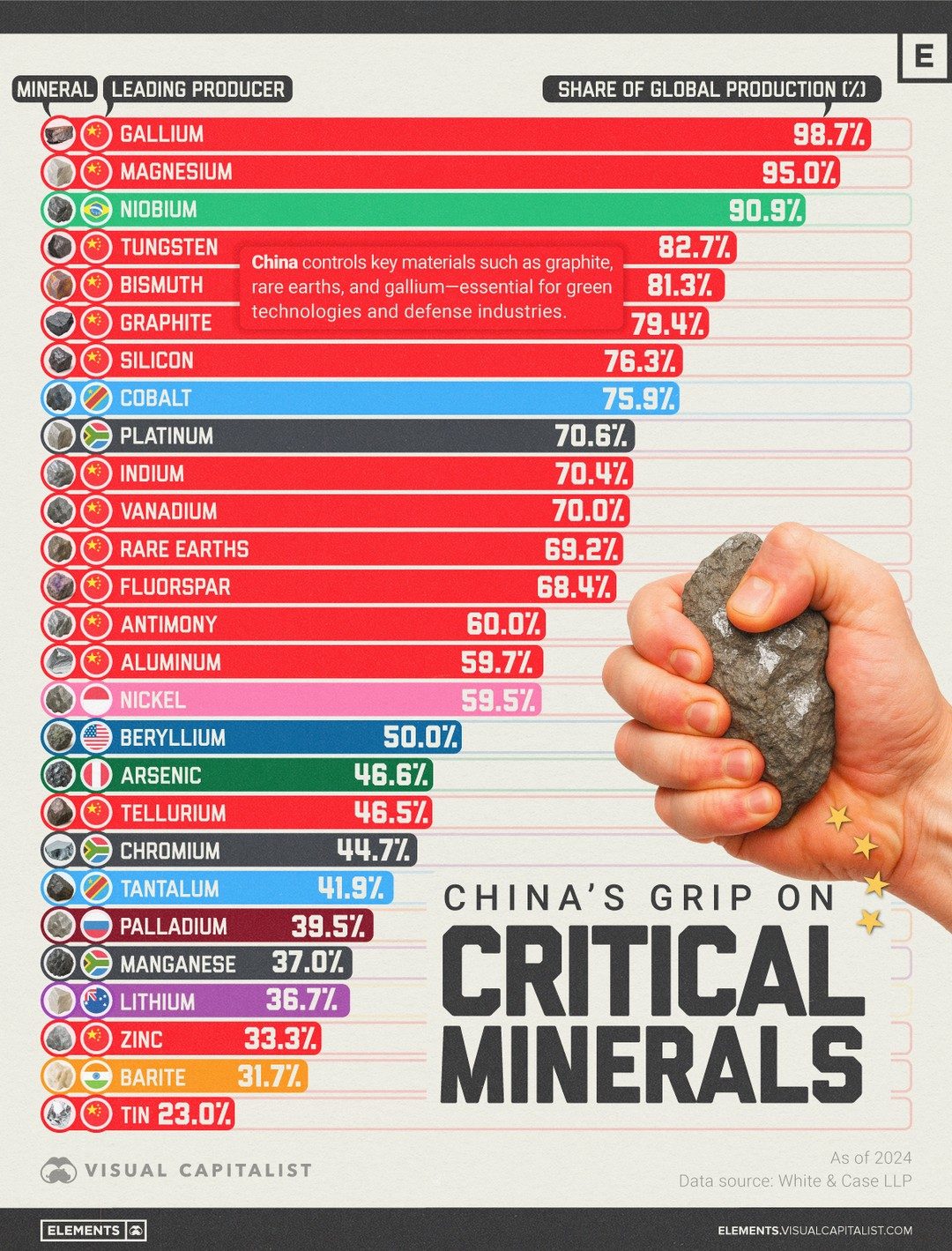
China dominates the global production of critical minerals, which are essential for various technologies, including electric vehicles, renewable energy, and semiconductors. This dominance is evident in the production of 25 key minerals, many of which are crucial for modern industrial applications. The data, sourced from White & Case LLP, highlights the concentration of global supply in China, with the country leading in the production of minerals such as gallium, magnesium, niobium, and many others.
Why This Matters
Critical minerals are essential for the development and operation of technologies that are driving the future. These minerals are used in everything from EVs to renewable energy and semiconductors. Understanding the supply chain dynamics of these minerals is crucial for industries and countries looking to secure their technology supply.
As the world shifts towards more sustainable and technologically advanced solutions, the reliance on these critical minerals will only increase. Therefore, the concentration of their production in China has significant implications for global supply chains, geopolitical dynamics, and the future of technology.
Global Mineral Production: China's Dominance
Key Minerals and Their Importance
China's dominance in the production of critical minerals is vast. The country leads in the production of many essential minerals:
- Magnesium (95.0%): Crucial for lightweight alloys in automotive and aerospace industries.
- Niobium (90.9%): Used in high-strength steel and superconducting materials.
- Tungsten (82.7%): Essential for hard metals, cutting tools, and military applications.
- Bismuth (81.3%): Utilized in pharmaceuticals, cosmetics, and low-melting-point alloys.
- Graphite (79.4%): Important for lithium-ion batteries and nuclear reactors.
- Silicon (76.3%): A key component in semiconductors and solar panels.
- Cobalt (75.9%): Vital for rechargeable batteries in electronics and EVs.
- Vanadium (70.0%): Used in steel alloys for high-strength applications.
- Rare Earths (69.2%): Essential for magnets in EVs, wind turbines, and electronics.
Additional Minerals and Their Applications
China also holds significant production shares in other critical minerals:
- Gallium (70.4%): Used in LEDs, semiconductors, and solar panels.
- Platinum (70.6%): Crucial for catalytic converters in automobiles and laboratory equipment.
- Palladium (70.7%): Used in catalytic converters and fuel cells.
- FluorSpar (68.4%): Essential for aluminum production and hydrofluoric acid.
- Antimony (60.0%): Utilized in flame retardants, batteries, and alloys.
- Arsenic (59.7%): Used in pesticides, wood preservatives, and semiconductors.
- Aluminum (59.5%): Essential for construction, transportation, and packaging.
- Beryllium (50.0%): Used in aerospace, electronics, and X-ray machines.
- Tellurium (46.6%): Vital for solar panels and thermoelectric devices.
- Chromium (44.7%): Crucial for stainless steel and alloys.
- Tantalum (41.9%): Used in capacitors for electronic devices.
- Barite (39.5%): Essential for drilling fluids in the oil and gas industry.
- Tin (23.0%): Used in soldering and various alloys.
Critical Minerals and the Energy Transition
Critical minerals play a pivotal role in the energy transition, enabling the development of clean energy technologies. For instance, rare earths are essential for the magnets used in wind turbines and electric motors, while cobalt and lithium are crucial for the batteries that power electric vehicles (EVs) and renewable energy storage systems.
Challenges and Dependencies
The concentration of critical mineral production in China poses challenges and dependencies for other countries. The supply chain for these minerals is complex and can be disrupted by geopolitical tensions, environmental regulations, and market fluctuations. For example, if China were to restrict exports or face internal disruptions, the global supply of critical minerals could be severely impacted. This could lead to shortages, price volatility, and potential delays in the production of essential technologies.
Moreover, the environmental and social impacts of mining critical minerals cannot be overlooked. The extraction of these minerals often involves significant environmental degradation, including deforestation, water pollution, and soil contamination. Additionally, mining operations can have adverse effects on local communities, leading to issues such as displacement, human rights abuses, and health hazards.
Practical Tips
If you are involved in industries that rely on critical minerals, here are some practical tips to navigate the complexities of the supply chain:
Diversify Supply Sources
Consider diversifying your supply sources to minimize reliance on a single country. This can help mitigate risks associated with geopolitical tensions and supply disruptions. Look for countries with emerging mining industries or those with untapped mineral reserves that are environmentally and socially sustainable.
Invest in Sustainable Mining
Support companies that are committed to sustainable mining practices. This includes those that prioritize environmental conservation, community engagement, and ethical labor practices. Investing in sustainable mining can help ensure a stable and responsible supply of critical minerals.
Develop Recycling Programs
Establish recycling programs for products that contain critical minerals. This can help reduce the demand for newly mined materials and mitigate the environmental impact of mining operations. Recycling can also create new economic opportunities and promote circular economy principles.
Foster Innovation in Alternative Technologies
Encourage research and development in alternative technologies that do not rely on critical minerals. This can help reduce dependence on these materials and promote more sustainable and resilient supply chains. For example, explore the development of batteries that use fewer critical minerals or the use of alternative materials in electronics and renewable energy technologies.
Collaborate with Policymakers
Work with policymakers to develop regulations and incentives that promote sustainable mining and responsible supply chain management. This can help ensure a stable and secure supply of critical minerals while addressing environmental and social concerns.
Important Takeaways
- China is the leading producer of many critical minerals essential for modern technologies.
- The concentration of mineral production in China poses risks and challenges for global supply chains.
- Critical minerals are crucial for the development of renewable energy, EVs, and semiconductors.
- Supply chain diversification, sustainable mining, recycling, and innovation are key strategies for mitigating risks and promoting responsible resource management.
- Collaboration between industry and policymakers is essential for developing sustainable and resilient supply chains.
Conclusion
The dominance of China in the production of critical minerals is a significant factor in global supply chains. Understanding the implications of this dominance and taking proactive steps to mitigate risks and promote sustainability are essential for industries relying on these minerals. By diversifying supply sources, investing in sustainable mining, developing recycling programs, and fostering innovation, industries can navigate the complexities of the critical minerals supply chain and contribute to a more sustainable and resilient future.
Watch the Reel
Questions readers ask
Which critical minerals does China dominate in production?
China leads in the production of over 25 critical minerals, including gallium, magnesium, niobium, and silicon. These minerals are essential for technologies such as electric vehicles, renewable energy systems, and semiconductors.
Why are critical minerals important for the future of technology?
Critical minerals are vital for the development and operation of advanced technologies. They are used in a wide range of applications, from electric vehicles and renewable energy to semiconductors, making them crucial for the future of sustainable and technological advancement.
How does China's dominance in mineral production affect global supply chains?
China's control over the production of many critical minerals means that global supply chains are heavily reliant on China. This can lead to potential disruptions and geopolitical tensions, as other countries may face challenges in accessing these essential resources.
What are some of the strategic implications of China's mineral dominance?
China's dominance in mineral production gives the country significant geopolitical leverage. Other nations may need to diversify their supply sources or invest in domestic mining and processing capabilities to reduce dependence on China, which can be both costly and time consuming.
What are some of the key minerals China exports, and how do they impact global markets?
China exports a wide range of critical minerals, including rare earth elements and other strategic minerals. These exports have a significant impact on global markets, influencing prices, availability, and technological development in other countries.
How can other countries mitigate the risks associated with China's mineral dominance?
Other countries can mitigate these risks by investing in alternative mineral sources, developing domestic mining capabilities, and fostering international partnerships. Diversifying supply chains and reducing reliance on a single source can enhance stability and security in the global mineral market.
What are the benefits for China with regard to the global mineral supply chain?
China's dominance in the global mineral supply chain provides significant economic and strategic benefits. The country can negotiate better trade deals and technological partnerships, while also securing a competitive advantage in industries dependent on these minerals. This control can also enhance China's influence in global markets and geopolitical dynamics.
Recent articles
Fresh deep dives from the latest Reels we unpacked.




Comments
Be the first to comment.