Battery Recycling Dominance in 2025
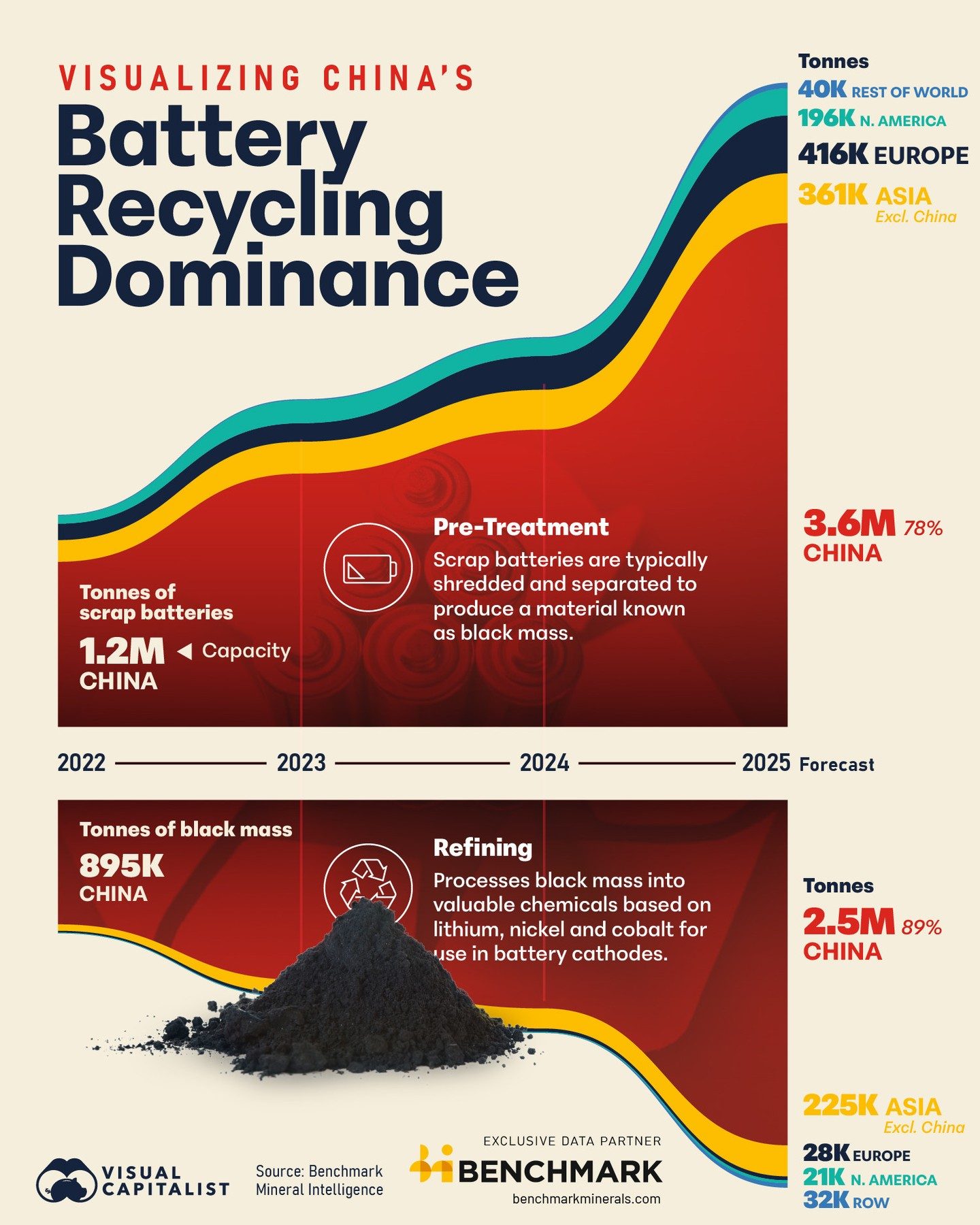
China leads the global battery recycling industry, processing 78% of pre-treatment and 89% of refining capacity by 2025. This dominance is driven by early investments and a robust recycling infrastructure, solidifying China's role in the clean energy transition.
Context / Why this matters
Understanding the dynamics of battery recycling is crucial for several reasons. First, it highlights the increasing importance of sustainable waste management as the demand for batteries surges, particularly for electric vehicles and energy storage systems. Second, it underscores the strategic significance of critical minerals like lithium, nickel, and cobalt, which are essential for battery production. China's dominance in this sector means that it plays a pivotal role in the global supply chain for these valuable resources.
Main discussion
China's Dominance in Battery Recycling
China's leadership in battery recycling is evident in both pre-treatment and refining capacities. Pre-treatment involves the initial sorting and shredding of batteries to prepare them for recycling. Refining, on the other hand, converts the processed materials into valuable metals that can be reused in new batteries.
As of 2025, China handles an impressive 1.2 million tonnes of battery pre-treatment. This figure is significantly higher than other regions, highlighting China's dominance in this crucial stage of the recycling process.
The refining stage is where China truly shines. With a refining capacity of 895,000 tonnes by 2025, China outpaces other regions by a substantial margin. This capacity allows China to convert black mass—an intermediate material obtained from pre-treatment—into essential minerals like lithium, nickel, and cobalt.
Global Battery Recycling Landscape
While China leads the market, other regions also contribute to global battery recycling efforts.
North America
North America's battery recycling capacity is growing, with significant strides in both pre-treatment and refining. By 2025, North America is expected to process 225,000 tonnes in the pre-treatment stage. The refining capacity is projected to reach 40,000 tonnes, showcasing the region's commitment to sustainable practices.
Europe
Europe is another key player in the battery recycling arena. The region's pre-treatment capacity is set to reach 416,000 tonnes by 2025, with a refining capacity of 361,000 tonnes. Europe's advanced recycling infrastructure and stringent environmental regulations drive this growth.
Asia (excluding China)
Asia, excluding China, also makes significant contributions to battery recycling. The pre-treatment capacity is expected to reach 28,000 tonnes, while the refining capacity stands at 32,000 tonnes. This highlights the diverse efforts within the Asian region to manage battery waste sustainably.
The Role of Benchmark Mineral Intelligence
Benchmark Mineral Intelligence, the exclusive data partner for this analysis, provides valuable insights into the global battery recycling market. Their data highlights the critical role that recycling plays in the clean energy transition. By converting waste materials into valuable resources, recycling not only reduces environmental impact but also ensures a steady supply of critical minerals for future battery production.
Practical tips for Recycling Batteries
Proper Disposal Methods
Proper disposal of batteries is the first step in effective recycling. Always follow local regulations and guidelines for battery disposal. Many retailers offer battery recycling programs, providing a convenient way to dispose of used batteries responsibly.
Participate in Local Recycling Programs
Many communities have battery recycling programs. Participating in these programs helps ensure that batteries are recycled properly and that valuable materials are recovered.
Support Innovative Recycling Technologies
Advances in recycling technologies are making the process more efficient and environmentally friendly. Supporting companies that invest in innovative recycling technologies can help drive the industry forward.
Important takeaways
China's dominance in the global battery recycling market underscores the importance of sustainable waste management and the strategic value of critical minerals. As the demand for batteries continues to grow, effective recycling practices will be crucial for a sustainable future. Other regions, including North America, Europe, and Asia (excluding China), also play significant roles in the global recycling landscape. Supporting initiatives that promote proper disposal, participation in recycling programs, and investment in innovative technologies can help ensure a more sustainable and efficient battery recycling industry.
Conclusion
The future of battery recycling looks promising, with China leading the way and other regions contributing significantly. As the global demand for batteries continues to rise, the importance of effective recycling practices cannot be overstated. By understanding the dynamics of the global recycling market and supporting sustainable initiatives, we can ensure a cleaner and more efficient future for battery production and waste management.
Watch the Reel
Questions readers ask
What makes China a leader in the global battery recycling industry?
China's leadership in global battery recycling is attributed to early investments in the field and a well-established recycling infrastructure. By 2025, the country will handle nearly 80% of pre-treatment and 90% of refining capacity, solidifying its top position.
Why is China's role in battery recycling crucial for the clean energy transition?
China's dominance in battery recycling is vital for the clean energy transition because it ensures a steady supply of critical minerals like lithium, nickel, and cobalt. These minerals are essential for producing batteries, particularly for electric vehicles and energy storage systems, which are central to reducing reliance on fossil fuels.
What is the significance of China's battery pre-treatment and refining capacity?
By 2025, China will process 78% of global battery pre-treatment and 89% of refining capacity. This means that nearly all the recycling processes of old and waste batteries are carried out in China. This puts China in a dominant position for the global battery recycling market.
What are the implications of China's dominance in the global battery recycling market?
China's dominance in the global battery recycling market has several implications. It means that the strategic raw materials are controlled by China, which makes China a key player in the global economy. It also means that countries that want to build electric cars and other energy storage systems will have to rely on China.
How does China's battery recycling infrastructure support sustainable waste management?
China's robust battery recycling infrastructure plays a pivotal role in managing the increasing volume of battery waste generated by the rising demand for electric vehicles and energy storage systems. By recycling these batteries, China helps reduce environmental pollution and conserves critical minerals, promoting a more sustainable ecosystem.
What are critical minerals, and why are they important in battery production?
Critical minerals such as lithium, nickel, and cobalt are essential components in battery production, particularly for electric vehicles and energy storage systems. These minerals are crucial for the performance and efficiency of batteries, and their supply is vital for the continuous growth of the clean energy sector.
What is the projected battery recycling data for 2025 and why is it significant?
By 2025, China is expected to handle nearly 80% of pre-treatment and 90% of refining capacity in the global battery recycling market. This data underscores China's dominant position in the industry and highlights the strategic importance of the country's role in securing critical minerals for the global clean energy transition.
Related deep dives
Similar reads based on topic and creator.

Recent articles
Fresh deep dives from the latest Reels we unpacked.




Comments
Be the first to comment.