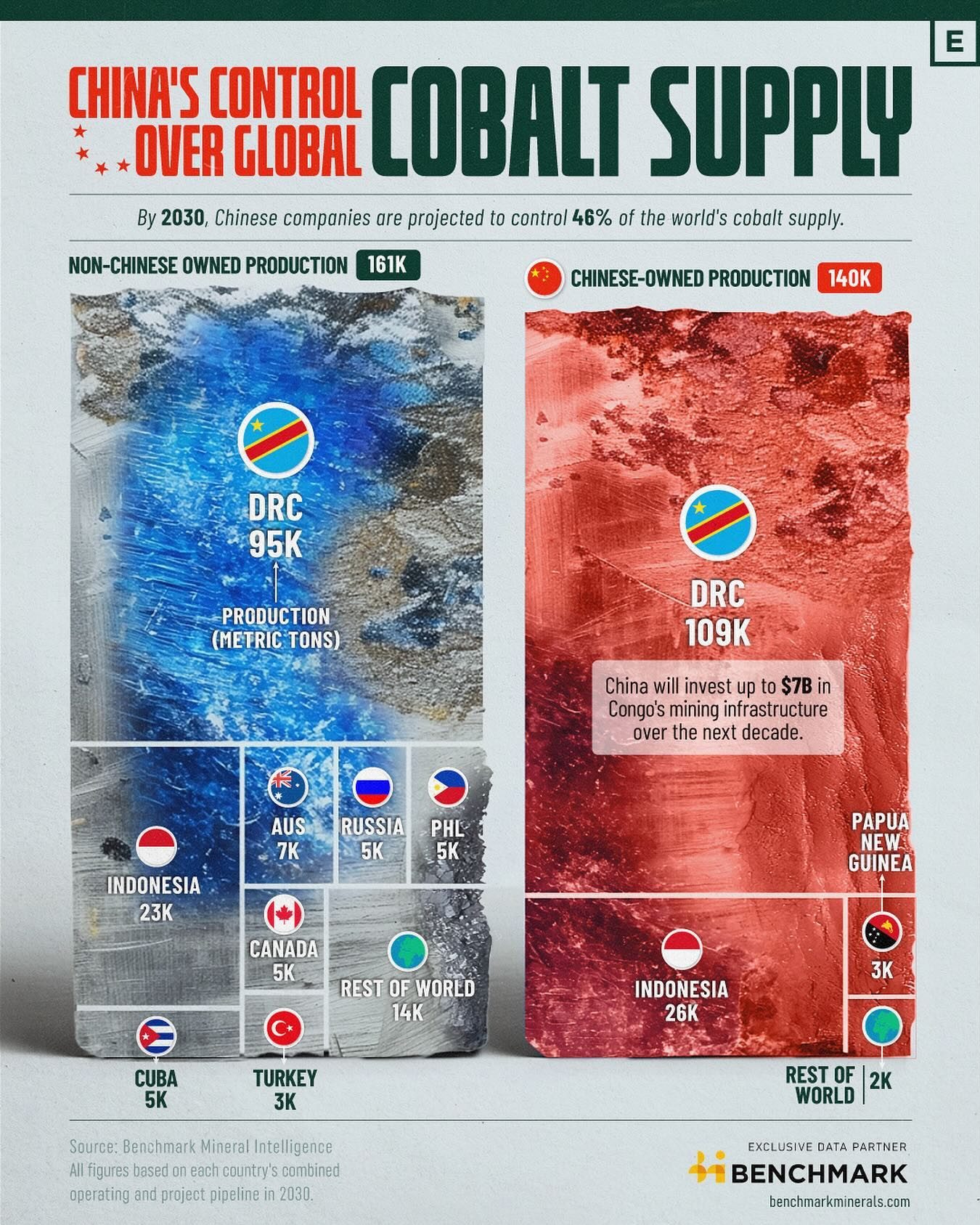
Cobalt Supply Chain: China's Projected Dominance by 2030
Cobalt is a critical mineral essential for various industrial, military, and commercial applications, with a significant role in the electric vehicle (EV) sector. By 2030, Chinese companies are projected to control 46% of the global cobalt mined supply, making them a dominant force in the market. This shift is driven by strategic investments and a strong focus on securing resource supplies.
Context: Why This Matters
Cobalt is a critical component in the production of lithium-ion batteries, which power electric vehicles, smartphones, and other electronics. The demand for cobalt is expected to surge as the world transitions to renewable energy sources and electric transportation. Understanding the dynamics of the cobalt supply chain is crucial for industries and governments planning for a sustainable future.
The Global Cobalt Supply Landscape
The cobalt supply chain is complex, involving multiple countries and companies. The Democratic Republic of Congo (DRC) is the largest producer of cobalt, responsible for a significant portion of the global supply. According to data from Benchmark Mineral Intelligence, the DRC is expected to produce 109,000 metric tons of cobalt by 2030, with 95,000 metric tons of it owned by non-Chinese entities.
Other major producers include Indonesia, which will contribute 26,000 metric tons, and Canada, with 23,000 metric tons. The rest of the world, including smaller producers like Australia, Russia, and the Philippines, will collectively produce around 2,000 metric tons.
China's Control Over the Cobalt Supply
China's influence in the cobalt market is set to grow significantly. Chinese companies are projected to control 46% of the global cobalt supply by 2030. This control is not just about production; it also involves strategic investments in mining infrastructure.
China plans to invest up to $7 billion in the DRC's mining infrastructure over the next decade. This investment is aimed at securing a stable supply of cobalt and maintaining a competitive edge in the global market. By enhancing mining operations and infrastructure in the DRC, China is poised to control a substantial portion of the world's cobalt reserves.
Benchmark Minerals: Providing Insights
Benchmark Mineral Intelligence, a leading provider of market analysis and price assessments for the battery raw materials sector, offers valuable insights into the cobalt supply chain. Their data provides a comprehensive view of the global cobalt market, highlighting the projected control of Chinese companies and the breakdown of cobalt production by country. This information is crucial for stakeholders in the EV sector and other industries reliant on cobalt.
Practical Tips for Industry Stakeholders
Diversify Supply Sources
For companies reliant on cobalt, diversifying supply sources can mitigate risks associated with over-dependence on a single region or country. This strategy can help ensure a steady supply chain and reduce vulnerabilities to market fluctuations.
Monitor Market Trends
Staying informed about market trends and industry developments is essential. Regularly reviewing data from sources like Benchmark Mineral Intelligence can provide valuable insights and help in strategic planning.
Invest in Sustainable Practices
With the growing demand for cobalt, it is crucial to invest in sustainable mining practices. This includes adhering to environmental standards and ensuring fair labor practices, which can enhance long-term sustainability and social responsibility.
Explore Alternative Technologies
Investing in research and development for alternative battery technologies can reduce dependence on cobalt. Innovations in battery chemistry and materials science can lead to more sustainable and efficient energy storage solutions.
Important Takeaways
- China's Dominance: By 2030, Chinese companies are projected to control 46% of the global cobalt supply.
- Critical Mineral: Cobalt is essential for various industrial and commercial applications, particularly in the EV sector.
- Investment in Infrastructure: China's planned investment of $7 billion in the DRC's mining infrastructure underscores its strategic focus on securing cobalt supplies.
- Global Production: The DRC is the largest producer of cobalt, followed by Indonesia and Canada.
- Data Insights: Benchmark Mineral Intelligence provides valuable data and analysis for understanding the cobalt supply chain.
Conclusion
The cobalt supply chain is at a critical juncture, with Chinese companies poised to dominate the market by 2030. This shift is driven by strategic investments and a focus on securing resource supplies. Understanding the dynamics of the cobalt supply chain is essential for industries and governments planning for a sustainable future. By diversifying supply sources, monitoring market trends, investing in sustainable practices, and exploring alternative technologies, stakeholders can navigate the complexities of the cobalt market effectively.
Watch the Reel
Questions readers ask
What is driving China's expected dominance in the global cobalt market by 2030?
China's anticipated control of 46% of the global cobalt market by 2030 is driven by its strategic investments in mining infrastructure and resource supplies. These investments are aimed at securing a significant share of the world cobalt supply, particularly in regions outside of the Democratic Republic of Congo.
How does China's control of the cobalt market impact the EV sector?
China's expected 46% control of the cobalt market by 2030 could significantly influence the EV sector as cobalt is a crucial component in lithium-ion batteries. This dominance could affect the supply chain, pricing, and technological advancements in electric vehicle manufacturing globally.
What role does cobalt play in the industrial and military sectors?
Cobalt is vital in the industrial and military sectors due to its use in high-strength alloys, magnetic materials, and superalloys. These materials are essential for various applications, including jet engines, gas turbines, and specialized equipment, making cobalt a critical resource for these sectors.
Why is there a surge in global cobalt demand?
The global demand for cobalt is rising due to the increasing adoption of renewable energy sources and electric transportation. Cobalt's importance in lithium-ion batteries, which power electric vehicles and other electronics, is a key driver of this surge in demand.
What are Chinese mining companies doing to achieve this dominance?
Chinese mining companies are actively investing in cobalt mines and refining facilities, particularly in regions like the Democratic Republic of Congo, and exploring non-Congo sources to diversify their supply. These companies are also focusing on building a robust supply chain and infrastructure to meet the growing global demand for cobalt.
How does China's control of the cobalt market impact other countries?
China’s dominance in the cobalt market could impact other countries by influencing the global supply and pricing of cobalt. Countries heavily reliant on cobalt for their industries, particularly in the EV and technology sectors, might need to secure alternative supplies or negotiate with Chinese companies to ensure a stable cobalt supply.
What are the implications of China's cobalt dominance for the global supply chain?
China's expected control of 46% of the global cobalt market could reshape the global supply chain, potentially leading to shifts in manufacturing and production hubs. Countries dependent on cobalt for their industries may need to adapt their strategies, potentially leading to increased investment in alternative technologies or securing cobalt supplies from non-Chinese sources.
Related deep dives
Similar reads based on topic and creator.


Recent articles
Fresh deep dives from the latest Reels we unpacked.




Comments
Be the first to comment.