Foreign Bank Reserves
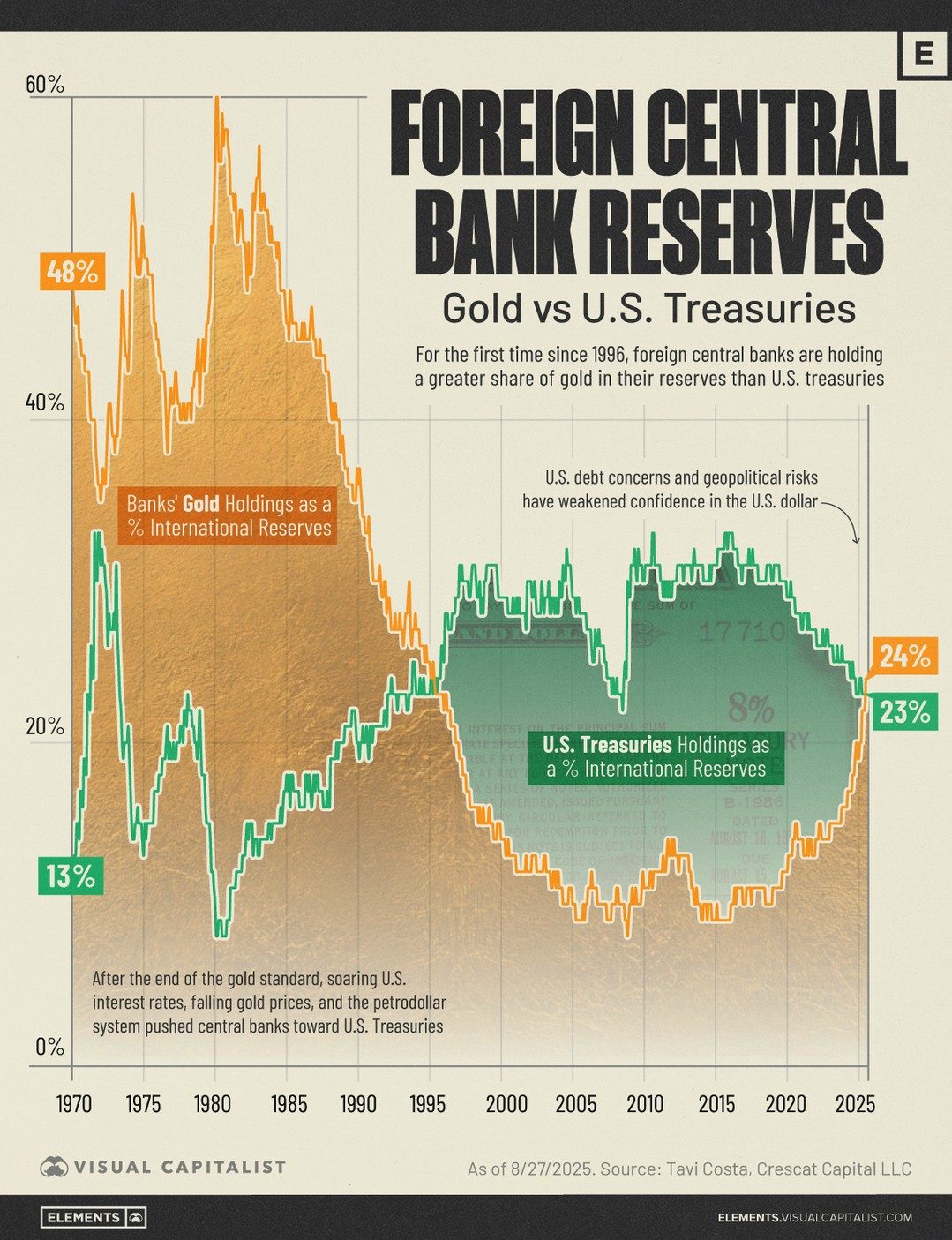
Foreign central banks’ shift in reserves from U.S. Treasuries to gold marks a significant change in global finance. For the first time since 1996, gold reserves have surpassed U.S. Treasury holdings, reflecting a broader trend towards hard assets amidst rising debt risks. Understanding this shift requires a deeper look into the factors driving this change and its implications for the global economy.
Context / Why this matters
The composition of foreign central bank reserves is a critical aspect of global finance. These reserves act as a buffer against unexpected economic shocks and are used to stabilize currency values and manage debt. The shift from U.S. Treasuries to gold is not just a financial decision but a geopolitical one, influenced by various economic and political factors.
Main discussion
The Shift from Gold to U.S. Treasuries
The shift from gold to U.S. Treasuries began after the end of the gold standard in 1971. Prior to this, many countries held gold as a primary reserve asset. However, the move to a fiat currency system led to a significant increase in U.S. Treasury holdings. This shift was driven by several factors, including the stability and liquidity of U.S. Treasuries, which offered higher returns compared to gold.
The Resurgence of Gold
Recently, there has been a resurgence in gold holdings among foreign central banks. This trend is driven by several key factors:
Interest Rates and Yield
One of the primary reasons for the shift back to gold is the decline in interest rates and yields on U.S. Treasuries. As yields decrease, the attractiveness of holding Treasuries diminishes, making gold a more appealing option. Gold does not yield interest, but it offers stability and a hedge against inflation, which can be particularly valuable in times of economic uncertainty.
Geopolitical Risks
Geopolitical risks, including trade tensions and political instability, have also contributed to the shift towards gold. Gold is seen as a safe haven asset that can protect against geopolitical risks, making it a preferred choice for central banks looking to diversify their reserves.
U.S. Debt Concerns
Rising U.S. debt levels have also raised concerns among foreign central banks. With increasing debt, there is a perceived risk that the value of U.S. Treasuries could decline. This has led to a preference for gold, which is not subject to the same debt risks.
The Role of Visualizations
Visualizations, such as those provided by Visual Capitalist, play a crucial role in understanding these trends. By presenting data from the IMF and Bloomberg, these visualizations help illustrate the historical shift in reserve compositions. The visuals not only show the percentage of reserves held in gold and U.S. Treasuries but also highlight the factors contributing to this change, providing a comprehensive view of the evolving landscape.
Practical tips
Understanding this shift can provide valuable insights for investors and policymakers alike. Here are some practical tips to navigate this changing landscape:
Diversify Your Portfolio
Diversification is key in managing financial risks. For both individuals and central banks, holding a mix of assets, including gold and U.S. Treasuries, can provide a balanced approach to managing economic uncertainties.
Stay Informed
Keeping up with economic indicators and geopolitical developments can help in making informed decisions. Regularly reviewing data from reliable sources, such as the IMF and Bloomberg, can provide timely insights into global financial trends.
Consider the Long-Term View
Financial decisions, especially those involving reserves, should take a long-term view. Short-term fluctuations in interest rates or yields should not overshadow the long-term benefits of holding stable assets like gold.
Important takeaways
This shift in foreign central bank reserves underscores the importance of diversification and the need to adapt to changing economic conditions. The move towards gold reflects a broader trend towards hard assets, driven by geopolitical risks and concerns over U.S. debt levels. Understanding these dynamics can help investors and policymakers make more informed decisions.
Conclusion
The shift in foreign central bank reserves from U.S. Treasuries to gold is a significant development in global finance. Driven by a combination of geopolitical risks, interest rate changes, and U.S. debt concerns, this trend highlights the evolving nature of international reserves. By staying informed and adapting to these changes, investors and policymakers can better navigate the complex landscape of global finance.
Watch the Reel
Questions readers ask
Why are central banks increasingly moving towards gold instead of U.S. Treasuries?
Central banks are shifting towards gold due to a mix of low interest rates, rising inflation concerns, and increasing geopolitical risks. Gold is seen as a stable store of value, especially during times of economic uncertainty, which makes it an attractive option for central banks looking to safeguard their reserves.
What does the shift from U.S. Treasuries to gold mean for the global economy?
This shift indicates a growing preference for hard assets and could potentially reduce demand for U.S. Treasuries, impacting yields and the broader financial markets. It also reflects a changing geopolitical landscape where countries are seeking to diversify their reserves to mitigate risks associated with over-reliance on a single asset class.
How significant is the increase in gold reserves among central banks?
The increase is substantial. For the first time since 1996, gold reserves have surpassed U.S. Treasury holdings in foreign central banks' portfolios. This milestone underscores a major change in global finance and highlights the growing importance of gold as a strategic asset.
What are the implications of this shift for U.S. Treasuries?
The shift away from U.S. Treasuries could lead to decreased demand, potentially affecting their yields and liquidity. It might also prompt the U.S. to reassess its fiscal policies and the role of the dollar in the global economy.
Are there any specific geopolitical risks driving this trend?
Yes, geopolitical risks such as trade tensions, sanctions, and political instability are prompting central banks to diversify their reserves. Gold, being a neutral and universally accepted asset, provides a safe haven against these uncertainties.
How might this trend evolve by 2025?
By 2025, central banks are expected to continue increasing their gold reserves as a hedge against various risks. This trend could lead to a more balanced global financial system, where gold plays a more prominent role alongside traditional assets like U.S. Treasuries.
Which central banks are leading this shift towards gold?
While specific details can vary, central banks from emerging markets and countries with significant foreign reserves, such as Russia, China, and several Middle Eastern nations, have been notably increasing their gold holdings. This trend is also seen in some European central banks.
Recent articles
Fresh deep dives from the latest Reels we unpacked.




Comments
Be the first to comment.