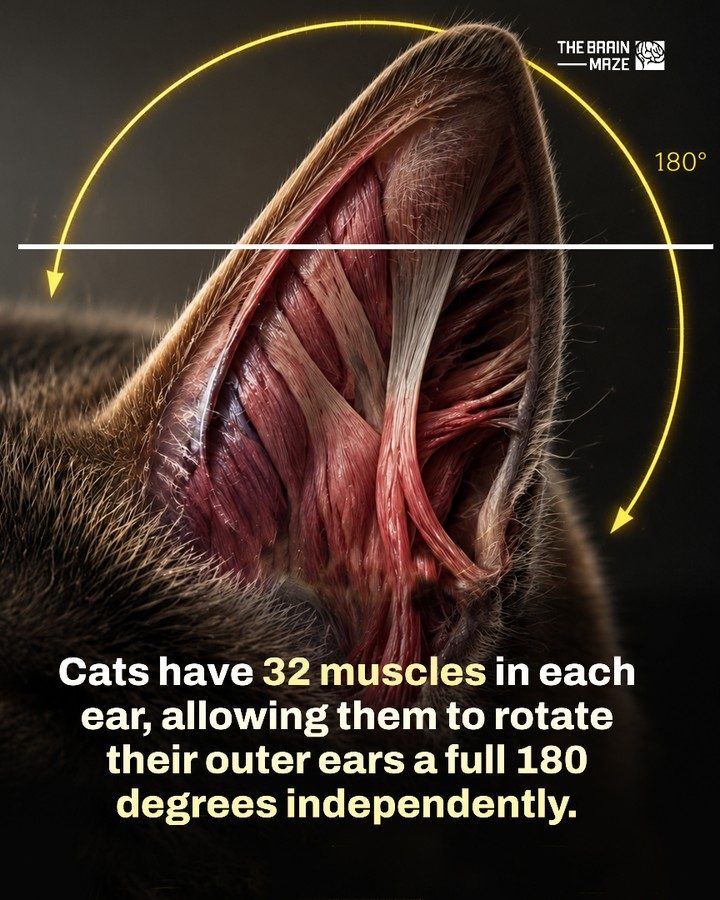
Cat Ear Anatomy
Cats possess a remarkable auditory system, particularly evident in the intricate design of their ears. Each ear is controlled by an extraordinary network of 32 muscles, allowing for independent rotation through an arc of up to 180 degrees. This unique flexibility enables cats to pinpoint the exact location of even the faintest sounds without moving their heads, which is crucial for their survival and hunting prowess.
Context / Why This Matters
Understanding the anatomy and function of a cat's ears provides valuable insights into their behavior and abilities. Cats are natural hunters, and their ears play a pivotal role in their hunting strategies. The ability to rotate their ears independently allows them to detect the slightest movements and sounds, making them exceptional predators.
Main Discussion
The Muscular Network
The 32 muscles in each of a cat's ears are distributed in a way that allows for precise control over the ear's movement. This intricate network enables the ear to rotate independently, which is a significant advantage for cats in various situations. The muscles are finely tuned to respond to even the smallest vibrations, allowing cats to detect movements that humans might miss.
Independent Ear Rotation
The independent rotation of a cat's ears is a critical aspect of their auditory system. This capability allows cats to determine the direction of a sound source accurately. By moving each ear separately, cats can focus on sounds coming from different directions simultaneously. This is particularly useful in hunting, as it helps them locate prey more efficiently.
Pinpointing Sounds
Cats can pinpoint the exact location of sounds even in the presence of background noise. This ability is due to the independent movement of their ears, which allows them to filter out irrelevant noise and focus on the sound they want to hear. This is especially important for detecting prey, as it enables cats to move quickly and accurately towards their target.
Easily Detecting Prey
The ability to detect hidden prey is another advantage of a cat's ear anatomy. Cats can sense the slightest movements and sounds made by prey, even if the prey is well-hidden. This makes them formidable hunters, as they can quickly locate and capture their prey, improving their chances of survival.
Practical Tips
If you're a cat owner, understanding your cat's ear anatomy can help you better communicate with your pet. For example, you can use your knowledge of their ear movements to determine when they are alert, relaxed, or stressed. This can help you provide a more comfortable and enriching environment for your cat.
Observing Ear Movements
Observe your cat's ear movements to understand their emotional state. When a cat is alert, their ears will be upright and pointing forward. If they are relaxed, their ears will be in a neutral position. If they are stressed or frightened, their ears may be flattened against their head.
Creating a Stimulating Environment
Provide your cat with a stimulating environment that encourages them to use their natural hunting instincts. For example, you can create a playground with toys that make sounds or move, allowing your cat to practice their hunting skills.
Ensuring Good Ear Health
Regularly check your cat's ears for any signs of infection or injury. Clean their ears gently with a vet-approved solution and monitor for any unusual discharge or odor. If you notice any issues, consult a veterinarian immediately.
Important Takeaways
The extraordinary network of 32 muscles in each of a cat's ears allows them to rotate their outer ears independently through an arc of up to 180 degrees. This remarkable flexibility is crucial for pinpointing sounds, detecting prey, and staying aware of potential threats in every direction. Understanding this aspect of a cat's anatomy can help you communicate better with your pet and provide a more enriching environment for them.
Conclusion
Cats' ears are a marvel of biological engineering, designed to give them a significant advantage in their natural habitat. The ability to rotate their ears independently allows them to detect even the faintest sounds, pinpoint their location, and react quickly to potential threats. This makes them exceptional hunters and survivors, a testament to the remarkable adaptability of nature.
Watch the Reel
Questions readers ask
How many muscles are involved in controlling a cat's ears?
Each of a cat's ears is controlled by 32 muscles, which is significantly more than humans and other animals have. These muscles allow for precise movement and independent rotation of the ears, enhancing the cat's ability to locate sounds and movements.
What is the significance of a cat's ability to rotate its ears 180 degrees?
A cat's ability to rotate its ears up to 180 degrees allows it to pinpoint the exact location of sounds without needing to move its head. This is crucial for their hunting strategies, as it enables them to detect and respond to prey movements quickly and accurately.
How does a cat's hearing ability differ from that of humans?
Cats have a much broader hearing range than humans, detecting frequencies up to 85 kHz compared to humans' 20 kHz. Additionally, their 32 outer ear muscles allow for precise control and movement, enabling them to locate sounds and movements in a way that humans cannot.
Why is a cat's ability to hear in noisy environments so important?
Cats' ability to hear in noisy environments is vital for their survival and hunting. Their sophisticated ear anatomy allows them to filter out background noise and focus on relevant sounds, such as the movements of potential prey or approaching threats, even when the environment is lively.
How do a cat's outer ear muscles contribute to its extraordinary hearing ability?
A cat's 32 outer ear muscles are integral to their exceptional hearing. They allow for independent ear rotation, pinpointing sound sources, and amplifying sounds by funnelling them into the ear canal, making cats highly attuned to their surroundings and enhancing their hunting and survival skills.
Do cat kittens have the same hearing ability as adult cats?
Kittens' hearing develops over time, and they are not born with the same hearing ability as adult cats. At birth, their ear canals are closed, and they are functionally deaf. It takes several weeks for their hearing to develop fully, with the ear canals opening around 3-7 days after birth and hearing improving significantly by the time they are 3-4 weeks old.
How does cat ear anatomy contribute to their hunting strategies?
A cat's ear anatomy significantly contributes to their hunting strategies. The 180-degree rotation of the ears, controlled by 32 muscles, allows them to detect and locate prey movements accurately. This precise sound localization helps cats to stalk and capture their prey efficiently, even in challenging environments.
Recent articles
Fresh deep dives from the latest Reels we unpacked.




Comments
Be the first to comment.