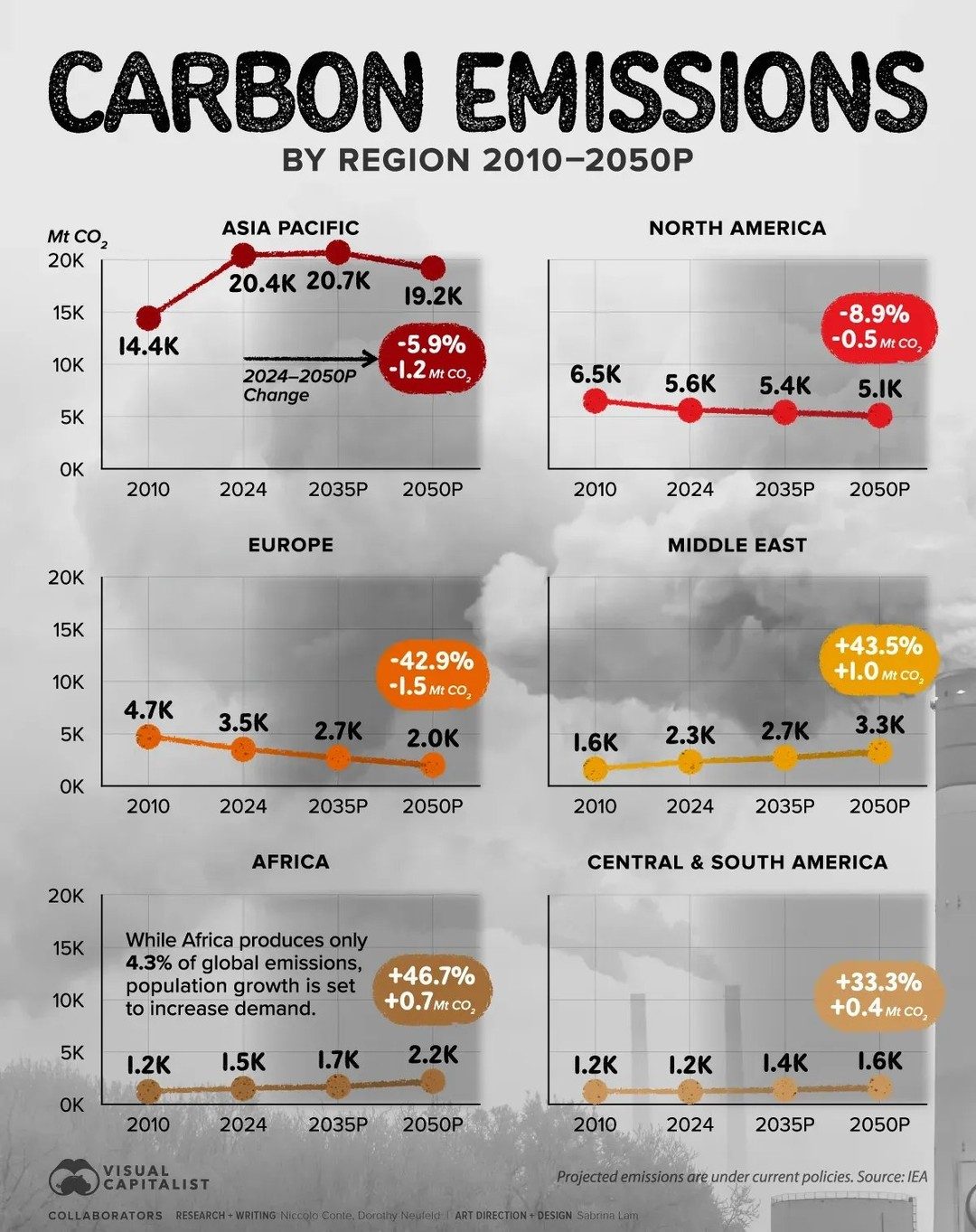
Carbon Emission Projections by Region
Carbon emissions are a critical aspect of global climate change, and understanding their projected trends is essential for policymaking and environmental planning. The International Energy Agency (IEA) provides valuable insights into how these emissions are expected to evolve across different regions from 2024 to 2050. Here, we delve into the projected changes in carbon emissions for major regions, highlighting key trends and implications.
Why This Matters
The trajectory of carbon emissions is pivotal for global climate goals. Projections help countries and organizations plan strategies to mitigate climate change, adapt to its impacts, and transition to more sustainable energy systems. The data from the IEA offers a comprehensive view of how emissions might change, influencing policies, investments, and technological advancements in each region.
Main Discussion
Europe's Lead in Emission Reduction
Europe is projected to experience the most significant reduction in carbon emissions, with a steep decline of 42.9% by 2050. This dramatic decrease is driven by stringent environmental policies, investments in renewable energy, and a strong commitment to the Paris Agreement. Europe's leadership in this area sets a benchmark for other regions aiming to achieve similar reductions.
Key Drivers for Europe's Success
Several factors contribute to Europe’s projected success in reducing emissions:
- Renewable Energy Investments: Europe has heavily invested in renewable energy sources like wind, solar, and hydroelectric power.
- Policy and Regulation: Stringent environmental policies and regulations, such as the European Green Deal, drive the shift towards cleaner energy.
- Technological Advancements: Innovations in energy efficiency and carbon capture technologies play a crucial role.
- Public and Corporate Initiatives: There is a growing emphasis on sustainable practices among corporations and individuals, further accelerating emission reduction efforts.
Asia-Pacific: Steady but Moderate Decline
Asia-Pacific, the region currently with the highest carbon emissions, is expected to see a moderate decrease of 5.9% by 2050. This region, which includes economic powerhouses like China and India, faces unique challenges and opportunities in its emission reduction efforts.
Challenges and Opportunities in Asia-Pacific
- Economic Growth vs. Environmental Goals: Rapid economic development often comes at the cost of increased energy demand, which leads to higher emissions. Balancing growth with environmental sustainability is a significant challenge.
- Transition to Clean Energy: Investments in renewable energy and clean technologies are crucial. Countries like China are making substantial strides in this area.
- Policy and Infrastructure: Developing robust policies and infrastructure to support clean energy adoption and reduce emissions from industrial and transport sectors.
North America's Gradual Decline
North America, including countries like the United States and Canada, is projected to see a decline of 8.9% in carbon emissions by 2050. While this is a notable reduction, it is less dramatic than Europe’s projected decline.
Reasons for North America's Decline
- Renewable Energy Transition: There is a growing shift towards renewable energy sources like solar and wind power.
- Policy and Regulation: Policies at both federal and state levels are driving the transition to cleaner energy.
- Public Awareness and Advocacy: Increased public awareness and advocacy for environmental sustainability are pushing for more aggressive climate action.
Africa and the Middle East: Rising Emissions
Africa and the Middle East are forecast to see significant increases in carbon emissions, driven primarily by population growth and the resultant increase in energy demand. While Africa currently produces only 1.7% of global emissions, its projected increase of 46.7% is concerning.
Impact of Population Growth
- Energy Demand: As populations grow, so does the demand for energy, which often relies on fossil fuels.
- Economic Development: Rapid economic development in African countries and the Middle East often leads to increased industrial activity, further boosting emissions.
- Policy and Infrastructure: There is a need for substantial investments in renewable energy and infrastructure to support sustainable growth.
Central and South America: Mixed Outlook
Central and South America show a mixed outlook, with projections indicating a slight increase in carbon emissions. The region has made strides in renewable energy but faces challenges in balancing economic growth with environmental sustainability.
Key Factors
- Renewable Energy: The region has abundant renewable energy resources, but harnessing them effectively is a challenge.
- Economic Growth: Economic development, particularly in sectors like mining and agriculture, contributes to increased emissions.
- Policy and Investment: Continued investments in clean technologies and stringent policies are essential to curb emission growth.
Practical Tips
For Policymakers
- Strengthen Renewable Energy Policies: Implement policies that incentivize the adoption of renewable energy sources and penalize high-emission activities.
- Invest in Clean Technology: Allocate funds for research and development in clean technologies, including carbon capture and energy efficiency.
- Public Awareness: Launch awareness campaigns to educate the public on the importance of reducing carbon emissions and sustainability.
For Individuals
- Adopt Sustainable Practices: Implement sustainable practices in daily life, such as conserving energy, reducing waste, and using public transportation or electric vehicles.
- Support Renewable Energy: Opt for energy providers that use renewable sources and encourage the use of renewable energy in your community.
- Advocate for Change: Participate in community initiatives and advocate for policies that prioritize environmental sustainability.
For Businesses
- Green Initiatives: Implement green initiatives within the organization, such as energy-efficient technologies and sustainable supply chains.
- Renewable Energy: Transition to renewable energy sources for your operations to reduce your carbon footprint.
- Sustainable Practices: Encourage sustainable practices among employees and consumers to support broader environmental goals.
Important Takeaways
- Europe’s Lead: Europe’s projected 42.9% reduction sets a benchmark for other regions.
- Asia-Pacific’s Moderate Decline: The region’s moderate decline highlights the challenges of balancing economic growth with environmental goals.
- North America’s Steady Progress: North America’s gradual decline reflects a commitment to renewable energy and sustainability.
- Africa and the Middle East’s Increases: Population growth and economic development are driving significant emission increases in these regions.
- Central and South America’s Mixed Outlook: The region’s mixed outlook underscores the need for balanced policies and investments.
Conclusion
Understanding the projected changes in carbon emissions across different regions is crucial for global climate action. While Europe leads the way with a significant reduction, other regions face unique challenges and opportunities. By focusing on renewable energy, sustainable practices, and robust policies, we can work towards a more environmentally sustainable future. The data from the IEA provides a roadmap for policymakers, businesses, and individuals to take informed actions and contribute to global emission reduction efforts.
Watch the Reel
Questions readers ask
Which region is projected to achieve the highest carbon emission reduction by 2050?
By 2050, Europe is anticipated to achieve the most significant reduction in carbon emissions, with a projected decrease of 42.9%. This is largely due to substantial investments in renewable energy sources and the implementation of strict environmental regulations.
How do carbon emissions in the Asia Pacific region compare to other regions?
The Asia Pacific region is poised to experience a moderate reduction in carbon emissions. While there is a reduction, it is expected to be less significant than in Europe. This is influenced by the region's rapid industrialization and high population growth.
What factors contribute to the carbon emission forecasts for the Middle East?
The Middle East's carbon emission forecasts are heavily influenced by its reliance on fossil fuels and robust economic growth. The region's high energy consumption, driven by oil and gas production, is expected to maintain elevated carbon emission levels.
How do population growth and carbon emissions correlate in regions like Africa?
In Africa, population growth is a key factor in carbon emission projections. As the population rises, so does the demand for energy, leading to an increase in carbon emissions. However, the rate of increase is expected to vary based on each country's energy policies and infrastructure development.
What role do environmental policies play in North America's carbon emission projections?
Environmental policies in North America are expected to play a significant role in reducing carbon emissions. With plans to increase renewable energy and reduce reliance on fossil fuels, the region is projected to see a notable decrease in emissions, although it may not match Europe's benchmark.
How reliable are the International Energy Agency's projections for carbon emissions by 2050?
The International Energy Agency (IEA) projections are based on extensive research and data analysis, providing valuable insights into future carbon emission trends. While they offer a comprehensive view, it's important to note that actual outcomes can vary due to changes in policy and technological advancements.
What impact do investments in renewable energy have on regional carbon emission forecasts?
Investments in renewable energy can significantly lower a region's carbon emission projections. By transitioning away from fossil fuels, regions can reduce their reliance on carbon-intensive energy sources, thereby lowering overall emissions. The more robust the investment, the greater the potential for emission reduction.
Related deep dives
Similar reads based on topic and creator.


Recent articles
Fresh deep dives from the latest Reels we unpacked.




Comments
Be the first to comment.