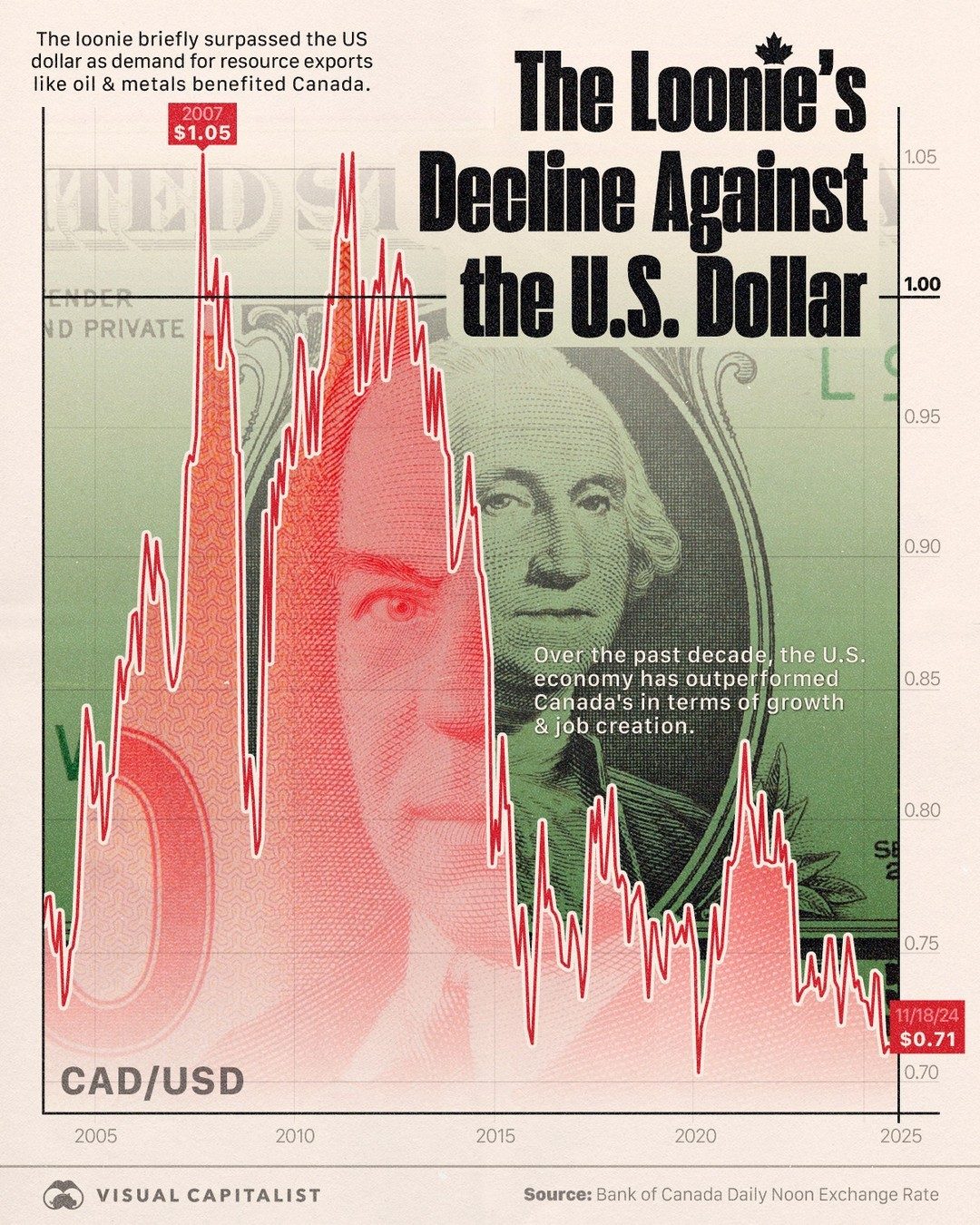
The Canadian Dollar's Decline: A Detailed Look
The Canadian dollar (CAD), often referred to as the "Loonie," has recently weakened significantly against the U.S. dollar (USD). In late October, the CAD fell below 72 cents USD for the first time since 2020. This decline reflects a broader trend over the past decade where the U.S. economy has consistently outperformed Canada's in terms of growth and job creation.
Why This Matters
The exchange rate between the CAD and USD is a critical economic indicator that affects trade, investment, and the cost of living for Canadians. Understanding the factors driving this decline can provide insights into the economic landscape and its implications for both businesses and consumers.
Historical Context
To comprehend the recent drop, it's essential to look at the long-term trends. Over the past decade, the USD has consistently strengthened against the CAD. This trend is primarily driven by the U.S. economy's robust performance, which has led to stronger growth and job creation compared to Canada.
The infographic from Visual Capitalist highlights the USD to CAD exchange rate from 2004 to 2024, using data from the Bank of Canada Daily Noon Exchange Rate. This data shows a steady decline in the value of the Loonie, reflecting the economic disparities between the two countries.
Main Discussion
Economic Performance
The U.S. economy has been a powerhouse of growth, driven by various sectors including technology, healthcare, and finance. This has led to significant job creation and economic stability, making the USD a more attractive currency. In contrast, Canada's economy, while stable, has not shown the same level of growth and job creation. This economic performance disparity has contributed to the weakening of the Loonie.
Resource Exports
Canada's economy is heavily reliant on resource exports, particularly oil and gas. The price of these commodities has been volatile, affecting Canada's economic performance. The U.S., on the other hand, has a more diversified economy, reducing its dependence on any single sector. This diversification has made the U.S. economy more resilient and attractive to investors, further strengthening the USD.
Interest Rates and Monetary Policy
Interest rates play a crucial role in determining the value of a currency. The U.S. Federal Reserve has been more aggressive in raising interest rates compared to the Bank of Canada. Higher interest rates make investing in U.S. assets more attractive, leading to an influx of capital into the U.S. economy. This increased demand for U.S. assets has strengthened the USD, while the relatively lower interest rates in Canada have had the opposite effect on the Loonie.
Trade and Investment
Trade and investment flows between the two countries also impact the exchange rate. The U.S. has historically been a significant trade partner for Canada, and a strong USD makes Canadian exports more expensive in the U.S. market. This can lead to a reduction in export volumes, affecting Canada's trade balance and overall economic performance. Conversely, a weaker Loonie makes Canadian imports more expensive, which can drive up the cost of living for consumers.
Practical Tips
For Canadians, the weakening of the Loonie has several practical implications. Here are some tips to navigate this economic landscape:
Travel and Tourism
For Canadians planning to travel to the U.S., the weaker CAD means that your purchasing power will be reduced. It's advisable to budget accordingly and consider travel insurance to mitigate any unforeseen expenses.
Investing
For investors, the declining CAD presents both opportunities and risks. Diversifying your investment portfolio by including foreign assets can help hedge against currency fluctuations. It's also a good idea to stay informed about economic indicators and seek professional financial advice.
Business Operations
For businesses involved in international trade, the weakened Loonie can impact both imports and exports. Companies exporting to the U.S. may need to re-evaluate their pricing strategies to remain competitive. Conversely, companies importing goods from the U.S. may face higher costs, which can affect profitability. It's crucial to implement currency risk management strategies to navigate these challenges.
Important Takeaways
- The Canadian dollar has depreciated against the U.S. dollar over the past decade, driven by stronger U.S. economic performance and job creation.
- The U.S. economy's diversification and robust sectors have made the USD more attractive, while Canada's reliance on resource exports has contributed to the Loonie's decline.
- Interest rates, trade, and investment flows play a significant role in determining the exchange rate between the CAD and USD.
- For Canadians, the weakened Loonie has implications for travel, investment, and business operations.
- Staying informed and adaptable in the face of currency fluctuations is key to navigating the economic landscape effectively.
Conclusion
The decline of the Canadian dollar against the U.S. dollar reflects broader economic trends and disparities between the two countries. Understanding the factors driving this trend can help Canadians better navigate the economic landscape, whether it's through travel, investment, or business operations. By staying informed and adaptable, Canadians can mitigate the impacts of a weaker Loonie and take advantage of opportunities that arise.
Watch the Reel
Questions readers ask
Why has the Canadian dollar (CAD) been declining against the U.S. dollar (USD) over the past decade?
The CAD has been declining against the USD due to the strong performance of the U.S. economy. This includes factors such as robust growth, job creation, and overall economic stability, which have made the USD more attractive to investors compared to the CAD.
How does the daily exchange rate in Canada affect trade and investment?
Fluctuations in the daily exchange rate can significantly impact trade and investment. A weaker CAD makes imports more expensive and exports cheaper, which can benefit certain industries but also increase the cost of living for Canadians. Conversely, it can make Canadian assets more attractive to foreign investors seeking better returns.
What are the implications of a weaker Canadian dollar on the cost of living for Canadians?
A weaker CAD can increase the cost of living for Canadians, as imported goods become more expensive. This includes everything from consumer products to groceries, and can impact household budgets and spending power.
How does the performance of the Canadian dollar (CAD) to USD exchange rate influence investment decisions?
The CAD to USD exchange rate influences investment decisions by affecting the relative attractiveness of assets in each currency. A weaker CAD can make Canadian stocks and bonds more appealing to foreign investors, while a stronger USD can attract Canadian investors to U.S. markets.
What role does the U.S. dollar strength play in the decline of the Canadian dollar?
The strength of the USD plays a significant role in the decline of the CAD. When the USD is strong, it often means that the U.S. economy is performing well, which can lead to investors seeking safer havens and better returns in USD-denominated assets, thereby reducing demand for the CAD.
What are the implications of the Canadian dollar's decline on the Canadian economy and job creation?
The CAD's decline can have mixed effects on the Canadian economy and job creation. It can boost exports by making Canadian goods cheaper for foreign buyers, potentially creating more jobs in export-oriented sectors. However, it can also increase costs for businesses that rely on imported materials and machinery, which could dampen overall economic activity.
How can individuals in Canada protect their finances from fluctuations in the CAD to USD exchange rate?
Individuals can protect their finances by diversifying their investments to include assets denominated in different currencies, such as USD. Additionally, they can consider hedging strategies, such as forward contracts, to lock in exchange rates for future transactions. It is also advisable to monitor the daily exchange rate and stay informed about economic trends that could impact currency movements.
Recent articles
Fresh deep dives from the latest Reels we unpacked.




Comments
Be the first to comment.