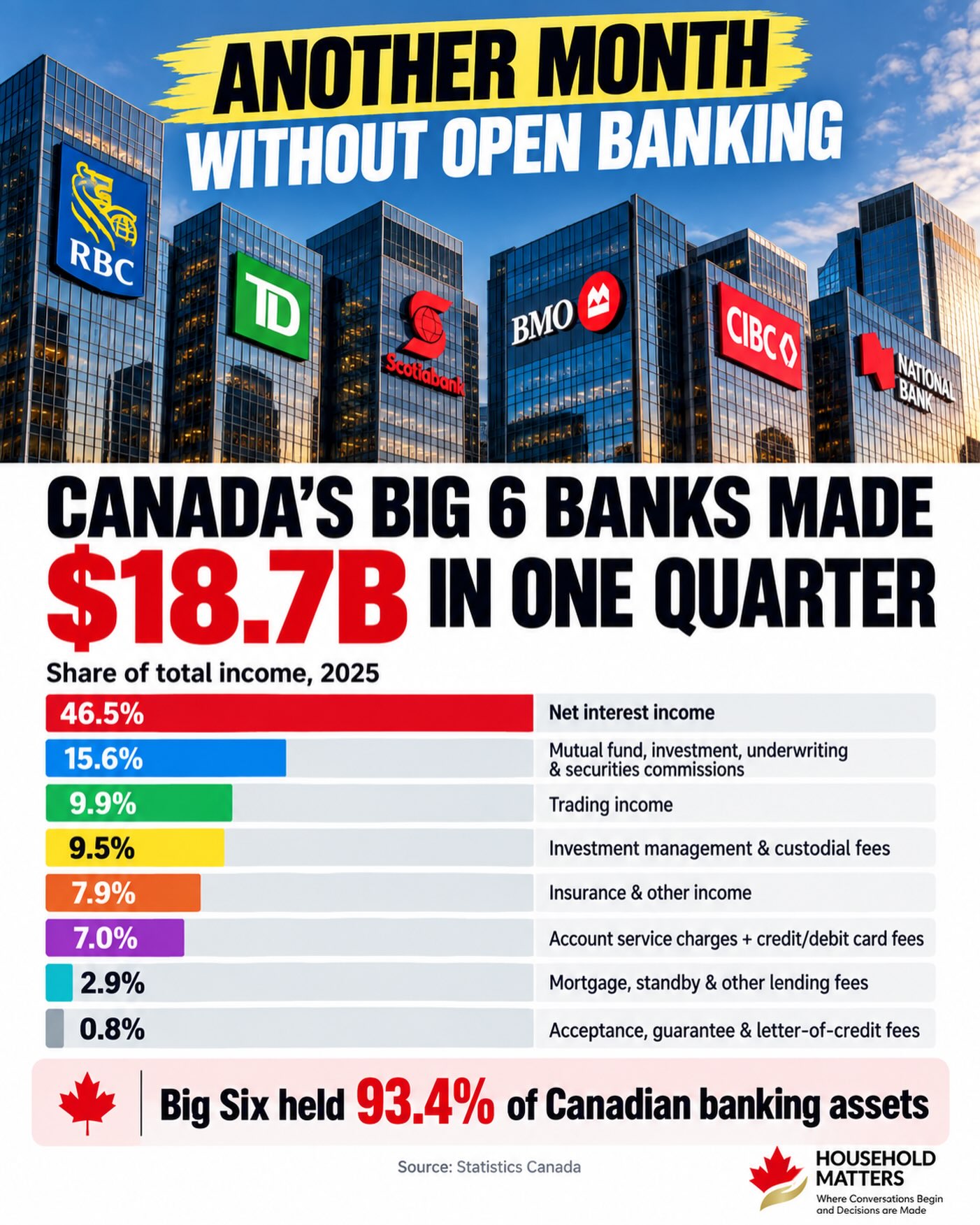
Canada's Big Six banks — Royal Bank of Canada (RBC), Toronto-Dominion Bank (TD), Bank of Nova Scotia (Scotiabank), Bank of Montreal (BMO), Canadian Imperial Bank of Commerce (CIBC), and National Bank of Canada (National Bank) — raked in an astronomical $18.7 billion in just one quarter. These financial giants are not just profitable; they dominate the Canadian banking sector, holding a staggering 93.4% of the country's total banking assets. This concentration of power and profit raises critical questions about the state of Canadian finance and the impact on the economy.
The Big Six's Monopoly
Canada's Big Six banks are not just dominant; they are nearly omnipresent in the financial market. Their interconnectedness with key sectors of the economy means that their performance has a ripple effect across the country. The banking oligopoly holds 93.4% of the nation's banking assets. This level of control can be useful in times of crisis, but it can also limit competition and innovation. The Big Six's combined total income for 2025 is diverse, with mutual fund, investment, trading income and other fees as major components. Mutual fund, investment, underwriting, and securities commissions contribute the largest share at 46.5%, followed by trading income at 15.6%, and investment management and custodial fees at 9.9%. These sources highlight the banks' strategic focus on high-yield activities and financial services. The banks' dominance extends to the household level, where they offer a range of services from basic accounts to complex investment products. By holding 93.4% of Canadian banking assets, these institutions wield significant influence over the economic trends of the nation. The Big Six's influence over households begins with their role in managing household finances, including savings, loans, and investment products. Households are encouraged to deposit savings, take loans, and engage in the investment business. ANOTHER MONTH WITHOUT OPEN BANKING On-screen text opens with a blunt fact: another month has passed without open banking, a financial system that would give consumers more control over their financial data. "Where conversations begin..." suggests that open banking will alter the way consumers and businesses interact with financial services. Though open banking is not implemented, its potential to disrupt the market looms. Banks stand to lose revenue from current practices. With more transparency and consumer control, direct fees from credit or debit card usage, account servicing, and lending fees could plummet. The transition to open banking is a complex issue that impacts economic stability, consumer behaviour, and corporate strategy. The trading income which contributes 15.6% of their total income can be significantly impacted. Investment management and custodial fees at 9.9% can be a major loss with open banking. The fees associated with mortgage, standby, and other lending, along with acceptance, guarantee, and letter-of-credit fees, which make up 2.9% and 0.8% of their earnings, respectively, could see a drop. The Big Six hold the reins in Canadian banking, and their grip will likely tighten. Investment management and custodial fees, making up 9.9% of their earnings, allow banks to manage and hold client assets. The banks are central to investment management while generating profits from these transactions.
The Power of Profits
Canada’s banking sector’s size and power are not just economic issues; they’re existential ones that touch every Canadian directly and indirectly. The size and power of Canada's Big Six banks have important implications for the national economy and consumer choices. The Big Six's dominance means that decisions made at the top levels of these institutions have significant impacts on everyday Canadians. Everything from interest rates to lending policies is influenced by the actions of these financial giants. Household banking matters, indeed. Deposits and investment products are directly impacted. Reducing open banking delays could pave the way for modernising the financial sector. Household finances can be significantly affected by high lending and interest rates. Mortgage, standby, and other lending fees, acceptance, guarantee, and letter-of-credit fees contribute 2.9% and 0.8% of the total income. These fees can drive up the cost of borrowing, potentially leading to increased debt levels for Canadian households. Open banking could impact this process.
In-depth Research
High-Value Customers and Strategies
Canada’s Big Six banks often target high-value customers to maximize profits. Clients with large deposits, high creditworthiness, and investment portfolios are preferred. They contribute significantly from mutual fund and investment services — 46.5% total income. Clients with significant assets are attractive because they bring in greater fees for managed investments, underwriting, and securities commissions. These high-value clients often have more complex financial needs, which create opportunities for banks to offer a range of services and products. Banks invest a lot in technology and customer service to make handling complex transactions more efficient. They often provide personalized financial advice and bespoke investment strategies.
The Role of Emerging Financial Innovations
FinTech startups are reshaping the financial landscape. These companies, often targeting markets dominated by the Big Six, are pushing for regulatory changes to promote open banking. What would the Big Six lose from FinTech and open banking innovations? Canadians might get lower fees, transparency, and portability. "ANOTHER MONTH WITHOUT OPEN BANKING" highlights the consequences of delay. The Big Six could lose revenues from their current business model, costing them between $0.8% to 46.5% of their total income. Without these regulations, the Big Six banks could lose significant earnings from their current business model. The Big Six banks dominate the Canadian market, but they also have to adapt. Transaction costs, fees, and customer convenience are increasingly important. The Big Six often respond to FinTech innovations by acquiring or collaborating with startups, which allows them to integrate new technologies and expand their service offerings. They invest in tech to stay relevant and attract new customers.
Profit by the Numbers
The breakdown of the Big Six's income sources reveals a strategic focus on high-yield activities. Mutual fund income, investment, underwriting, and securities commissions together contribute 46.5% of their total income. This highlights the banks' emphasis on generating revenue through investment services and trading activities. Other significant contributors to their income include trading income at 15.6%, and investment management and custodial fees at 9.9%. This diversified approach allows the banks to weather market fluctuations and maintain steady earnings.
Income Contributions of the Big Six
The Big Six banks have a diverse range of income streams, allowing them to maintain profitability. The major components of their income are trading at 15.6%, investment management and custodial fees at 9.9%, account service charges and credit/debit card fees at 7.9%, and mortgage, standby and other lending fees at 2.9%, and finally acceptance, guarantee & letter-of-credit fees contribute 0.8%. Trading income and mutual fund investments are high because of the banking system's reliance on financial markets.
Ready to Engage
with the Big Six
If you are looking to engage with Canada’s Big Six banks, there are specific steps you can take:
- Research the Bank’s available products and services: The banks offer various financial products, including savings accounts, investment services, and loans.
- Preparing your Matters: It's important to have a clear understanding of your financial situation, including your income, expenses, and financial goals.
- Gathering Documents: You'll also need to gather necessary documents, such as proof of income, identification, and any relevant financial statements.
- Staying Informed: Open banking can help. It provides more transparency about fees and services, allowing you to make informed decisions. Browsing the banks' promotions and services can help.
- Comparing Products: It’s also a good idea to compare products and services from different banks to ensure you get the best rate and terms.
Watch the Reel
Questions readers ask
What exactly are the Big Six banks, and why are they called that?
The Big Six banks are the six largest banks in Canada: Royal Bank of Canada (RBC), Toronto-Dominion Bank (TD), Bank of Nova Scotia (Scotiabank), Bank of Montreal (BMO), Canadian Imperial Bank of Commerce (CIBC), and National Bank of Canada. They are called the Big Six because they dominate the Canadian banking sector, controlling 93.4% of the country's total banking assets.
How do the Big Six banks generate their profits?
The Big Six banks generate their profits from a variety of sources, including mutual fund, investment, and trading income, as well as fees from services like investment management, custodial services, and lending. The largest share of their income comes from mutual fund, investment, underwriting, and securities commissions at 46.5%.
What is open banking, and how would it affect the Big Six banks?
Open banking is a financial system that gives consumers more control over their financial data. If implemented, it could significantly disrupt the market by increasing transparency and consumer control, which might lead to a drop in revenue from fees associated with credit or debit card usage, account servicing, and lending. This could impact the Big Six's trading and investment management fees.
Why is the dominance of the Big Six banks a concern for the Canadian economy?
The dominance of the Big Six banks is a concern because it can limit competition and innovation in the financial sector. While their control can be useful in times of crisis, it also means that any issues within these banks could have a ripple effect across the entire economy, affecting both businesses and consumers.
What role do the Big Six banks play in the financial lives of Canadian households?
The Big Six banks play a significant role in the financial lives of Canadian households by offering a wide range of services, including savings accounts, loans, and investment products. They manage household finances, encourage savings, and provide loans and investment options, making them a central part of the economic trends in the nation.
How does the lack of open banking impact consumers and businesses in Canada?
The lack of open banking means that consumers and businesses do not have as much control over their financial data as they could. This lack of transparency can limit competition and innovation in the financial sector, potentially leading to higher fees and less flexibility in financial services. However, the transition to open banking is complex and would impact economic stability, consumer behavior, and corporate strategy.
Recent articles
Fresh deep dives from the latest Reels we unpacked.




Comments
Be the first to comment.