Canadian Housing Market Trends
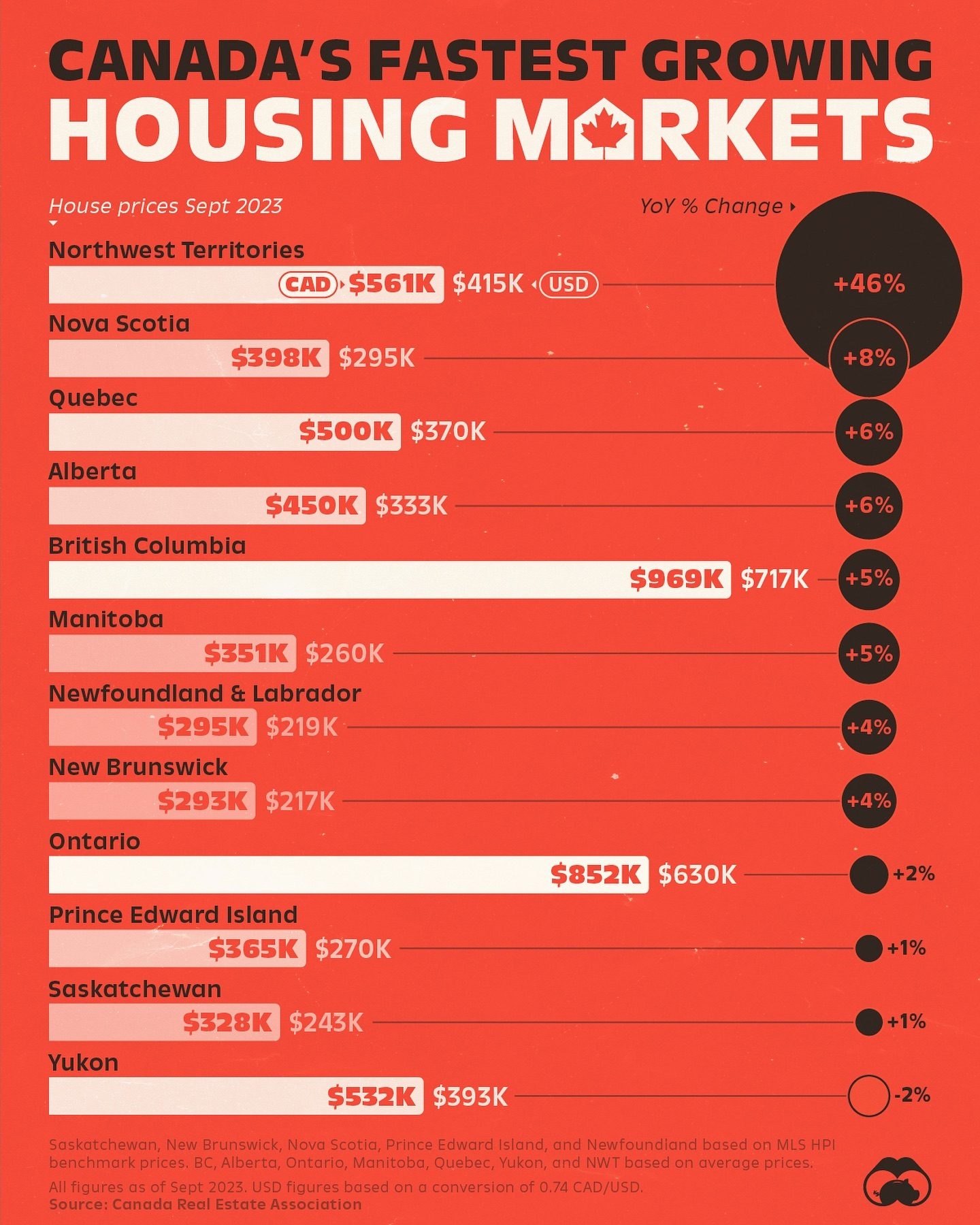
Between 2010 and 2022, Canadian housing prices surged by 90%, raising concerns about affordability. This dramatic increase has positioned Canada as one of the most expensive housing markets globally. In this article, we delve into the current state of Canada’s housing market, focusing on the average prices across its provinces and territories as of September 2023, excluding Nunavut. This data, sourced from the Canada Real Estate Association (CREA), provides a clear picture of the market dynamics and trends shaping the Canadian real estate landscape.
Why This Matters
Understanding the trends in Canada’s housing market is crucial for anyone involved in real estate, from potential homebuyers and sellers to investors and policymakers. The market’s volatility can significantly impact personal finances, economic stability, and overall quality of life. By examining the fastest-growing housing markets and the year-over-year changes in property values, we gain insights into which regions are experiencing the most significant growth and why.
Main Discussion
fastest-growing Housing Markets
As of September 2023, the Northwest Territories led the nation with a remarkable 46% year-over-year (YoY) increase in housing prices, making it the fastest-growing market. This surge is likely driven by a combination of factors, including limited housing supply, increased demand, and economic opportunities in the region. The average home price in the Northwest Territories stood at CAD 561,000 (USD 415,000), reflecting its high cost of living.
Nova Scotia followed closely with an 8% YoY increase. The province’s housing market has been buoyed by its natural beauty, strong job market, and relatively affordable cost of living compared to other Canadian provinces. With an average home price of CAD 398,000 (USD 295,000), Nova Scotia remains an attractive option for both residents and investors.
Mid-Tier Growth
Several provinces and territories experienced moderate growth, ranging from 5% to 6% YoY. British Columbia, known for its vibrant cities and stunning landscapes, saw a 5% increase. This growth is likely due to the continuous demand for housing in major urban centers like Vancouver. The average home price in British Columbia reached CAD 969,000 (USD 717,000), making it one of the most expensive markets in the country.
Manitoba and Alberta both recorded a 6% YoY increase. These provinces benefit from strong economies, diverse industries, and a growing population. In Manitoba, the average home price was CAD 351,000 (USD 260,000), while in Alberta, it was CAD 450,000 (USD 333,000). These figures reflect the economic stability and job opportunities in these regions.
Steady Growth
Some provinces and territories experienced more modest growth but remain important markets to watch. Newfoundland and Labrador, New Brunswick, Ontario, Prince Edward Island, and Saskatchewan all saw YoY increases between 1% and 4%. These markets, while growing at a slower pace, are still attractive due to their relatively lower cost of living and unique lifestyles. For example, the average home price in Prince Edward Island was CAD 293,000 (USD 217,000), while in Ontario, it was significantly higher at CAD 852,000 (USD 630,000).
Economic Factors and Market Dynamics
The housing market in Canada is influenced by a variety of economic and social factors. Interest rates play a crucial role in determining affordability and demand. Lower interest rates generally lead to higher demand, as mortgages become more accessible. Conversely, higher interest rates can cool the market by making home ownership more expensive.
Population growth and migration patterns also impact housing prices. Provinces and territories experiencing significant influxes of new residents often see increased demand for housing, driving up prices. For instance, the Northwest Territories’ rapid growth is likely tied to economic opportunities and a growing population.
Regional Differences and Local Influences
Each province and territory in Canada has its unique characteristics that influence housing prices. Urban versus rural dynamics, for example, can lead to significant price disparities. Urban centers, with their high demand for housing and limited land availability, tend to have higher prices. Rural areas, while often more affordable, may offer fewer job opportunities and amenities.
Economic diversity also plays a role. Regions with a diverse industrial base, including manufacturing, technology, and natural resources, tend to have more stable and growing housing markets. This is evident in provinces like Alberta, which benefits from its strong energy sector, and British Columbia, which has a thriving tech industry.
Practical Tips
For those looking to navigate the Canadian housing market, here are some practical tips:
- Research Local Markets: Understand the specific trends and dynamics in the regions you are interested in. Local factors can significantly impact housing prices and availability.
- Monitor Economic Indicators: Keep an eye on economic factors such as interest rates, employment rates, and population growth, as these can influence the housing market.
- Consider Long-Term Goals: Think about your long-term plans, such as career prospects and family needs, when choosing where to buy a home. Stability and growth potential are key considerations.
- Engage with Professionals: Consult real estate agents, financial advisors, and mortgage brokers to gain insights and make informed decisions.
Important Takeaways
- Northwest Territories has the fastest-growing housing market, with a 46% YoY increase, followed by Nova Scotia at 8%.
- British Columbia remains one of the most expensive markets, with an average home price of CAD 969,000 (USD 717,000).
- Ontario and Alberta are experiencing steady growth driven by strong economies and job opportunities.
- Interest rates, population growth, and urban versus rural dynamics are key factors influencing housing prices.
- Economic diversity and local influences play crucial roles in shaping regional housing markets.
Conclusion
The Canadian housing market is a dynamic and complex landscape, with significant variations across its provinces and territories. From the rapid growth in the Northwest Territories to the steady increases in Ontario and Alberta, understanding these trends is essential for anyone involved in real estate. By keeping an eye on economic indicators, local factors, and market dynamics, individuals and investors can make informed decisions and navigate the market effectively.
Watch the Reel
Questions readers ask
Which provinces or territories in Canada have shown the most significant housing market growth in 2023?
As of 2023, the Northwest Territories and Nova Scotia stand out as the fastest-growing housing markets in Canada. These regions have experienced notable year-over-year price increases driven by unique local factors.
How much have housing prices in Canada increased since 2010?
Canadian housing prices have surged by 90% between 2010 and 2022, making Canada one of the most expensive housing markets globally. This significant increase has raised concerns about affordability across the country.
What data sources are used to track Canada's housing market trends?
The Canada Real Estate Association (CREA) provides comprehensive data on housing market trends, including average prices across provinces and territories. This data is crucial for understanding the current state and future directions of the Canadian real estate landscape.
Why is it important to stay informed about Canada's housing market trends?
Staying informed about Canada's housing market trends is essential for anyone involved in real estate, including potential homebuyers, sellers, investors, and policymakers. Understanding these trends helps in making informed decisions and navigating the volatile market.
Which factors are driving the demand in the Northwest Territories and Nova Scotia housing markets?
The demand in the Northwest Territories and Nova Scotia is driven by a mix of factors, including economic opportunities, lifestyle changes, and demographic shifts. These unique elements contribute to the rapid growth and price increases in these regions.
What are the average housing prices in Canada as of 2023, and which provinces are leading the market?
As of September 2023, the average housing prices in Canada vary significantly by province and territory. For specific figures, it's best to refer to the latest data from the Canada Real Estate Association (CREA), which provides detailed insights into the market dynamics and trends.
How do the housing market trends in 2023 compare to previous years in Canada?
The 2023 housing market trends in Canada show continued growth, with some provinces and territories experiencing faster price increases than others. Compared to previous years, the market remains volatile, influenced by factors such as economic conditions, interest rates, and government policies.
Recent articles
Fresh deep dives from the latest Reels we unpacked.




Comments
Be the first to comment.