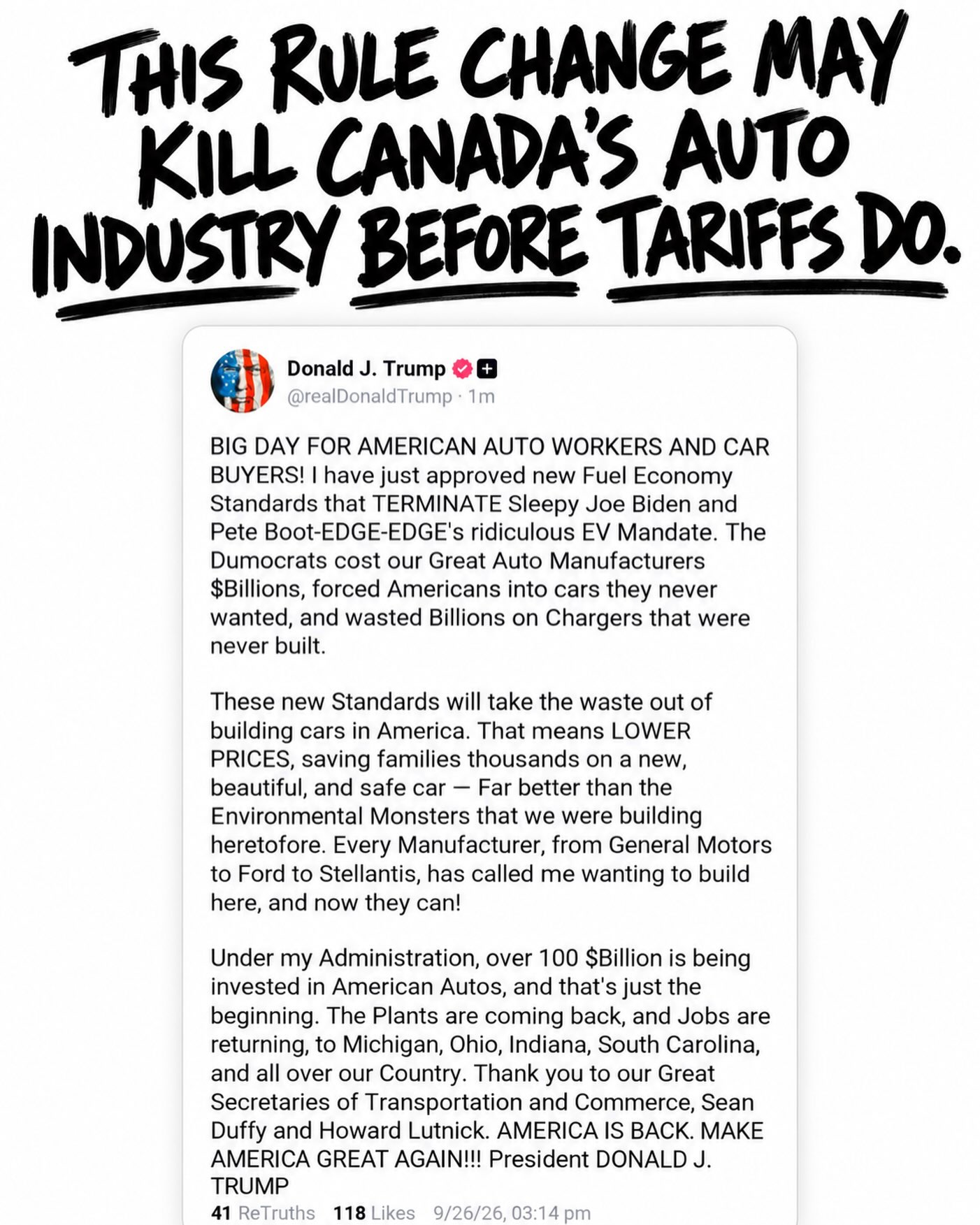
A sweeping change in U.S. auto policy is stirring up trouble north of the border. The U.S. government has announced new standards it claims "will kill Canada’s auto industry before tariffs do". The text-based post also boasts of a resurgence in the American auto industry.
What's at stake
This is not a shift in manufacturing standards or safety regulations, but an alteration in standards and mandates. The changes impact electric vehicles — not just the cars themselves, but charging infrastructure. The current demand for electric vehicles is insufficient, at least according to the source, with too many chargers installed. These changes, rolled out under the last administration, were part of an effort to reduce waste in building cars. And in the process, were thought to make cars more affordable. The new mandates could force plants out of Canada, thereby killing jobs. This may be a misstep for the Biden administration, particularly in light of the recent tariffs on Canada. Such a change, coupled with inflation, could hurt the auto industry in Canada. The source does not explain why it believes the changes will kill the industry, but points to the new standards.
Economic nationalism
The call above for economic nationalism may be seen coming from a politician trying to shore up support. The post is critical of environmental regulations and the cost they impose on auto plants. The Biden Administration sought to reverse the effects of climate change by changing the auto industry, however, in the source's mind, this has failed. The source claims that the previous administration had a more effective policy of reducing overall cost to manufacturers and consumers. The source highlights that by reducing costs, the previous administration "encourage" the industry, but is silent on what these were. The post insists that the new standards will lower prices to consumers and make cars more beautiful and safe to drive. It is not clear who is funding this change, but the previous White House touted agreements it reached with automakers to build cars in America. Those agreements amounted to over $100 billion of investment.
How the change affects individuals
The source suggests that the Administration succeeded in getting manufacturers to consider building new plants in the U.S., but fails to explain what these changes are or how they came to be. Instead, it concludes that the auto industry will return. It would be interesting to understand the impact on consumers. The source claims that the change will make cars cheaper, but it fails to explain how. It is also not clear which auto parts would be cheaper to consumers. Instead, it claims that cars will be cheaper. The source does not explain the impact of the change on jobs. It has ambiguous language regarding jobs, stating that "the plants are coming back and jobs are returning" to unspecified locations, without explaining how many jobs will be created or where. The source suggests that the change will benefit consumers, but fails to explain how. It merely promises that "the Plants are coming back, and Jobs are returning."
The-chip crisis
The cars that will be built under the new regulations will be better than the cars that preceded them, according to the source. It isn't clear what about the cars will be better, but one possibility is that the new cars will be built to be more fuel-efficient or less polluting. The source itself is silent as to whether it supports the push to cheaper cars. It is unclear what the economic impact will be of building cars made by foreign parts. It is especially unclear what the source means by cheaper. And it is unclear what it means by "reducing waste." The post does not explain why cheaper cars would be better than environmentally friendly ones.
The new model
Many automakers are eager to locate to the U.S. under the new regulations, suggesting that the new regulations benefit them financially. However, the source is silent as to whether automakers seek to build cars in the U.S., or whether they seek to build cars for the U.S. market. The post does not explain the geographic scope of the change. And although it names some car manufacturers, it is not clear why those manufacturers support the change. The source's view of the new regulations is clear. It is hopeful that the new regulations will benefit American manufacturers, without explaining how. It is not clear if the viewpoint is current or a matter of faith.
Building regulation
Car builders will benefit. But building cars locally will require more oil, the source claims. But it fails to say what the impact of each will be or how the regulations will do so. Consumers: anything at all about how they will be affected. There should be information on how the move to locally-sourced cars will affect car prices, quality, and availability in the market. There could be effects on real estate prices in car-building districts. Investors should be aware of the regulations' impact on the bottom line of American car companies.The post specifically calls out General Motors, Ford, and Stellanis, so it would be good to understand how these companies are affected by the change. There are no promises of American made cars. If there is increased investment in jobs, the source does not say what those jobs are or how they will be paid for. If you want to understand the economic effects of a major shift in U.S. policy, there are a few questions to ask. Will the change affect all car manufacturers in the same way? How will it affect car consumers? And will it cause prices to drop?
Watch the Reel
Questions readers ask
What exactly are the new U.S. electric vehicle standards that are causing concern in Canada's auto industry?
The new U.S. electric vehicle standards are not just about the cars themselves, but also about the charging infrastructure. The U.S. government claims these changes will make cars more affordable and reduce waste in manufacturing. However, the specifics of these standards and how they will impact the industry are not detailed in the article.
How might these new standards force auto plants to relocate out of Canada?
The new standards could potentially make it more costly or less feasible for auto plants in Canada to meet the updated requirements. This could lead to plants relocating to the U.S. where the regulations are being implemented, thereby forcing job losses in Canada.
What is the economic nationalism angle mentioned in the article, and how does it relate to these policy changes?
Economic nationalism in this context refers to policies that prioritize domestic production and jobs. The article suggests that the U.S. is pushing for more auto production within its borders, which could be seen as a form of economic nationalism. This shift is criticized for potentially hurting Canadian jobs and the auto industry.
What are the environmental implications of these new standards, and why are they controversial?
The new standards are part of an effort to reduce waste in car manufacturing and make cars more affordable, but the article suggests they may come with unintended consequences. The environmental regulations are seen as costly by some, and there is a debate over whether they effectively reduce climate change impacts while also encouraging domestic production.
How will these policy changes affect consumers in both the U.S. and Canada?
The article suggests that the new standards aim to make cars cheaper and more beautiful and safe to drive, but it doesn't specify which auto parts will be cheaper or how. The impact on jobs is also unclear, with vague statements about plants returning and jobs being created without specific details.
Recent articles
Fresh deep dives from the latest Reels we unpacked.




Comments
Be the first to comment.