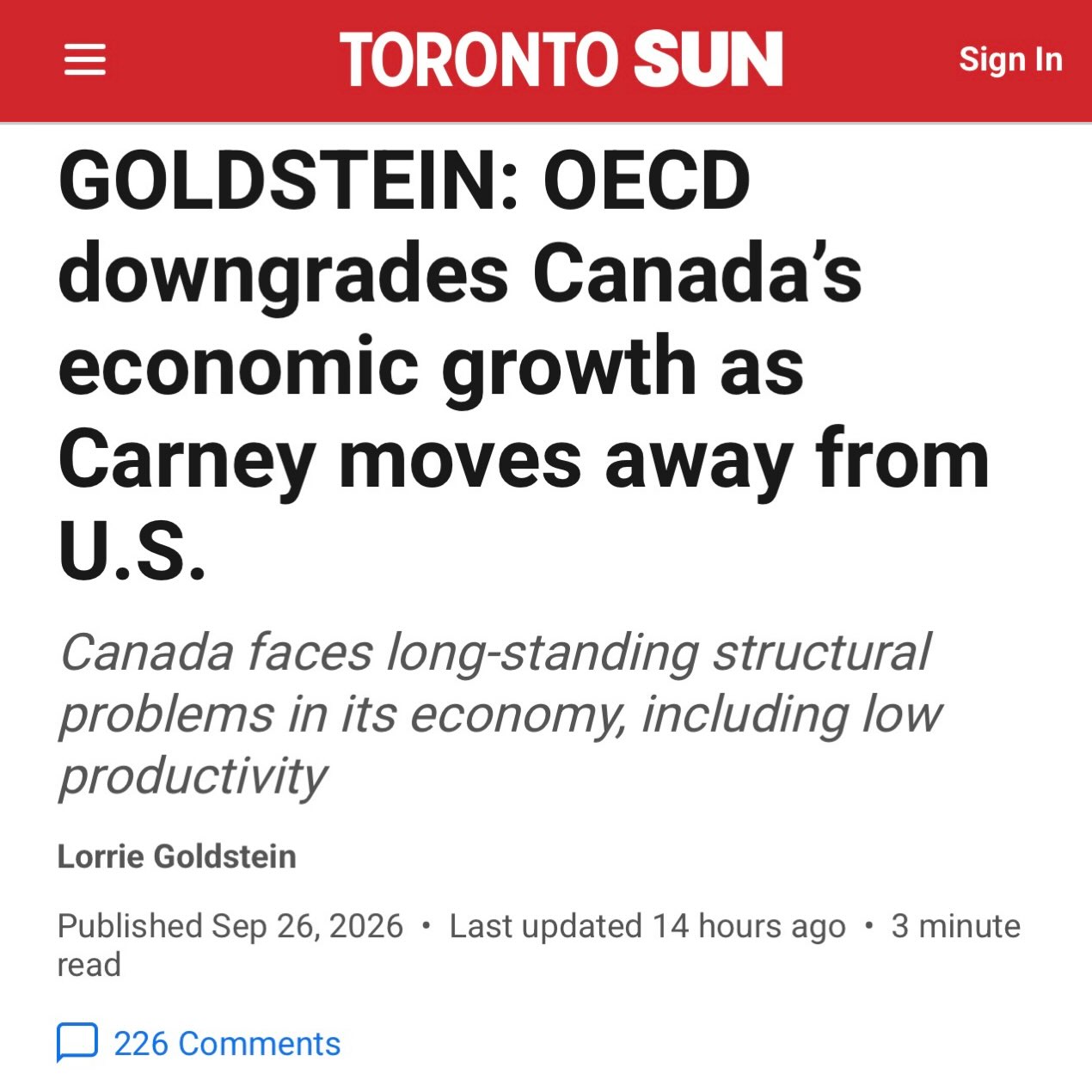
On September 26, 2026, the Toronto Sun released a detailed report that shed light on a significant revision by the Organisation for Economic Co-operation and Development (OEC) on Canada’s economic forecast. This landmark article delved into the issues underlying Canada’s economic health, highlighting the critical factors that are shaping the country’s future.
Canada's Economic Slowdown
The OECD's decision to downgrade Canada’s economic growth is not a minor shock. At its core, this pivot is an acknowledgment that Canada’s economic trajectory is facing significant hurdles. These structural issues have been longstanding, but the recent shift away from aligning with U.S. economic policies has brought them into sharp focus. One of the biggest concerns the report identifies is that Canada’s productivity levels lag behind those of its economic peers. Productivity measures the efficiency of labour and capital in transforming inputs into outputs. Low productivity then means that the same inputs now yield less economic output; it is a key indicator of economic growth. This has long been a problem, but the OECD has clearly stated that Canada is now lagging behind the international pack; its economy is not keeping up with the pace set by its peers. This article by Lorrie Goldstein published Tuesday was published on the site of the Toronto Sun, a major Canadian newspaper. The large number of views on the article suggest that many readers are interested in the news of Canada's economic slowdown.
A Turning Point For Canadian Economics
The OECD’s downgrade arrives at a time when Canada’s economy has been striving for recovery, but its economy is not yet performing at a healthy pace. According to Goldstein, this issue is exacerbated by the country’s shift away from aligning itself closely with U.S. economic policies. The OECD has long encouraged countries to look closely at these policies for direction. Canada faces long-term structural problems that are not quickly solved. Discussing the shift away from U.S. economic policies, Goldstein writes “While Canada’s move away from the U.S. has opened up new trade opportunities, it has also forced the country to confront its own long-standing economic problems.” These structural problems run deep and have long troubled Canada, but the OECD just gave the most recent, and perhaps the strongest, warning sign.
The OECD's Changing Attitude
The OECD has always been a careful and steady voice within the international economic community, and this is no exception. In recent years the OECD has been one of the most encouraging international partners of the Canadian economy, and it seems they're finally voicing their concerns. This means that Canada can no longer look to the OECD as a reliable cheerleader. If this change in attitude is because of Canada’s shift away from U.S. policies, this could signal friction between the OECD and Canada in the coming months.
The Problem with Low Productivity
Low productivity is a deeply entrenched problem. It can take years to solve, and it requires broad changes to the entire economy. Canada’s economic productivity has long been considered a problem, and it is foundational to many of the systemic problems Canada's economy now faces. The OECD’s downgrade is a clear end to ignoring it. DetectiveChad, commenting on the OECD’s decision, lamented “Canada’s falling productivity is a national tragedy. Why do we have such large economic gaps”? His question raises important points about the societal effects of economic productivity. Now more than ever, these questions about the reasons behind Canada's low productivity need to be front and centre of the discussion. The OECD has made it clear that this is a serious problem that needs addressing, and these questions are the first step.
Moving Forward
The OECD has called on Canada to focus on addressing its productivity issues. But they also recognise that Canada's struggle to move its economy forward is beset by other problems. Goldstein writes "The OECD’s downgrade has highlighted the need for Canada to diversify its economy, not only to support economic growth but also to support a favourable economic environment for the future." This means that Canada is going to have to take a hard look at what it can do to fix its problems; and it's a problem that needs solving.
The Issue of Isolation
Canada’s policy of moving away from the world’s leading economy has made it more isolated for the guardians of the global economy. Canada's business deals and growth plans are now mostly independent of the world's wealthiest economy. This means that the two economies are now more independent than they have ever been. Traditionally, Canada’s economic growth has often been concerned with the U.S. market, but now it will have to create its own market.
Investing in Canada
For investors interested in Canada, the OECD’s downgrade should be seen as a clear signal: Canada needs investment. Despite Canada’s economic issues, it is still a country of opportunity. The OECD’s downgrade is a clear signal that Canada’s economy is facing challenges, but it is also an opportunity for investment.
- Prioritize sectors with preexisting growth: targetting growth sectors such as healthcare and green energy can provide better avenues for investment. Canada has always been strong in sectors such as renewable energy, and the recent focus on sustainability has created new opportunities.
- Support Innovation: Canada’s low productivity is concerning and addressing it will require better innovation and infrastructure. Medical and legal innovation will be essential to improving Canada’s productivity and could be a huge growth area.
- Watch Ottawa's financial policy: Canada’s financial policy is evolving. Following Ottawa's recent decisions will be essential for investors, and keeping an eye on the Government's plans will be essential for international investors.
Keep an Eye on Canadian Economics
The recent downgrade of Canada’s economic outlook by the OECD marks a turning point in Canada’s economic trajectory. It is a call to action to address long-standing structural issues, particularly low productivity. While Canada faces significant challenges, it also presents substantial opportunities for growth.
Watch the Reel
Questions readers ask
What exactly is the OECD and why does its downgrade of Canada's economic growth matter?
The Organisation for Economic Co-operation and Development (OECD) is an international organization that promotes policies to improve the economic and social well-being of people around the world. Its downgrade of Canada's economic growth matters because it signals that Canada is facing significant economic challenges and is not keeping pace with global peers, which could impact future policy decisions and investor confidence.
How does low productivity specifically impact Canada's economic growth?
Low productivity means that Canada's economy is not efficiently converting inputs into outputs, which directly impacts economic growth. The OECD's report indicates that Canada's productivity levels are lagging behind those of its economic peers, suggesting that the country is not as efficient as other nations in generating economic output.
What are the long-term structural problems Canada is facing, as mentioned in the article?
The article highlights that Canada has long-term structural problems, such as low productivity, that are deeply rooted. These issues are not easily or quickly resolved and have been exacerbated by Canada's shift away from aligning closely with U.S. economic policies. The OECD's downgrade serves as a strong warning sign about these persistent economic challenges.
Why is Canada's shift away from U.S. economic policies significant in this context?
Canada's move away from U.S. economic policies has opened up new trade opportunities but has also forced the country to confront its long-standing economic problems. This shift is significant because it has brought these structural issues into sharp focus, making it clear that Canada needs to address its own economic challenges more directly.
How has the OECD's attitude towards Canada's economy changed recently?
The OECD, which has been a supportive partner of Canada's economy, has recently started voicing concerns about Canada's economic trajectory. This change in attitude suggests that Canada can no longer rely on the OECD as a reliable cheerleader, and it may indicate potential friction between the two in the coming months.
What kind of changes are needed to improve Canada's productivity levels?
Improving productivity levels requires broad changes across the entire economy. This could involve investments in technology, education, and infrastructure, as well as policy reforms aimed at enhancing efficiency and innovation. Given the deeply entrenched nature of the problem, these changes are likely to take years to implement and show results.
How might the OECD's downgrade affect Canada's future economic policies?
The OECD's downgrade could influence Canada's future economic policies by pushing policymakers to address the identified structural issues more urgently. It may also impact investor confidence and trade relations, potentially leading to changes in how Canada approaches economic growth and development.
Recent articles
Fresh deep dives from the latest Reels we unpacked.




Comments
Be the first to comment.