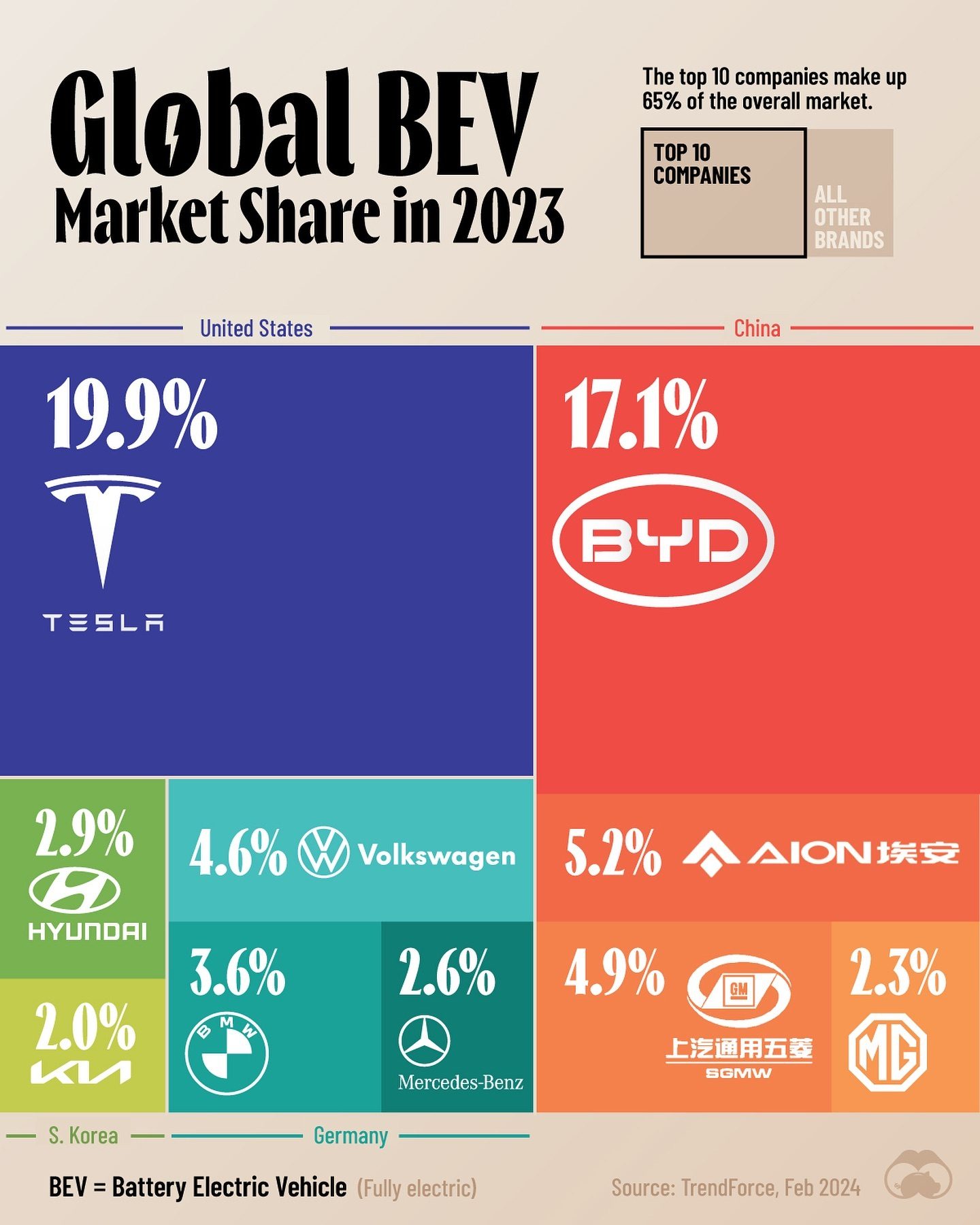
Global BEV Market Share in 2023
Electric vehicles (EVs) are increasingly becoming a dominant force in the automotive industry, and battery electric vehicles (BEVs) are at the forefront of this revolution. Understanding the market share dynamics of BEVs is crucial for both industry stakeholders and enthusiasts. This analysis provides a comprehensive overview of the global BEV market share for 2023, highlighting key players and market trends.
Why This Matters
The BEV market is rapidly evolving, with significant shifts in market share among top automakers. Recent trends indicate that China’s largest electric automaker, BYD, is poised to surpass Tesla in BEV sales by 2024. This shift underscores the growing influence of Chinese manufacturers in the global EV landscape. For consumers and industry professionals, staying informed about these changes can help in making strategic decisions and anticipating future market developments.
Main Discussion
Market Share Dynamics
As of 2023, Tesla holds the largest share of the global BEV market at 19.9%, closely followed by BYD with 17.1%. These two companies dominate the market, together accounting for nearly 37% of global BEV sales. The rest of the top 10 includes Hyundai, Volkswagen, AION, BMW, Mercedes-Benz, GM, and MG. These companies collectively make up 65% of the overall market, leaving the remaining 35% to all other brands.
Regional Market Dominance
The United States and China are the two leading markets in the global BEV landscape. The United States, with its robust EV infrastructure and consumer demand, has a significant presence in the market. China, on the other hand, is rapidly expanding its EV production capabilities and is expected to surpass the United States in the coming years. South Korea and Germany are also notable players, with significant contributions from Hyundai, BMW, and Mercedes-Benz.
Top Companies and Their Market Share
-
Tesla (19.9%): Tesla continues to lead the BEV market, driven by its innovative technology and strong brand presence. The company's Model 3 and Model Y are particularly popular among consumers.
-
BYD (17.1%): China's BYD is a close competitor, benefiting from strong domestic support and a wide range of BEV models. BYD’s extensive investment in battery technology and electric buses has also contributed to its market dominance.
-
Hyundai (2.9%): Hyundai, with its focus on sustainability and innovation, has steadily increased its market share. Models like the Ioniq 5 and Kona Electric have gained traction globally.
-
Volkswagen (4.6%): Volkswagen's aggressive push into the EV market, including models like the ID.3 and ID.4, has helped it secure a significant market share.
-
AION (5.2%): AION, a subsidiary of GAC Motor, has made impressive strides in the BEV market, particularly in China. Its models, such as the AION S and AION V, have gained popularity for their performance and design.
Emerging Players and Market Trends
While the top 10 companies dominate the market, there are several emerging players and trends worth noting. For instance, companies like BMW, Mercedes-Benz, GM, and MG are investing heavily in BEV technology and expanding their product lines. Additionally, there is a growing trend towards more affordable and compact BEVs, catering to a broader consumer base.
Practical Tips
For consumers looking to enter the BEV market, it’s important to consider several factors:
-
Research and Compare Models: With a wide range of BEVs available, it’s crucial to research and compare different models to find the one that best suits your needs.
-
Incentives and Subsidies: Many governments offer incentives and subsidies for purchasing BEVs. Check local regulations to see if you qualify for any financial benefits.
-
Charging Infrastructure: Ensure that your area has a robust charging infrastructure or consider models that offer longer range and faster charging capabilities.
-
Long-term Costs: Consider the long-term costs of owning a BEV, including maintenance, insurance, and potential resale value. While the upfront costs can be higher, BEVs often have lower operational costs.
Important Takeaways
- The global BEV market is highly competitive, with Tesla and BYD leading the way.
- Regional dynamics play a significant role, with the United States and China being the dominant markets.
- Emerging players and trends, such as more affordable and compact BEVs, are shaping the future of the market.
- Consumers should consider research, incentives, charging infrastructure, and long-term costs when entering the BEV market.
Conclusion
The global BEV market is experiencing rapid growth and significant shifts in market share. Tesla and BYD are currently the top players, with a combined market share of nearly 37%. The United States and China lead the regional dominance, while emerging players and trends continue to shape the market. For consumers and industry professionals, staying informed about these dynamics is essential for making strategic decisions and navigating the evolving BEV landscape.
Watch the Reel
Questions readers ask
Who are the top players in the global BEV market for 2023?
The top players in the global BEV market for 2023 are Tesla and BYD. These two companies together hold 37% of the market. Other significant players follow behind, but these two giants lead the way.
What is the significance of BYD's growth in the BEV market?
BYD's growth in the BEV market is significant because it is poised to surpass Tesla in BEV sales by 2024. This shift highlights the increasing influence of Chinese manufacturers in the global electric vehicle landscape. It also indicates a potential change in market leadership in the near future.
How does the global BEV market share breakdown affect consumers?
The breakdown of the global BEV market share affects consumers by influencing the availability and variety of electric vehicles. As major players like Tesla and BYD compete, consumers can expect more options, potentially better prices, and enhanced features in BEVs.
What are the key trends in the global BEV market for 2023?
Key trends in the global BEV market for 2023 include the rapid evolution of the market, with significant shifts in market share among top automakers. Additionally, the growing influence of Chinese manufacturers and the potential for new market leaders in the near future are notable trends.
How do Tesla and BYD compare in terms of market share in 2023?
In 2023, Tesla and BYD collectively control 37% of the global BEV market. While both companies are significant, recent trends suggest that BYD is gaining ground and could surpass Tesla in BEV sales by 2024. This dynamic makes their competition a critical factor in the global electric vehicle market.
What does the future hold for the global BEV market based on current trends?
Based on current trends, the global BEV market is expected to continue growing, with China playing an increasingly significant role. BYD's projected surge in 2024 and the dynamic competition with Tesla suggest a market in flux, with potential shifts in leadership and innovation.
What factors contribute to the growth of the BEV market in 2023?
The growth of the BEV market in 2023 is driven by the increasing dominance of electric vehicles in the automotive industry, advancements in battery technology, and the strategic moves of key players like Tesla and BYD. Additionally, regulatory pressures and consumer demand for sustainable transportation options are fueling this growth.
Related deep dives
Similar reads based on topic and creator.


Recent articles
Fresh deep dives from the latest Reels we unpacked.




Comments
Be the first to comment.