Terrorism Attacks in 2024
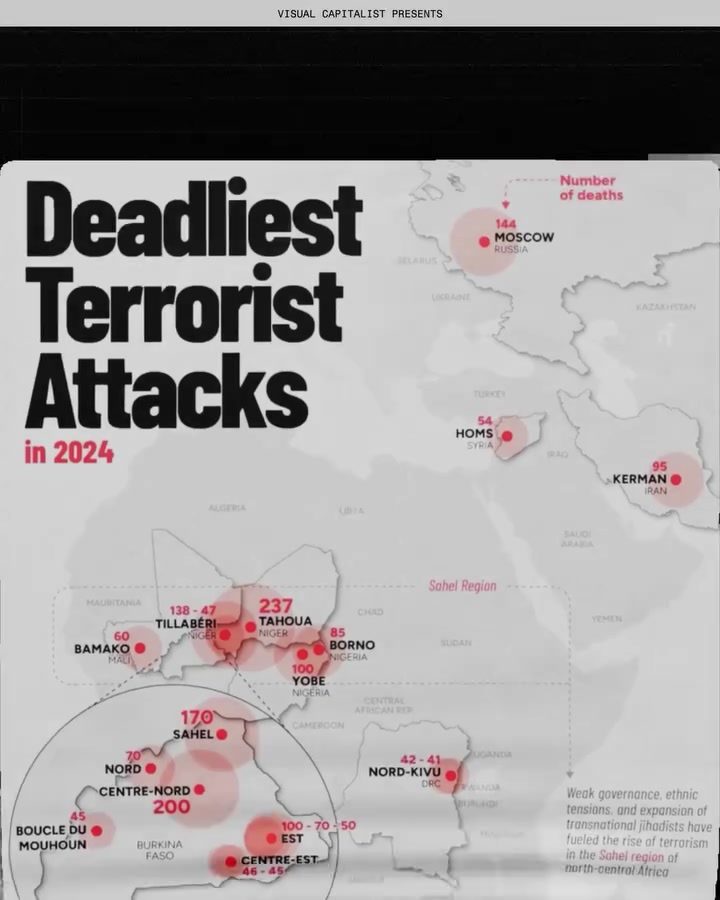
The deadliest terrorist attacks of 2024 have left an indelible mark on the Sahel region, particularly in Burkina Faso. The Institute for Economics & Peace has documented the escalating violence in this area, highlighting the urgent need for global attention and intervention.
Context / Why this matters
Understanding the global impact of terrorism is crucial for several reasons. It helps policymakers allocate resources effectively, informs international cooperation efforts, and raises awareness among the public about the regions most affected. The data from 2024 underscores the significance of addressing terrorism in the Sahel region and beyond.
Main discussion
The Sahel Region: A Hotspot for Terrorism
The Sahel region has become a focal point for terrorist activities. This vast area, stretching from the Atlantic Ocean to the Red Sea, includes parts of Burkina Faso, Mali, Niger, and Chad. The region's geography, characterized by its arid landscapes and porous borders, makes it difficult for governments to maintain control and monitor movements. This lack of effective governance has allowed extremist groups to flourish and carry out devastating attacks.
Key Locations in 2024
Several locations in the Sahel region and the Middle East were particularly hard-hit in 2024. These include:
- Tillabéri (Niger): A region in western Niger that has seen an increase in terrorist activity.
- Moussa (Mali): Known for its strategic importance due to its proximity to the Niger River.
- Homs (Syria): A city that has been a hotbed of conflict and terrorist activity for years.
- Kerman (Iran): A region that has seen increased activity from extremist groups.
- Nord-Kivu (Democratic Republic of Congo): An area plagued by conflict and terrorist attacks.
- Centre-Nord (Burkina Faso): A region that has experienced some of the most deadly attacks in 2024.
Burkina Faso: A Disproportionate Target
Burkina Faso, in particular, has been disproportionately affected by terrorist violence. Half of the 20 deadliest attacks in 2024 occurred in this country. The Centre-Nord region, which includes areas like Tillabéri and Nord-Kivu, has been especially targeted. The violence has not only claimed countless lives but has also displaced millions of people, leading to a humanitarian crisis.
Practical tips
Staying Informed
Staying informed about the latest developments in regions affected by terrorism can help individuals and organizations make better decisions. Following credible sources and monitoring reliable data can provide insights into the evolving nature of terrorist threats.
Supporting Anti-Terrorism Efforts
Supporting organizations and initiatives aimed at combating terrorism can make a significant difference. This could involve donating to humanitarian aid, advocating for policy changes, or participating in awareness campaigns.
Important takeaways
Regional Instability
The Sahel region's instability is a complex issue that requires a multifaceted approach. Addressing the root causes of conflict, such as poverty, lack of education, and poor governance, is essential for long-term solutions.
Global Engagement
International cooperation is crucial in combating terrorism. Collaboration between governments, non-governmental organizations, and international bodies can help in sharing resources, intelligence, and best practices.
The Role of Data
Data-driven insights are invaluable in understanding the scope and impact of terrorism. Organizations like the Institute for Economics & Peace provide essential data that can inform policies and interventions.
Conclusion
The escalating violence in the Sahel region, particularly in Burkina Faso, underscores the urgent need for global attention and intervention. By staying informed, supporting anti-terrorism efforts, and advocating for effective policies, we can contribute to a safer and more secure world. The data from 2024 serves as a stark reminder of the ongoing threat of terrorism and the importance of collective action in addressing it.
Watch the Reel
Questions readers ask
Why did Burkina Faso experience such a significant increase in terrorist attacks in 2024?
Burkina Faso's surge in terrorist attacks can be attributed to several factors, including its challenging geography, which provides cover for extremist groups, and persistent governance issues that create vulnerabilities. Additionally, the Sahel region's overall instability has made it a hotspot for extremist activities, further exacerbating the situation in Burkina Faso.
Which organizations have documented the rise in violence in Burkina Faso and the Sahel region?
The Institute for Economics & Peace has been instrumental in documenting the escalating violence in Burkina Faso and the broader Sahel region. Their data highlights the urgency for global intervention and attention to the growing conflict in these areas.
What are the main security challenges faced by Burkina Faso in 2024?
Burkina Faso's security challenges in 2024 include a rise in extremist activities, the impact of its complex geography on terrorist operations, and governance issues that hinder effective counter-terrorism measures. These factors collectively contribute to the country's safety concerns and the growing violence.
How does the data from 2024 underscore the significance of addressing terrorism in the Sahel region?
The data from 2024 reveals that the Sahel region, particularly Burkina Faso, has experienced a significant number of the deadliest terrorist attacks. This underscores the importance of global attention and intervention to address the root causes of terrorism in the region, which can inform international cooperation and resource allocation by policymakers.
What role do extremist groups play in the growing violence in Burkina Faso?
Extremist groups have exploited the challenging geography and governance issues in Burkina Faso to carry out deadly attacks. Their activities have made the Sahel region a hotspot for terrorism, contributing to the country's security challenges and overall instability in 2024.
Why is it important to understand the global impact of terrorism, particularly in Burkina Faso?
Understanding the global impact of terrorism in Burkina Faso helps policymakers allocate resources more effectively and informs international cooperation efforts. It also raises public awareness about the regions most affected by terrorism, highlighting the need for collective action to address the root causes of violence in the Sahel region.
What specific actions can be taken to mitigate the growing violence in Burkina Faso?
Mitigating the growing violence in Burkina Faso requires a multi-faceted approach, including strengthening governance, improving security measures, and addressing the underlying socio-economic factors that contribute to extremism. International cooperation and support are also crucial in tackling the security challenges faced by the country.
Recent articles
Fresh deep dives from the latest Reels we unpacked.




Comments
Be the first to comment.