Comparing GDP: BRICS vs. G7
The economic landscape is constantly evolving, and understanding the contributions of different regions to the global economy is crucial. This article delves into the GDP comparison between the BRICS nations (Brazil, Russia, India, China, and South Africa) and the G7 countries (United States, Canada, France, Germany, Italy, United Kingdom, and Japan) using data from the International Monetary Fund (IMF).
Context: The G7 and BRICS Economies
The G7 and BRICS are two significant groups of countries that play pivotal roles in the global economy. The G7, comprising some of the world's most advanced economies, has traditionally been a dominant force in global economic policies. On the other hand, the BRICS nations, while still developing, have shown remarkable growth and are increasingly influential in the global economic arena.
GDP Comparison: 1992 to 2028
The Early 1990s: A Dominant G7
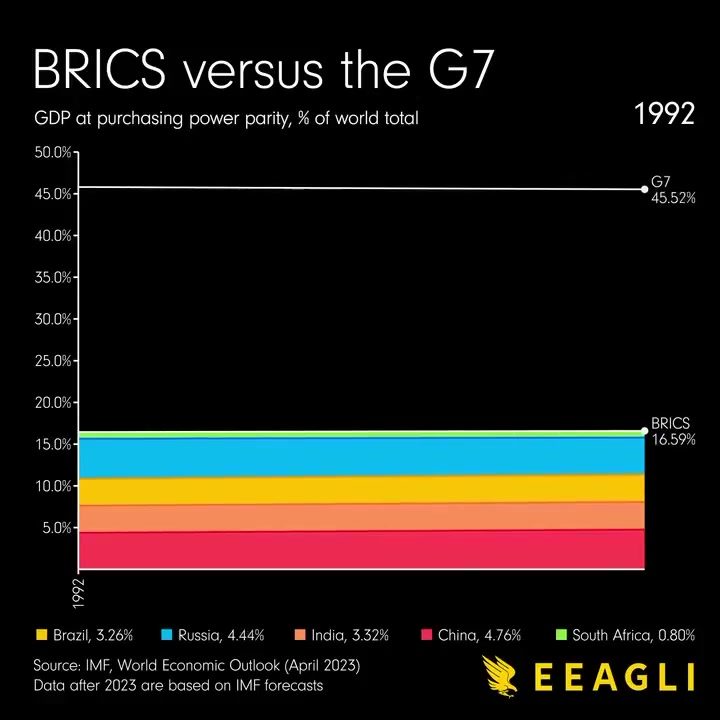
In 1992, the G7 countries contributed 45.67% of the world's GDP, while the BRICS nations accounted for only 16.52%. This disparity highlights the economic dominance of the G7 during that period. The data, sourced from the IMF's World Economic Outlook (April 2023), provides a robust foundation for understanding the economic landscape at that time.
The Mid-2000s: BRICS on the Rise
By 2007, there was a notable shift in the economic landscape. The BRICS nations increased their contribution to 23.52% of the world's GDP, while the G7's share decreased to 37.24%. This shift indicates the rapid economic growth of the BRICS countries, driven largely by China and, to a lesser extent, India and Russia.
The Present Day: A Closer Look
In 2021, the BRICS nations' contribution to the global GDP reached 30.34%, with the G7's share at 33.58%. This narrowing gap underscores the BRICS' continued economic ascent and the G7's relatively slower growth. The data for 2021 shows that China alone contributes significantly to the BRICS' GDP, with a 18.53% share, followed by India at 7.06%, Brazil at 2.35%, Russia at 3.05%, and South Africa at 0.59%.
The Future: Forecast for 2028
Looking ahead, the IMF forecasts that by 2028, the BRICS nations will contribute 33.65% to the world's GDP, while the G7's share will be 27.77%. This forecast suggests that the BRICS could potentially surpass the G7 in terms of GDP contribution within the next few years. China's projected contribution remains substantial, with a 19.72% share, followed by India at 8.65%, Brazil at 2.18%, Russia at 2.57%, and South Africa at 0.53%.
Factors Driving the Economic Shift
Rapid Industrialization and Urbanization
The rapid industrialization and urbanization in BRICS countries, particularly in China and India, have been major drivers of their economic growth. These processes have led to significant increases in manufacturing output, infrastructure development, and service sector growth.
Urbanization
China's shift towards urbanization has been particularly dramatic. Over the past few decades, hundreds of millions of people have moved from rural areas to cities, creating a vast consumer market and a massive labor force for industrial development.
Infrastructure Development
Investments in infrastructure, including transportation networks, energy production, and telecommunications, have been critical in supporting economic growth in the BRICS nations. These investments facilitate trade, enhance productivity, and create jobs, thereby fueling economic expansion.
The Role of Technology and Innovation
Technological Advancements
Technological advancements have played a pivotal role in the economic growth of the BRICS nations. Countries like China and India have emerged as global leaders in technology, with significant investments in research and development. These advancements have led to the growth of industries such as information technology, telecommunications, and renewable energy.
Practical Tips for Understanding Global Economic Trends
Stay Informed
Keeping up with the latest economic data and trends is essential for understanding the global economic landscape. Sources like the IMF's World Economic Outlook provide valuable insights into the economic performance of different regions.
Analyze Historical Data
Analyzing historical data can help identify trends and patterns that shape the current economic landscape. For instance, the data from 1992 to 2021 highlights the shifting economic power dynamics between the G7 and BRICS nations.
Consider Long-Term Forecasts
Long-term economic forecasts, such as those provided by the IMF, offer a glimpse into the future economic landscape. These forecasts can help policymakers, investors, and businesses make informed decisions.
Important Takeaways
- The BRICS nations have shown remarkable economic growth, narrowing the gap with the G7 in terms of GDP contribution.
- China's economic growth has been a significant driver of the BRICS' overall economic performance, followed by India, Brazil, Russia, and South Africa.
- Rapid industrialization, urbanization, and technological advancements have played crucial roles in the economic growth of the BRICS nations.
- The IMF forecasts that the BRICS could surpass the G7 in terms of GDP contribution by 2028.
Conclusion
The comparison between the GDP contributions of the G7 and BRICS nations provides valuable insights into the evolving global economic landscape. While the G7 has traditionally dominated the global economy, the BRICS nations have made significant strides, driven by rapid economic growth and technological advancements. Understanding these dynamics is essential for navigating the complex global economy and making informed decisions.
Watch the Reel
Questions readers ask
What is the significance of comparing the GDP of BRICS and G7 countries?
Comparing the GDP of BRICS and G7 countries provides insights into the shifting economic power dynamics globally. It helps identify emerging economic trends and potential future leaders in the global economy, influencing investment and policy decisions.
Which country among the BRICS is leading the economic growth?
China is the leading contributor to economic growth among the BRICS nations. Its rapid economic expansion significantly impacts the overall GDP of the BRICS group, narrowing the gap with the G7 countries.
What data source is used to compare the GDP of BRICS and G7 countries?
The comparison is based on data from the International Monetary Fund (IMF). The IMF provides comprehensive and reliable economic indicators, including GDP figures, which are essential for analyzing the economic contributions of BRICS and G7 nations.
Why is the economic power shift from G7 to BRICS significant?
The economic power shift from G7 to BRICS is significant because it reflects a change in the global economic landscape. As BRICS countries grow, they gain more influence in international economic policies and global trade, which can lead to new opportunities and challenges for the world economy.
What is the projected global GDP contribution of BRICS by 2028?
By 2028, the BRICS nations are expected to contribute significantly to global GDP, potentially closing the gap with the G7 countries. This projection is driven by the rapid economic growth of countries like China and India, which are increasingly becoming major players in the global economy.
How does the economic growth of BRICS countries compare to that of G7 countries?
The economic growth of BRICS countries, particularly China and India, has been robust and rapid. In contrast, the growth rates of G7 countries have generally been more stable but slower. This difference in growth rates is a key factor contributing to the narrowing gap in their global GDP contributions.
What role does China play in the BRICS vs. G7 economic comparison?
China plays a pivotal role in the BRICS vs. G7 economic comparison due to its massive GDP and rapid economic growth. China's economic expansion not only drives the overall GDP of the BRICS group but also significantly influences global economic trends and policies.
Recent articles
Fresh deep dives from the latest Reels we unpacked.




Comments
Be the first to comment.