GDP Comparison: G7 vs BRICS
The BRICS bloc is set to expand, adding six new member states at the start of 2024. This expansion raises important questions about the evolving global economic landscape. With the inclusion of these new countries, the combined GDP of the BRICS nations is projected to surpass $30 trillion, making up nearly 29% of the world's total GDP. This significant shift in economic power prompts a closer look at how the BRICS nations compare to the G7 countries, both in terms of individual contributions and overall economic strength.
Context / Why This Matters
The economic influence of both the G7 and BRICS blocs is undeniable. The G7, consisting of the United States, Canada, France, Germany, Italy, Japan, and the United Kingdom, has long been a dominant force in global economics. Meanwhile, the BRICS nations—Brazil, Russia, India, China, and South Africa—have been rapidly growing their economic influence, challenging the traditional dominance of the G7. As the BRICS expand, understanding the economic dynamics at play becomes crucial for investors, policymakers, and businesses alike.
Main Discussion
The G7: Economic Powerhouses
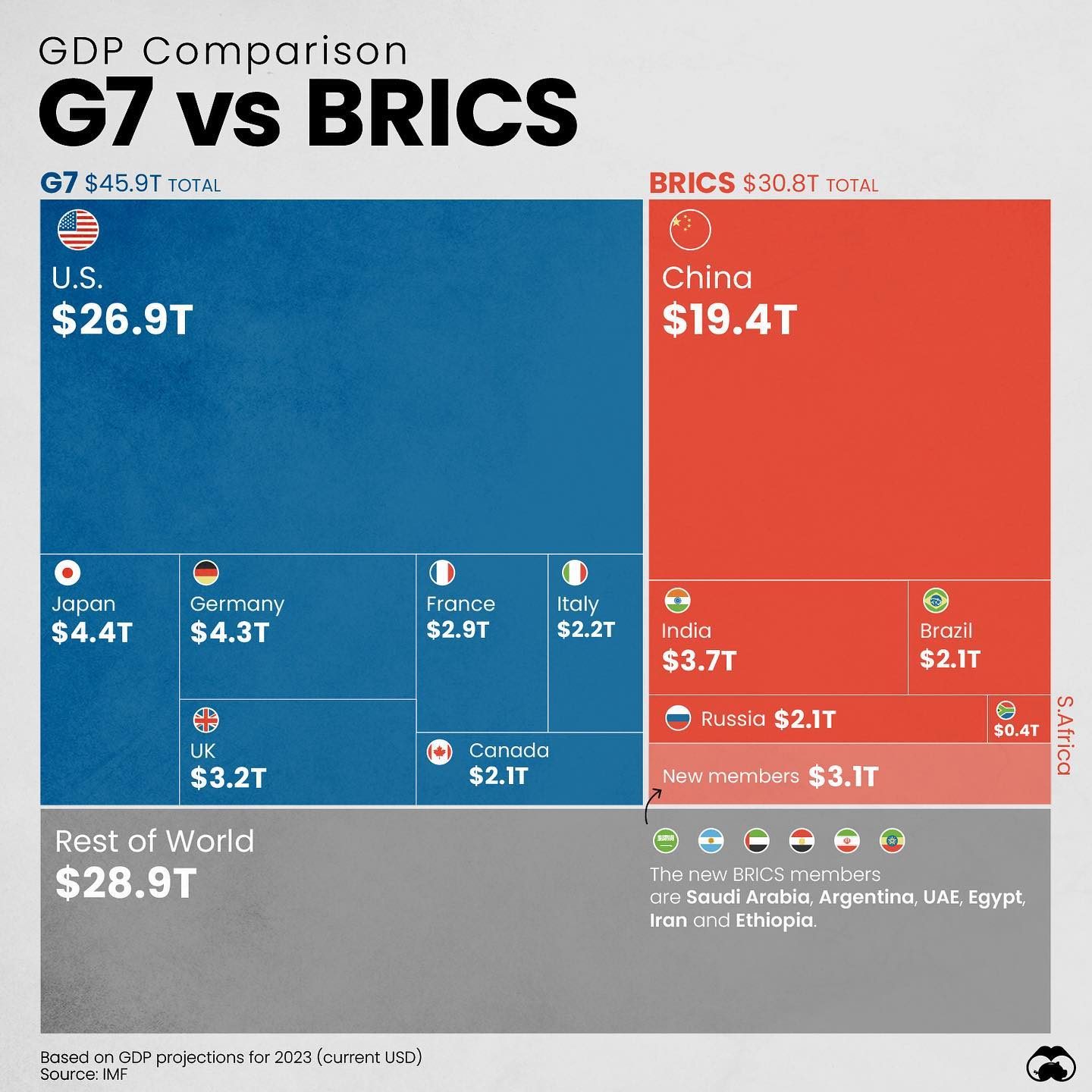
The G7 countries are renowned for their robust economies and significant contributions to global GDP. According to 2023 projections from the International Monetary Fund (IMF), the total GDP of the G7 nations is $45.9 trillion. The United States alone contributes a staggering $26.9 trillion, making it by far the largest economy in the group. Following the U.S. are Japan at $4.4 trillion, Germany at $4.3 trillion, and the United Kingdom at $3.2 trillion. France, Italy, and Canada each contribute around $2.9 trillion, $2.1 trillion, and $2.1 trillion, respectively.
The BRICS: Rapidly Growing Economies
The BRICS nations, while individually smaller than many G7 countries, collectively wield significant economic power. With a total GDP of $30.8 trillion, the BRICS group represents a formidable economic bloc. China is the standout contributor, with a GDP of $19.4 trillion, making it the second-largest economy in the world. India follows with a GDP of $3.7 trillion, Brazil with $2.1 trillion, and Russia with $2.1 trillion. These nations, along with South Africa, which contributes $0.4 trillion, form the core of the BRICS group. The expansion of the BRICS to include new members will further bolster its economic strength.
New Members: Expanding the BRICS Influence
The upcoming expansion of the BRICS bloc will include Saudi Arabia, Argentina, the United Arab Emirates (UAE), Egypt, Iran, and Ethiopia. These new members are projected to contribute an additional $3.1 trillion to the BRICS GDP. This expansion not only increases the economic clout of the BRICS but also diversifies its geographical and industrial base. The new members bring unique economic strengths and resources, further solidifying the BRICS as a global economic powerhouse.
Comparative Analysis
While the G7 countries have a larger combined GDP, the BRICS nations are closing the gap rapidly. The BRICS bloc's growth is driven by rapid industrialization, urbanization, and strategic investments in infrastructure and technology. In contrast, the G7 economies are more mature and stable, with a focus on innovation, services, and sustainability.
China's contribution to the BRICS GDP is particularly noteworthy. With a GDP of $19.4 trillion, China is not only the largest economy in the BRICS but also the world's second-largest economy overall. This places China in a unique position to influence global economic policies and trade agreements.
The Rest of the World
Beyond the G7 and BRICS, the rest of the world contributes a significant portion to the global GDP. Collectively, countries outside these two blocs account for $28.9 trillion in GDP. This highlights the importance of considering a broader range of economic players when analyzing global economic trends.
Practical Tips
For investors and businesses looking to navigate the evolving economic landscape, here are some practical tips:
- Diversify Investments: Consider diversifying your investment portfolio to include both G7 and BRICS countries. This approach can help mitigate risks and capitalize on growth opportunities in both regions.
- Stay Informed: Keep up with the latest economic data and projections from reliable sources like the IMF. Understanding the economic trends and forecasts can help you make informed decisions.
- Explore Emerging Markets: With the expansion of the BRICS, consider exploring the emerging markets within these countries. New members like Saudi Arabia and the UAE offer unique investment opportunities.
- Engage in Global Trade: Engage in global trade by exploring partnerships and collaborations with businesses in both G7 and BRICS countries. This can open up new markets and revenue streams.
Important Takeaways
- The G7 countries remain the largest economic bloc, with a combined GDP of $45.9 trillion.
- The BRICS nations are rapidly growing, with a combined GDP of $30.8 trillion and plans to expand further.
- The expansion of the BRICS to include six new member states will bolster its economic strength and diversify its industrial base.
- Investors and businesses should consider diversifying their portfolios and exploring emerging markets within the BRICS countries.
Conclusion
The expanding influence of the BRICS nations, coupled with the enduring strength of the G7 economies, is reshaping the global economic landscape. As the BRICS bloc continues to grow and diversify, it presents new opportunities and challenges for investors, policymakers, and businesses. By understanding the economic dynamics at play and staying informed about the latest trends and projections, stakeholders can navigate this evolving landscape more effectively.
Watch the Reel
Questions readers ask
Which countries are set to join BRICS in 2024?
The six countries expected to join BRICS in 2024 are Argentina, Egypt, Ethiopia, Iran, Saudi Arabia, and the United Arab Emirates. These additions will significantly boost the bloc's economic influence and total GDP.
How does the projected GDP of the expanded BRICS compare to the G7?
After the expansion, the combined GDP of BRICS nations is projected to surpass $30 trillion, which is comparable to the G7's total GDP. This makes BRICS a formidable economic powerhouse, challenging the long-standing dominance of the G7 countries.
What is the current list of BRICS countries?
The current BRICS countries, before the 2024 expansion, are Brazil, Russia, India, China, and South Africa. These nations have been collaborating on various economic and political fronts since the inception of the BRICS bloc.
How does the IMF view the BRICS expansion?
The International Monetary Fund (IMF) recognizes the potential of growing BRICS nations in the world economy. The IMF has stated that the BRICS expansion could lead to a shift in global economic power, with the bloc's share of the global GDP increasing. This shift is expected to influence global economic policies and financial markets.
What are the potential impacts of the BRICS expansion on the global economy?
The BRICS expansion could lead to a more balanced global economy, with increased representation from developing and emerging markets. It could also enhance trade opportunities, promote investment, and foster economic growth in the new member states, potentially leading to a shift in global economic dynamics.
How will the BRICS expansion affect trade relations among the member nations?
The BRICS expansion is likely to bolster trade relations among member states, fostering greater economic cooperation and integration. Enhanced trade is expected to boost economic growth, create employment opportunities, and promote technological advancement among the BRICS countries.
Recent articles
Fresh deep dives from the latest Reels we unpacked.




Comments
Be the first to comment.