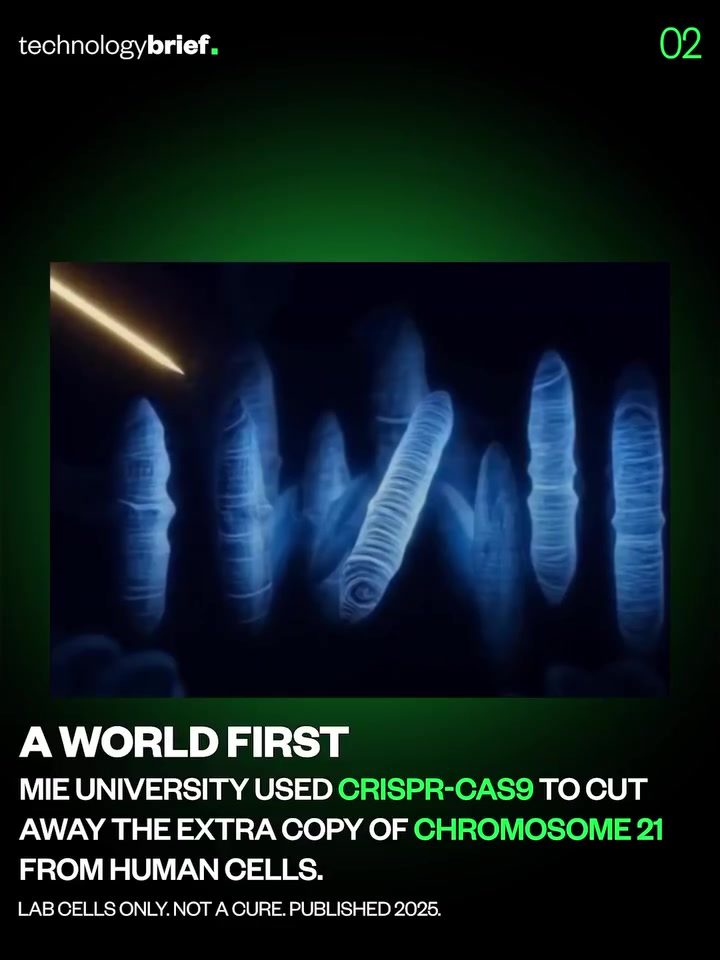
CRISPR-Cas9 Gene Editing
The groundbreaking work of researchers at Mie University in Japan has pushed the boundaries of CRISPR-Cas9 gene editing. The team successfully removed an extra copy of chromosome 21 from human cells, an achievement that marks a significant advancement in genetic manipulation. This extra chromosome is responsible for trisomy 21, more commonly known as Down syndrome. Instead of merely fixing a single broken gene, the researchers attempted to eliminate an entire extra chromosome.
Why This Matters
CRISPR-Cas9 technology has long been celebrated for its precision in editing individual genes. However, the ability to target and remove entire chromosomes opens up new avenues for treating complex genetic conditions. This breakthrough could potentially pave the way for innovative therapies for a range of chromosomal disorders, not just trisomy 21. This research underscores the evolving capabilities of CRISPR-Cas9 and its potential to reshape our approach to genetic diseases.
Main Discussion
The Science Behind the Breakthrough
The researchers at Mie University employed a targeted CRISPR-Cas9 approach. This method is designed to distinguish between the duplicated chromosome and the two chromosomes the cell should naturally possess. The process involved lab-grown stem cells and skin cells, where some of the edited cells successfully returned to the normal two-copy chromosome count. This achievement is remarkable, given the complexity and sensitivity of chromosomal manipulation.
The Mechanism of CRISPR-Cas9
CRISPR-Cas9 functions by using a guide RNA to locate the specific DNA sequence to be edited. In this case, the guide RNA was programmed to identify the extra copy of chromosome 21. The Cas9 enzyme then cuts the DNA at the targeted site, allowing for the removal of the unwanted chromosome. The precision of this method is crucial, as it minimizes the risk of off-target effects, where unintended parts of the genome are altered.
The Results and Implications
The team reported a correction rate as high as 37.5%. This means that nearly 40% of the edited cells successfully returned to the normal two-copy chromosome count. Furthermore, these corrected cells exhibited more typical gene activity, faster growth, and stronger antioxidant function. These findings suggest that the removal of the extra chromosome not only corrected the genetic anomaly but also improved the overall health and function of the cells.
Practical Tips
While this research is promising, it is essential to understand that it is still in its early stages. Here are some practical considerations for those interested in the potential applications of this technology:
- Safety and Efficacy: As with any new medical technology, safety and efficacy are paramount. Researchers must address potential risks, such as damaging chromosomes the cell actually needs. This involves extensive testing and refinement of the CRISPR-Cas9 approach.
- Clinical Trials: Before any treatment can be approved for human use, it must undergo rigorous clinical trials. These trials will help determine the safety and effectiveness of the procedure in real-world scenarios.
- Ethical Considerations: The ethical implications of gene editing are vast. This technology raises questions about genetic modification, its potential misuse, and the societal impact. Ongoing dialogue among scientists, ethicists, and the public is crucial.
Important Takeaways
- Potential for Treating Chromosomal Disorders: The ability to remove an entire extra chromosome opens up new possibilities for treating a range of chromosomal disorders, including trisomy 21.
- Precision and Safety: The targeted CRISPR-Cas9 approach demonstrates the precision and potential of gene editing technologies. However, safety concerns must be addressed before clinical applications.
- Proof of Concept: This research serves as a proof of concept, showing that CRISPR-Cas9 can be used to reshape chromosomes. It marks a significant shift in how we approach genetic manipulation.
Conclusion
The work done by Mie University researchers represents a major leap forward in the field of gene editing. By successfully removing an extra copy of chromosome 21, they have demonstrated the potential of CRISPR-Cas9 to treat complex genetic conditions. While there are still significant challenges to overcome, this breakthrough brings us one step closer to innovative therapies for a range of chromosomal disorders. As research continues, the ethical, safety, and clinical considerations will be crucial in shaping the future of this technology.
Watch the Reel
Questions readers ask
What is CRISPR-Cas9 and how does it work in gene editing?
CRISPR-Cas9 is a powerful tool for editing genomes. It works by using a specific guide RNA to target a particular section of DNA, and then an enzyme called Cas9 cuts the DNA at that location. This allows scientists to remove, add, or alter sections of the genetic code. In the context of the Mie University study, CRISPR-Cas9 was used to target and remove an entire extra chromosome.
How significant is the removal of the extra chromosome 21?
The removal of an extra chromosome 21 is a monumental achievement because it demonstrates the potential of CRISPR-Cas9 to address complex genetic conditions. Trisomy 21, or Down syndrome, is caused by the presence of an extra 21st chromosome, and removing this extra copy could lead to significant advancements in treating this and other similar conditions.
What makes this breakthrough different from previous gene editing efforts?
Previous efforts often focused on correcting single gene mutations. The Mie University research stands out because it successfully targeted and removed an entire extra chromosome. This opens up new possibilities for treating genetic diseases that are caused by chromosomal abnormalities, not just single gene defects.
What are the potential implications of this research for genetic disease treatment?
This research could pave the way for new therapies for a range of genetic conditions, including others caused by chromosomal abnormalities. By demonstrating the feasibility of removing an entire extra chromosome, this breakthrough expands the scope of what CRISPR-Cas9 can achieve in treating genetic diseases.
Can CRISPR-Cas9 be used to treat other genetic conditions besides Down syndrome?
Yes, the principles behind this research could be applied to other genetic conditions caused by chromosomal abnormalities, such as Patau syndrome (trisomy 13) or Edward syndrome (trisomy 18). However, each condition will require specific studies and adaptations of the CRISPR-Cas9 technology to ensure safe and effective treatment.
What are the next steps for researchers after this breakthrough?
The next steps likely involve further testing and refinement of the CRISPR-Cas9 technique in human cells, as well as animal models, to ensure safety and efficacy. Researchers will also need to address potential ethical considerations and develop protocols for clinical trials to translate this breakthrough into viable therapies for patients.
Recent articles
Fresh deep dives from the latest Reels we unpacked.




Comments
Be the first to comment.