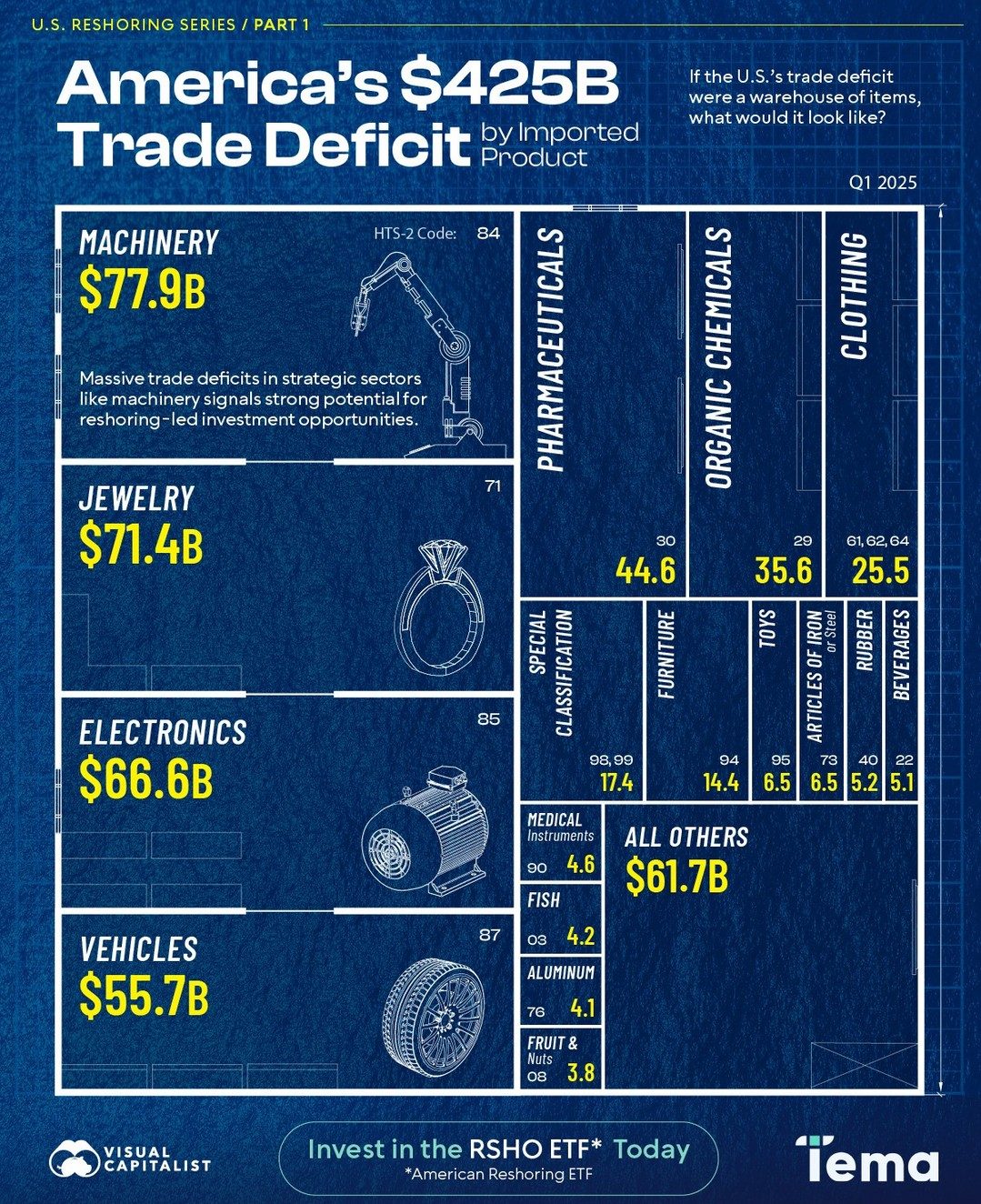
Trade Deficit Analysis: Breaking Down Q1 2025 Figures
In Q1 2025, the U.S. trade deficit soared to $425.5 billion. This staggering figure raises crucial questions about the underlying drivers of this deficit and the potential opportunities for reshoring investments. By analyzing the trade deficit by product category, we can gain a clearer understanding of where the challenges and opportunities lie.
Context / Why this matters
The trade deficit is a critical economic indicator that reflects the difference between a country's imports and exports. A high trade deficit can signal various economic issues, such as a lack of domestic production, high consumer demand for foreign goods, or competitive disadvantages in global markets. Understanding the specific product categories contributing to the trade deficit can help policymakers, investors, and businesses identify areas for potential reshoring and investment.
Main discussion
Machinery: The Largest Contributor
Machinery accounts for a significant portion of the trade deficit, totaling $77.9 billion. This category includes a wide range of industrial equipment, from construction machinery to manufacturing tools. The high deficit in machinery suggests a strong demand for foreign-made equipment, possibly due to cost advantages, advanced technology, or quality perceptions. Reshoring efforts in this sector could focus on enhancing domestic manufacturing capabilities, investing in R&D, and implementing policies that support local production.
Jewelry: A Surprising Contributor
Jewelry represents another substantial part of the trade deficit, amounting to $71.4 billion. This category encompasses everything from luxury jewelry to everyday accessories. The high deficit in jewelry can be attributed to factors such as consumer preferences for foreign brands, specialized craftsmanship, and the availability of raw materials. To address this deficit, domestic producers could focus on innovative design, high-quality materials, and leveraging domestic raw materials.
Electronics: A Key Driver
Electronics contribute $66.6 billion to the trade deficit. This category includes a broad range of products, from consumer electronics to industrial equipment. The high deficit in electronics highlights the dominance of foreign manufacturers in this sector, driven by factors such as lower labor costs, advanced technology, and economies of scale. Reshoring initiatives in electronics could involve investing in automation, promoting domestic innovation, and fostering a skilled workforce.
Vehicles: A Growing Sector
Vehicles, including both passenger cars and commercial vehicles, contribute $55.7 billion to the trade deficit. The automotive industry is highly competitive, with foreign manufacturers often having a cost advantage due to established supply chains, economies of scale, and technological advancements. Reshoring efforts in the automotive sector could focus on developing advanced manufacturing technologies, promoting domestic supply chains, and encouraging local innovation.
Other Significant Categories
Special classification and medical instruments are also significant contributors to the trade deficit. These categories encompass a wide range of products that play a critical role in various industries, including healthcare, manufacturing, and technology. Other sectors, contributing $61.7 billion, collectively highlight the diverse nature of the trade deficit and the numerous opportunities for reshoring.
Practical tips
Investing in the RSHO ETF
For investors looking to capitalize on reshoring opportunities, the RSHO ETF (American Reshoring ETF) is a strategic choice. This ETF focuses on companies that are actively involved in reshoring efforts, providing a diversified investment opportunity in the growing reshoring trend.
Policies Supporting Reshoring
Governments can play a pivotal role in supporting reshoring initiatives through various policies. These may include tax incentives for domestic production, grants for R&D, and regulations that promote local manufacturing. Additionally, fostering a skilled workforce and investing in advanced technologies can enhance the competitiveness of domestic industries.
Consumer Awareness and Demand
Consumers can also influence reshoring by supporting locally made products. Increasing demand for domestic goods can encourage manufacturers to invest in local production, creating a positive feedback loop that strengthens the domestic economy.
Important takeaways
- The U.S. trade deficit in Q1 2025 is driven by various product categories, including machinery, jewelry, electronics, and vehicles.
- Reshoring initiatives can help reduce the trade deficit by enhancing domestic production capabilities, investing in R&D, and promoting local innovation.
- The RSHO ETF (American Reshoring ETF) provides an investment opportunity for those interested in the reshoring trend.
- Policies supporting reshoring, consumer demand for domestic goods, and a skilled workforce are crucial for successful reshoring efforts.
Conclusion
The $425.5 billion trade deficit in Q1 2025 presents both challenges and opportunities. By analyzing the deficit by product category, we can identify key areas for reshoring investments. Policies that support domestic production, a skilled workforce, and consumer demand for local goods can drive successful reshoring initiatives. Investors can also benefit from the growing reshoring trend through the RSHO ETF. Understanding the underlying factors driving the trade deficit and leveraging opportunities for reshoring can contribute to a more robust and competitive U.S. economy.
Watch the Reel
Questions readers ask
What were the main contributors to the U.S. trade deficit in Q1 2025?
The primary drivers of the $425.5 billion trade deficit in the first quarter of 2025 were machinery and jewelry, along with other significant imports such as electronics and vehicles. These categories highlight areas where U.S. domestic production may need enhancement to balance the trade gap.
Why is the trade deficit an important economic indicator?
The trade deficit is a vital economic indicator as it shows the balance between a country's imports and exports. A high deficit can point to various issues, such as insufficient domestic production, high demand for foreign goods, or competitive disadvantages in global markets. It helps guide policies aimed at strengthening domestic industries.
What is the significance of machinery and jewelry in the Q1 2025 trade deficit?
Machinery and jewelry stand out as significant contributors to the trade deficit, indicating a high demand for these imported goods. This presents an opportunity for the U.S. to invest in domestic production to reduce reliance on imports and potentially lower the trade deficit in these categories.
What are the benefits of reshoring manufacturing in the context of the trade deficit?
Reshoring manufacturing can help reduce the trade deficit by increasing domestic production. This strategy can create jobs, boost local economies, and enhance the U.S. competitive position in global markets. Additionally, it can make the supply chain more resilient and reduce dependence on foreign suppliers.
How can the U.S. address the trade deficit highlighted in the Q1 2025 analysis?
To tackle the trade deficit, the U.S. can focus on increasing domestic production in key areas like machinery, jewelry, electronics, and vehicles. This can be achieved through investments in manufacturing, incentives for domestic production, and trade policies that promote U.S. exports. Strategic planning and targeted initiatives can help reshape domestic production to better meet consumer demand.
What are the main drivers of the Q1 2025 trade deficit increase?
The primary drivers of the Q1 2025 trade deficit increase include a surge in imports, particularly in sectors like machinery, jewelry, electronics, and vehicles. This trend highlights the need for a comprehensive analysis of import trends and the development of strategies to bolster domestic production in these areas.
What are opportunities for investment to address the US trade deficit?
Investment opportunities to address the trade deficit lie in enhancing domestic production capabilities in key sectors. By prioritizing machinery, jewelry, electronics, and vehicle manufacturing, the U.S. can reduce its reliance on imports, create jobs, and foster a more self-sufficient economy. Strategic investments in these areas can also promote long-term economic growth and stability.
Related deep dives
Similar reads based on topic and creator.

Recent articles
Fresh deep dives from the latest Reels we unpacked.




Comments
Be the first to comment.