AI Company Costs: A Detailed Breakdown
Artificial Intelligence (AI) is transforming industries, but the costs associated with developing and maintaining AI systems are substantial. This breakdown looks at how these expenses are distributed among different categories, focusing on research and development (R&D) compute, inference compute, and staff expenses. This analysis shines a light on the financial landscape of AI companies, using data visualization to illustrate key cost components.
Why This Matters
Understanding the cost structure of AI companies is crucial for investors, entrepreneurs, and business leaders. It helps in making informed decisions about resource allocation, budgeting, and strategic planning. Moreover, it provides insights into the economic impact of AI on the business landscape.
Main Discussion
Categories of AI Costs
AI company costs can be broadly categorized into three main areas: staff and other expenses, inference compute, and R&D compute. Let's delve into each category to understand their significance and the associated financial commitments.
Staff and Other Expenses
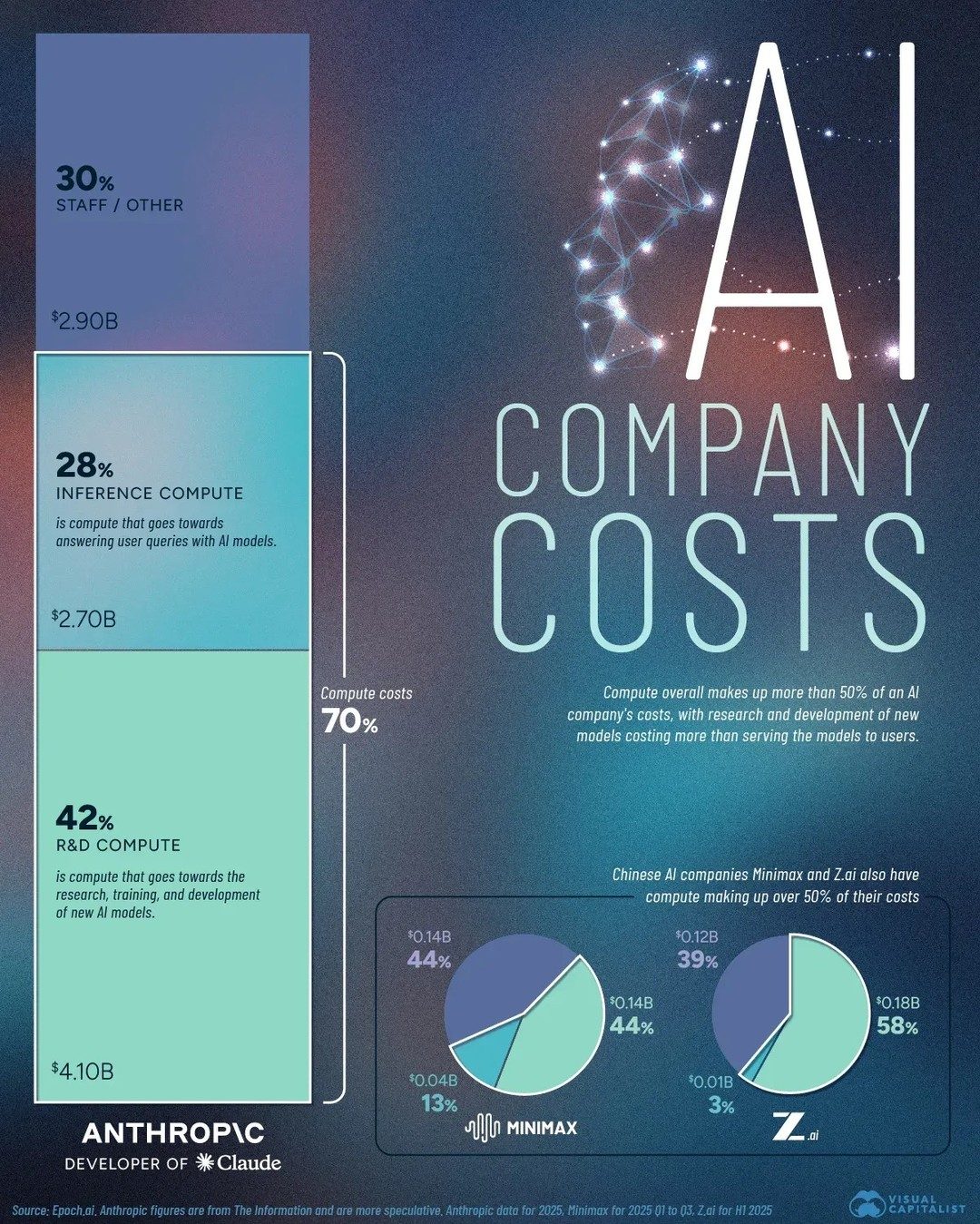
Staff and other expenses account for 30% of the total costs, amounting to $2.90 billion. This category includes salaries, benefits, and other operational expenses necessary to run the company.
Inference Compute
Inference compute refers to the computational resources used to serve AI models and answer queries. This category constitutes 28% of the total costs, totaling $2.70 billion. Inference compute is essential for delivering AI services to end-users, making it a critical component of the cost structure.
R&D Compute
R&D compute, which involves the research, training, and development of new AI models, is the most expensive category. It makes up 42% of the total costs, amounting to $4.10 billion. This highlights the significant investment required to innovate and stay competitive in the AI landscape.
Specific Company Costs
To provide a concrete example, let's look at the cost breakdown for Antropic, the developer of the Claude AI model.
Overall, compute costs—which include both inference and R&D compute—make up more than 50% of an AI company’s costs. This is a significant portion of the budget, illustrating the high computational demands of AI development and deployment. Additionally, developing new AI models is more expensive than serving existing models to users. This is evident in the higher costs associated with R&D compute compared to inference compute.
Comparison with Chinese AI Companies
Chinese AI companies like Minimax and Z.ai also face substantial costs. For instance, Minimax's costs are broken down as follows:
- Inference compute: 39%
- R&D compute: $0.14 billion
- Staff and other expenses: 13% ($0.04 billion)
- Other: 3%
Similarly, Z.ai has the following cost breakdown:
- Inference compute: 3% ($0.01 billion)
These figures highlight the significant financial commitments required to operate in the AI sector, regardless of the company's location or specific focus.
Practical Tips
For businesses looking to navigate the complexities of AI costs, here are some practical tips:
-
Prioritize R&D: Given the high costs associated with developing new models, it's crucial to allocate sufficient resources to R&D. This ensures continuous innovation and competitiveness.
-
Optimize Inference Compute: Efficiently managing inference compute can help reduce costs. This can involve optimizing algorithms, using more cost-effective hardware, or leveraging cloud services.
-
Invest in Staff: A skilled workforce is essential for driving AI projects forward. Investing in talent and training can yield long-term benefits.
-
Monitor and Analyze Costs: Regularly reviewing and analyzing cost data can help identify areas for improvement and optimize resource allocation.
Important Takeaways
- Compute costs, which include both inference and R&D compute, make up more than 50% of an AI company’s total expenses.
- Developing new AI models is more costly than serving existing models to users.
- Staff and other expenses, including salaries and benefits, account for a significant portion of the total costs.
- Chinese AI companies like Minimax and Z.ai face similar cost structures, with substantial investments in inference and R&D compute.
Conclusion
The cost structure of AI companies is complex and multifaceted, with significant investments required in staff, inference compute, and R&D compute. Understanding these costs is essential for businesses looking to thrive in the AI landscape. By prioritizing innovation, optimizing computational resources, and investing in talent, companies can navigate the financial challenges and reap the benefits of AI technology.
Watch the Reel
Questions readers ask
What are the primary components of AI company costs?
The primary components of AI company costs are research and development (R&D) compute, inference compute, and staff expenses. These categories cover the expenses associated with developing AI models, running them, and managing the team behind these operations.
How significant are R&D costs for AI companies?
R&D costs are substantial for AI companies, as they involve the development of new AI models and algorithms. These costs include computing resources, data acquisition, and the time spent by data scientists and engineers. This category is crucial for innovation and staying competitive.
What are inference costs and why are they important?
Inference costs are the expenses associated with running AI models to make predictions or decisions. These costs are significant because they represent the ongoing operational expenses of an AI system, directly impacting the profitability of AI-driven products and services.
How do staff expenses contribute to the overall costs of an AI company?
Staff expenses in AI companies include salaries, benefits, and other related costs for data scientists, machine learning engineers, and other specialists. These costs are high due to the specialized skills required for AI development and maintenance, and they are essential for the company's AI capabilities and growth.
What role does data visualization play in understanding AI company costs?
Data visualization is instrumental in understanding AI company costs by providing a clear, visual representation of where money is being allocated. This helps stakeholders identify trends, pinpoint areas for cost optimization, and make more informed financial decisions.
How can AI companies optimize their costs?
AI companies can optimize costs by evaluating their R&D and inference compute usage, leveraging cost-efficient cloud services, and investing in tools that automate and streamline processes. Additionally, strategic planning and budgeting can help allocate resources more effectively, reducing overall expenses.
What are some strategies to reduce AI inference costs?
To reduce AI inference costs, companies can employ strategies such as model optimization to make them more efficient, using hardware accelerators like GPUs or TPUs, and implementing batch processing to minimize the number of inferences performed. Additionally, choosing the right cloud service provider and leveraging their cost-saving features can significantly lower expenses.
Related deep dives
Similar reads based on topic and creator.


Recent articles
Fresh deep dives from the latest Reels we unpacked.




Comments
Be the first to comment.