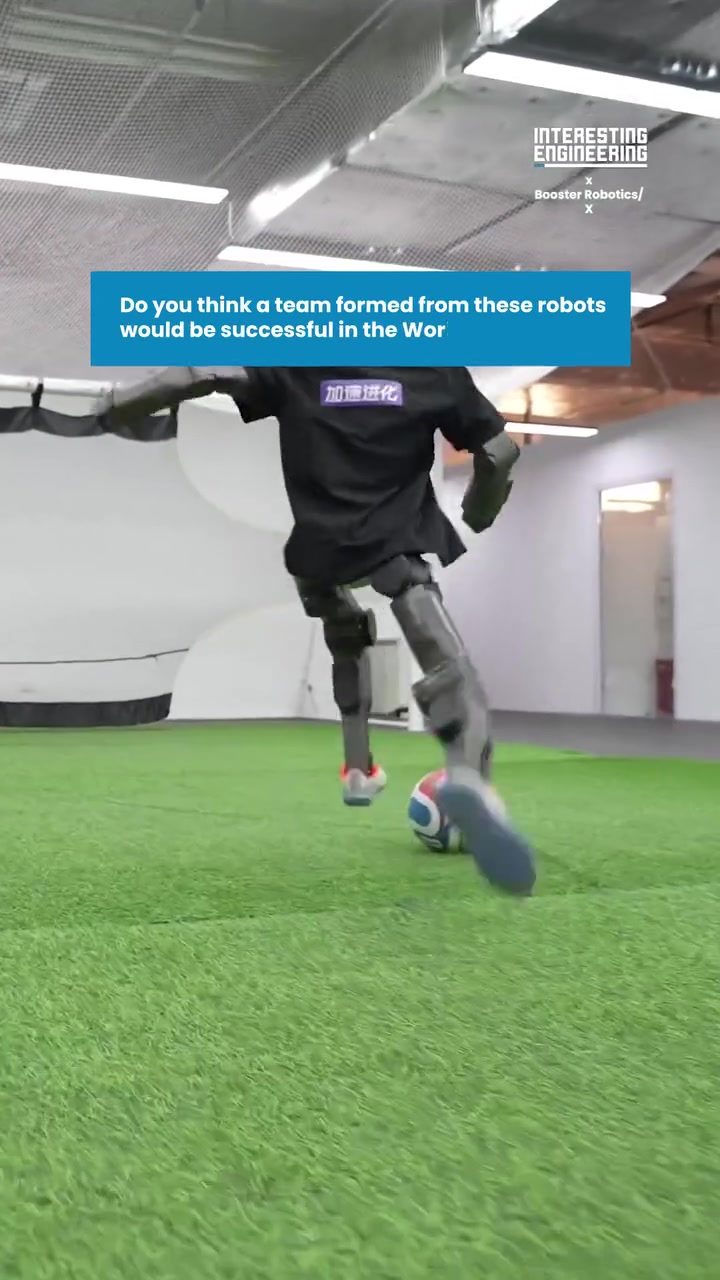
The Unstoppable Kick: Booster Robotics' Humanoid in Training for RoboCup
Humanoid robots are pushing boundaries of what robots can physically achieve in sports. Booster Robotics' humanoid, training for competitive RoboCup events, demonstrates an impressive soccer kick so powerful that it leaves a crack in the wall it uses as a target. This sets a new benchmark for robot performance.
Why Robots in Sports Matter
Robots compete in sports to test their physical and cognitive capabilities. RoboCup, an international robotics competition, challenges teams to build and program robots to play soccer against each other, emphasizing the importance of autonomous locomotion, vision, and teamwork. These capabilities are not just for sports but also have real-world applications in various industries. Robotics competitions have become a proving ground for developing technologies that can navigate complex environments, interact with objects, and work collaboratively.
Understanding the Humanoid's Capabilities
Autonomous Locomotion
The Booster Robotics humanoid showcases advanced autonomous locomotion. This means the robot can move around and navigate its environment without human intervention. It uses sophisticated algorithms and sensors to understand and respond to its surroundings, making it capable of complex maneuvers on the soccer field.
Vision Technology
Vision technology is crucial for the robot's performance. It allows the robot to perceive its environment, track the soccer ball, and make strategic decisions. The humanoid uses cameras and sensors to gather visual data, which is then processed to identify objects, estimate distances, and plan movements. This technology is essential for the robot's ability to kick and interact with the ball effectively.
Teamwork and Coordination
Teamwork is a key aspect of the humanoid's capabilities. In RoboCup, robots must work together to achieve a common goal, such as scoring a goal. The Booster Robotics humanoid is designed with advanced coordination systems that enable it to communicate and collaborate with other robots. This involves passing the ball, positioning itself strategically, and coordinating movements to outmaneuver opponents. These skills are not only crucial for sports but also for real-world applications where robots work together in collaborative environments.
The Engineering Behind the Kick
The robot's powerful kick is a testament to the engineering behind its movement. The humanoid uses a combination of advanced actuators, sensors, and control algorithms to execute precise and powerful movements. The actuators provide the force needed to kick the ball, while the sensors and algorithms ensure that the movement is executed with accuracy and timing. This engineering prowess is what allows the robot to leave a crack in the wall, demonstrating its potential for real-world applications.
Practical Tips for Building Robotic Soccer Players
Focus on Core Technologies
To build a successful robotic soccer player, focus on mastering core technologies such as autonomous locomotion, vision, and teamwork. These technologies form the foundation of the robot's capabilities and are essential for navigating the soccer field, interacting with the ball, and collaborating with other robots.
Invest in High-Quality Actuators
High-quality actuators are crucial for executing powerful and precise movements. Invest in actuators that can provide the necessary force and precision for kicking and moving around the field. Ensure that the actuators are integrated with advanced sensors and control algorithms to enhance the robot's performance.
Develop Advanced Vision Systems
Advanced vision systems are essential for perceiving the environment and making strategic decisions. Develop vision systems that can gather and process visual data in real-time, allowing the robot to track the ball, identify opponents, and navigate the field effectively.
Foster Collaboration and Teamwork
Develop systems that enable the robot to collaborate and communicate with other robots. This involves creating algorithms that can facilitate coordination, passing, and strategic positioning. Teamwork is crucial for achieving success in RoboCup and other competitive settings.
Important Takeaways
The Booster Robotics humanoid demonstrates the potential of robotics in sports and beyond. Here are the key takeaways from its impressive performance:
- Advanced autonomous locomotion, vision, and teamwork capabilities are essential for robotic success in sports.
- Powerful and precise movements are achieved through a combination of advanced actuators, sensors, and control algorithms.
- Collaboration and communication are crucial for achieving success in competitive settings.
- Robots in sports serve as a proving ground for developing technologies that can be applied to real-world applications.
Conclusion
The Booster Robotics' humanoid is setting new standards for what robot athletes can achieve. Its powerful kick and advanced capabilities highlight the potential of robotics in sports and beyond. As robotics continues to evolve, we can expect to see even more impressive feats from these sophisticated machines. Whether on the soccer field or in real-world applications, the future of robotics looks bright and strong.
Watch the Reel
Questions readers ask
What makes Booster Robotics' humanoid robot unique in the context of RoboCup?
Booster Robotics' humanoid robot stands out due to its exceptional physical capabilities, particularly its powerful soccer kick. This kick is so forceful that it leaves a mark on the target, demonstrating the advanced mechanical and control systems integrated into the robot. This level of performance is not just impressive in sports but also highlights the potential for real-world applications in industries requiring precision and strength.
How does the robot's vision technology contribute to its performance in RoboCup?
The robot's vision technology is crucial for its performance in RoboCup. It enables the robot to perceive its environment, track the ball, and navigate the field autonomously. This technology is essential for the robot's ability to play soccer effectively and efficiently, making it a key component in both competitive and practical applications.
What are the real-world applications of the skills demonstrated by Booster Robotics' humanoid robot?
The skills demonstrated by Booster Robotics' humanoid robot, such as autonomous locomotion, advanced vision, and teamwork, have significant real-world applications. These capabilities can be adapted for use in industries like manufacturing, healthcare, and disaster response, where robots need to navigate complex environments, perform precise tasks, and work collaboratively.
What is the primary goal of the robot training for RoboCup?
The primary goal of the robot training for RoboCup is to enhance its physical and cognitive abilities in a competitive environment. Booster Robotics' humanoid is trained to improve its autonomous locomotion, vision, and teamwork, all of which are essential for playing soccer competitively. Additionally, the training helps to advance modern robotics research and engineering.
How do humanoid robots in sports benefit from teamwork capabilities?
Teamwork capabilities are crucial for humanoid robots in sports, as they enable the robots to coordinate their movements and strategies to play soccer effectively. This involves communication and collaboration, which are important in real-world situations where robots may need to work together to achieve a common goal. The teamwork capabilities developed in sports can be extended to enhance the performance of robots in various industries.
What kind of technology allows the robot to perform a powerful kick?
The powerful kick performed by the robot is a result of advanced mechanical design and control systems. These systems include precise actuators, sensors, and algorithms that work together to generate and control the force and trajectory of the kick. This technology showcases the cutting-edge advancements in modern robotics and highlights the potential for robots to perform complex physical tasks.
Related deep dives
Similar reads based on topic and creator.
Recent articles
Fresh deep dives from the latest Reels we unpacked.




Comments
Be the first to comment.