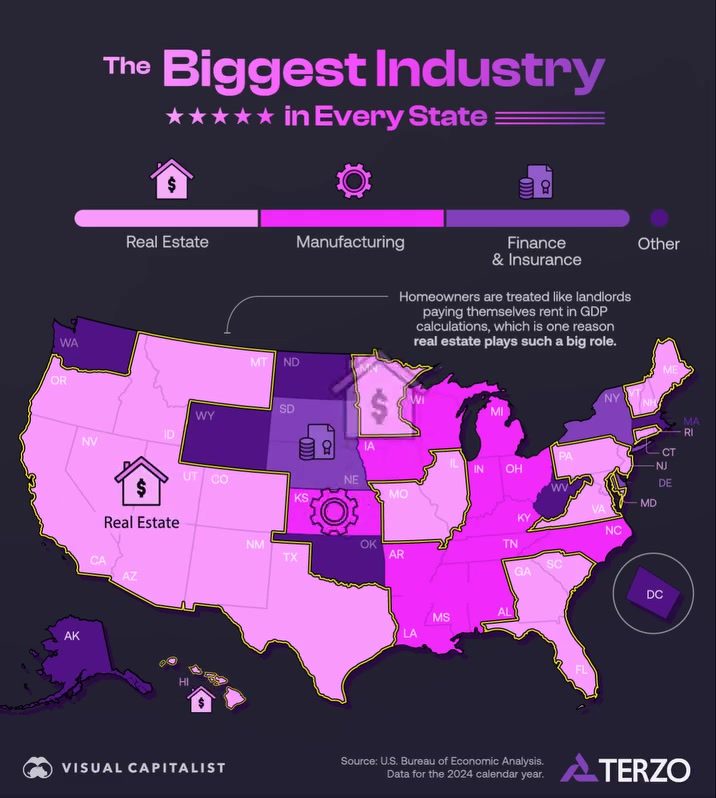
US Industry Dominance by State
The economic landscape of the United States is diverse, with different industries dominating the GDP in various states. While real estate is the top industry in 26 states, other sectors play significant roles in the remaining states. Understanding these variations provides valuable insights into the economic strengths and opportunities across the country.
Why This Matters
Knowing which industries are the biggest in each state can help businesses, investors, and policymakers make informed decisions. It highlights economic trends, identifies growth potential, and reveals the unique strengths of different regions.
Main Discussion
Real Estate: The Dominant Industry
Real estate stands out as the largest contributor to GDP in 26 out of the 50 U.S. states. This dominance can be attributed to several factors. One key aspect is how homeowners are treated in GDP calculations. In economic terms, homeowners are treated as if they are landlords paying themselves rent. This methodology significantly boosts the real estate sector's contribution to GDP. As a result, states with a high number of homeowners tend to show real estate as a dominant industry.
Manufacturing: A Key Player
Manufacturing is the largest industry in several states, particularly in the Midwest and Northeast. These regions have a long history of industrial production, with established manufacturing hubs. The presence of key industries like automotive, aerospace, and machinery manufacturing further solidifies their economic strength.
Finance and Insurance: Economic Powerhouses
States like New York and Connecticut are known for their robust finance and insurance sectors. These industries play a crucial role in the national economy, contributing billions of dollars to GDP. They also provide a significant number of high-paying jobs, making them vital economic drivers.
Other Notable Industries
While real estate, manufacturing, and finance and insurance lead in many states, other sectors also make substantial contributions. For instance, agriculture is a significant industry in many Midwestern and Southern states. Similarly, technology and healthcare are growing sectors in various states, reflecting the nation's evolving economic landscape.
Practical Tips
Investing in Real Estate
For those considering real estate investments, focusing on states where the industry is already dominant can be a strategic move. These states offer a strong market for both residential and commercial properties. Conduct thorough research to identify emerging areas and trends within these states.
Business Expansion
When looking to expand a manufacturing business, states with a strong manufacturing base can provide a supportive environment. These regions often have established supply chains, a skilled workforce, and favorable regulatory conditions. Consider state-specific incentives and tax benefits for manufacturers.
Diversifying Investments
Investing in a variety of industries and regions can help mitigate risk and maximize returns. Explore states where different sectors, such as finance, insurance, or technology, are thriving. Diversification can offer a more balanced investment portfolio, especially in the face of economic fluctuations.
Utilizing Data for Decision Making
Access and analyze data from sources like the U.S. Bureau of Economic Analysis to make informed decisions. Understanding the economic trends and strengths of different industries and regions can guide investment, business expansion, and policy-making.
Important Takeaways
Economic Variety
The variety in dominant industries across states highlights the diverse economic landscape of the U.S. Each state has its strengths and opportunities, making the nation a dynamic economic powerhouse.
Data-Driven Insights
Data from reliable sources, such as the U.S. Bureau of Economic Analysis, is essential for making informed decisions. It provides a comprehensive view of economic trends and industry contributions.
Strategic Decision Making
By understanding the dominant industries in different states, businesses, investors, and policymakers can make strategic decisions. This knowledge can lead to better investment opportunities, business growth, and economic policy formulation.
Conclusion
The economic landscape of the United States is rich and varied, with each state contributing uniquely to the nation's GDP. Real estate, manufacturing, and finance and insurance are among the most dominant industries, but many other sectors play crucial roles. By understanding these dynamics, individuals and organizations can navigate the economic landscape more effectively, leveraging opportunities and contributing to the country's growth.
Watch the Reel
Questions readers ask
Which industry leads in the majority of US states?
Real estate is the leading industry in 26 out of 50 states, making it the most dominant sector across the country. This highlights the significant role of property development, sales, and management in many state economies.
What are the key industries that dominate in the states where real estate is not the leading sector?
In the states where real estate is not the top industry, sectors like manufacturing, finance, and insurance play significant roles. These industries contribute substantially to the GDP and economic landscape of their respective regions.
Why is it important to understand the biggest industry in each state?
Knowing the biggest industry in each state helps businesses, investors, and policymakers make informed decisions. It provides insights into economic trends, growth potential, and the unique strengths of different regions. This information can guide strategic planning and resource allocation.
Which states are particularly notable for their manufacturing industry?
States like Michigan, Indiana, and Ohio are known for their strong manufacturing sectors. These states have a long history of industrial production and continue to be significant contributors to the manufacturing industry in the US.
How does the finance industry compare across different states?
The finance industry is a major contributor in states like New York and California. These states are home to major financial hubs and have a substantial influence on the national and global financial markets. Understanding these regional differences can help in identifying investment opportunities and economic trends.
Which states have a strong presence in the insurance industry?
States such as Connecticut and Pennsylvania are notable for their insurance industries. These states host many major insurance companies and have a significant impact on the national insurance market. The insurance sector contributes significantly to the GDP and job market in these regions.
What are some of the benefits of knowing the regional industry differences across the US?
Understanding regional industry differences allows for tailored business strategies, targeted investments, and effective policy-making. It helps identify emerging markets, assess competition, and leverage the unique advantages of each state. This knowledge is crucial for fostering economic growth and development.
Recent articles
Fresh deep dives from the latest Reels we unpacked.




Comments
Be the first to comment.