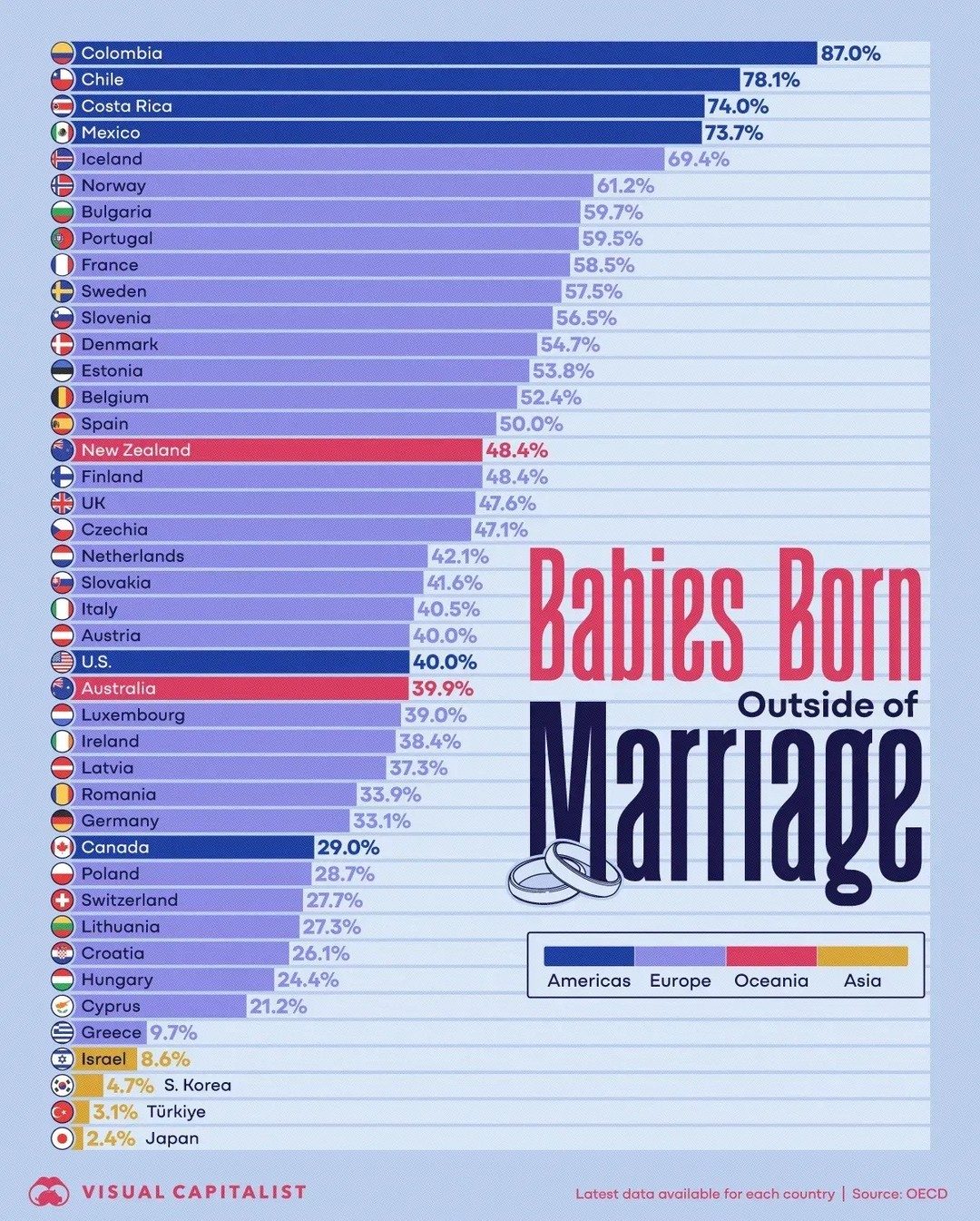
Babies born outside of marriage have become a significant demographic trend, with notable variations across different regions of the world. Let's explore the prevalence of this trend globally and what it means for families and societies.
Context: Why this matters
Understanding the global trends in births outside of marriage is crucial for several reasons. It provides insights into societal attitudes towards marriage and family structures. It also has implications for policies related to family support, child welfare, and social benefits. By examining data from the OECD Family Database, we can gain a clearer picture of how different regions are approaching these issues.
The infographic from Visual Capitalist highlights the stark differences in the prevalence of births outside of marriage across various continents. This data underscores the importance of considering cultural, economic, and social factors when analyzing family demographics.
Main discussion
Americas
The Americas, particularly Latin America, show some of the highest rates of births outside of marriage. In several countries, more than 70% of children are born to unmarried parents. This trend can be attributed to a variety of factors, including changing social norms, economic conditions, and shifts in family dynamics.
While the rate of births outside of marriage is high in Latin America, it is not uniform across the region. Countries like Brazil and Guatemala have higher rates compared to others. This variation suggests that local cultural and economic factors play a significant role in shaping family structures.
Europe
Nordic and Western European countries also report relatively high shares of births outside of marriage. Countries like Sweden, Denmark, and France have seen a steady increase in this trend over the past few decades. In these regions, the rise in births outside of marriage is often correlated with a more liberal approach to family structures and a broader acceptance of non-traditional families.
The high rates in these countries can also be linked to robust social welfare systems that provide support to all families, regardless of marital status. This support can include financial assistance, healthcare, and educational benefits, which help to mitigate some of the challenges associated with single parenthood.
Oceania
Oceania, particularly Australia and New Zealand, shows a moderately high rate of births outside of marriage. These countries have seen a gradual increase in this trend, reflecting broader societal changes and a shift towards more flexible family structures. Similar to Europe, the availability of social support and benefits for families can influence this trend.
Asia
Parts of East Asia continue to show very low rates of births outside of marriage. Countries like Japan, South Korea, and China have traditionally placed a strong emphasis on marriage and family stability. This cultural preference is reflected in the relatively low percentages of births outside of marriage in these regions.
However, it's important to note that even in these countries, attitudes and practices are evolving. Economic pressures, urbanization, and changes in educational and career paths are leading to shifts in family dynamics. These changes may contribute to a future increase in births outside of marriage in East Asia.
Global Trends
Globally, the trend of births outside of marriage is influenced by a complex interplay of cultural, economic, and social factors. In regions where social welfare systems are robust, families may feel more secure in choosing non-traditional family structures. Conversely, in areas with less support, the stigma or practical challenges of raising a child outside of marriage may be more pronounced.
Practical tips
For policymakers and social support organizations, understanding these trends can inform the development of effective programs and services. Here are some practical tips:
Support Systems
Developing comprehensive support systems for all families, regardless of marital status, can help to ensure the well-being of children. This can include financial assistance, healthcare, and educational support.
Policy Alignment
Aligning policies with the diverse needs of families can help to reduce stigma and promote inclusivity. This includes recognizing and supporting non-traditional family structures in legal and social frameworks.
Community Engagement
Engaging with communities to understand their unique needs and challenges can help to create tailored support programs. This can involve partnerships with local organizations, community leaders, and families themselves.
Data Collection
Continuous data collection and analysis can provide valuable insights into evolving family dynamics. This data can inform policy decisions, program development, and resource allocation.
Important takeaways
Cultural Variation
The prevalence of births outside of marriage varies significantly across different regions. This highlights the importance of considering local cultural, economic, and social factors.
Social Support
The availability of social support and benefits can influence family structures and the well-being of children. Robust support systems can help to mitigate the challenges associated with single parenthood.
Policy and Practice
Understanding these trends can inform the development of effective policies and support programs. By aligning policies with the diverse needs of families, we can promote inclusivity and ensure the well-being of all children.
Continued Evolution
Family dynamics are evolving, and it's crucial to stay informed about these changes. Continuous data collection and analysis can provide valuable insights and help to create tailored support programs.
Conclusion
The global trend of births outside of marriage offers a nuanced perspective on family structures and societal attitudes. By examining data from the OECD Family Database and considering the unique contexts of different regions, we can gain a deeper understanding of these trends and their implications. This knowledge can inform policies and support programs, ensuring the well-being of all families and their children. As societies continue to evolve, it's essential to remain adaptable and responsive to the changing needs of families, fostering inclusivity and support for all.
Watch the Reel
Questions readers ask
What are the global trends in babies born out of wedlock?
Globally, the number of babies born out of wedlock has been increasing. This trend varies significantly by region, with some areas seeing much higher rates than others. For instance, Europe and Latin America have higher percentages of non-marital births, while Asia and Africa generally have lower rates.
Why are non-marital births statistics important for family policy?
Non-marital births statistics are important for family policy as they influence decisions on resources allocation and support systems. Governments can use this data to better understand the needs of families and to tailor support systems to ensure the welfare of children born outside of marriage and their families.
What are the birth trends in Asia for babies born outside of marriage?
In Asia, the trend of babies born outside of marriage is generally lower compared to other regions. However, there are variations within Asia. Countries like Japan and South Korea have seen a gradual increase in non-marital births, but the overall rates remain relatively low compared to Europe and Latin America.
How do non-marital births in Europe compare to other regions?
Europe has one of the highest rates of non-marital births globally. Countries such as Sweden, France, and Iceland often lead the world in this statistic. This trend reflects broader societal attitudes and policies that support various family structures.
What are the trends in Oceania for babies born outside of marriage?
In Oceania, particularly in countries like Australia and New Zealand, the rate of babies born outside of marriage is relatively high and has been increasing. This trend mirrors the broader societal shifts towards more diverse family structures and changing attitudes towards marriage.
How do family structures trends in Latin America relate to non-marital births?
Latin America has seen a significant rise in non-marital births, reflecting changes in family structures. Many countries in the region have high percentages of children born to unmarried parents, which influences social policies and support systems for families.
What insights can be gained from global family policy data on non-marital births?
Global family policy data on non-marital births provides valuable insights into societal norms and public policy approaches. By analyzing this data, policymakers can identify effective strategies for supporting families and children, regardless of marital status. This information can also highlight disparities between regions and inform international comparisons.
Recent articles
Fresh deep dives from the latest Reels we unpacked.




Comments
Be the first to comment.