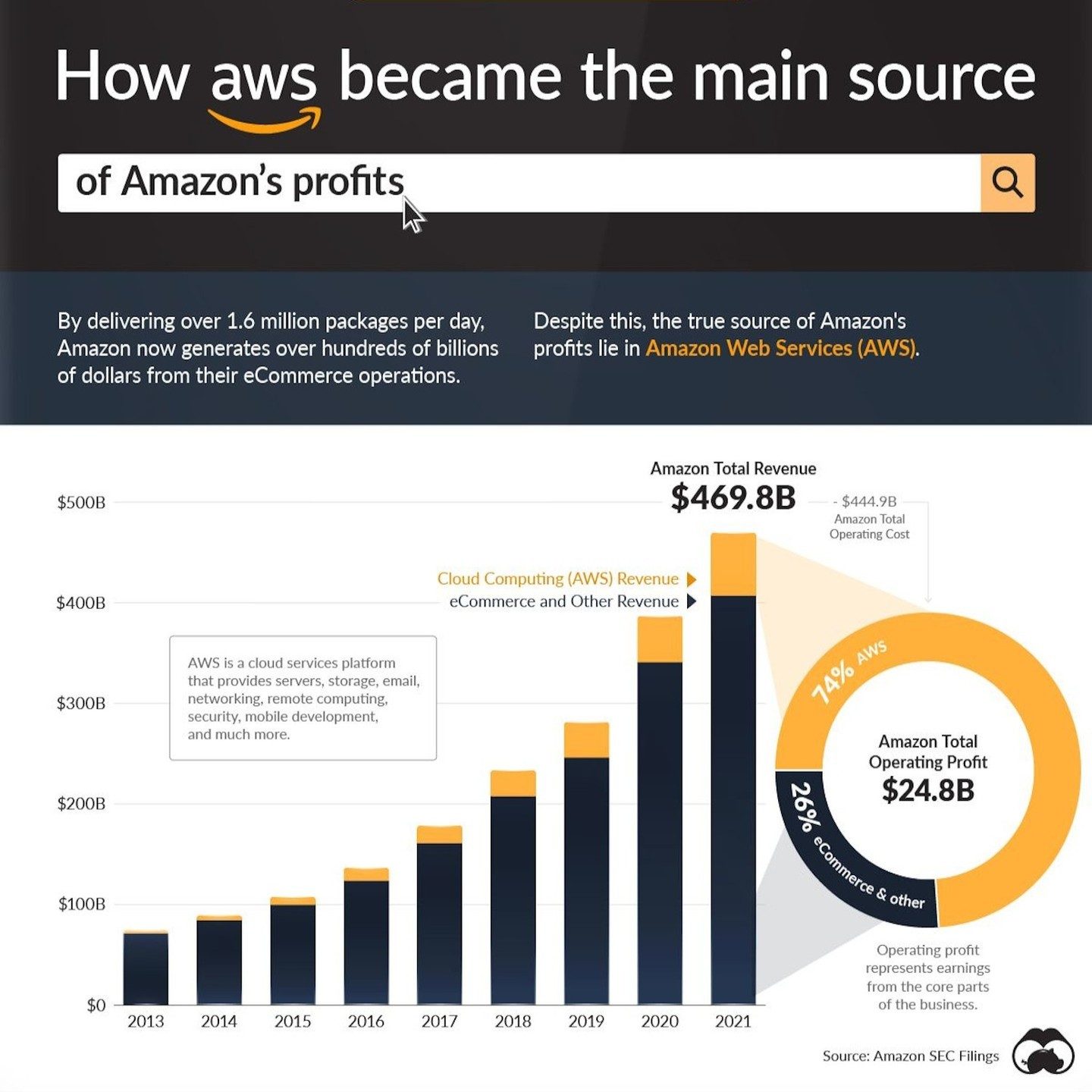
Amazon's growth has been nothing short of extraordinary, with consistent revenue increases every year since its inception. In 2004, Amazon generated a modest $6.9 billion in revenue, a figure that ballooned to a staggering $469.8 billion by 2021. The lion's share of these sales comes from Amazon's retail and e-commerce operations, the sectors for which the company is most renowned. However, the story of Amazon’s profitability is quite different.
Why this matters
Amazon Web Services (AWS) plays a crucial role in Amazon's financial landscape. Understanding the significance of AWS is essential for grasping the overall health and future directions of the company. AWS has transitioned from a supplementary service to the main source of Amazon’s profits, accounting for 74% of the company’s operating profit. This shift has significant implications for the tech industry as a whole, highlighting the growing importance of cloud services in modern business.
The rise of AWS
Amazon's journey into the cloud services industry began with the launch of AWS in 2006. Initially conceived as a way to utilize Amazon's existing infrastructure more efficiently, AWS quickly evolved into a standalone business. The platform offers a comprehensive suite of cloud services, including servers, storage, email, networking, mobile computing, and security solutions.
AWS and Amazon's total revenue
The significance of AWS is evident in its contribution to Amazon's total revenue. While e-commerce and other retail operations contribute to the majority of Amazon's sales, AWS has become the backbone of the company’s profitability. In 2021, Amazon’s total revenue was $469.8 billion, with AWS playing a pivotal role in achieving this milestone.
The shift in profitability
One of the most striking aspects of Amazon’s financial performance is the disparity between its top-line revenue and its bottom-line profitability. Despite the massive revenue generated by e-commerce and retail operations, these segments do not contribute significantly to the company’s operating profit. In contrast, AWS generates 74% of Amazon’s operating profit.
AWS achieved this remarkable feat by providing a wide range of high-demand services, such as computing power, data storage, and machine learning capabilities. These services are essential for businesses of all sizes, from startups to Fortune 500 companies, driving a consistent demand for AWS offerings.
The impact of AWS on Amazon's growth
AWS has fundamentally altered Amazon’s business model, transforming it from a traditional retailer into a technology powerhouse. By leveraging AWS, Amazon has diversified its revenue streams, reducing its reliance on e-commerce and retail operations.
The cloud services sector is highly competitive, with major players like Microsoft Azure and Google Cloud Platform vying for market share. However, AWS has maintained its dominance, thanks to its early start, continuous innovation, and extensive service portfolio.
Diversifying revenue streams
AWS allows Amazon to tap into new markets and industries, broadening its customer base. By offering a range of cloud services, Amazon can cater to diverse needs, from small businesses seeking basic web hosting to large enterprises requiring complex data analytics and machine learning solutions. This diversification not only strengthens Amazon's market position but also ensures long-term sustainability.
The future of AWS
Amazon's investment in AWS is a testament to the company’s commitment to the future of technology. With advancements in artificial intelligence, machine learning, and the Internet of Things (IoT), the demand for cloud services is set to grow exponentially. AWS is well-positioned to capitalize on these trends, continuing to drive Amazon’s growth and profitability.
Practical tips
For businesses looking to leverage cloud services, AWS offers a range of solutions that can enhance operational efficiency and drive growth. Here are some practical tips to make the most out of AWS:
Assess your needs
Before diving into AWS, it’s crucial to assess your business needs and determine which services will provide the most value. AWS offers a wide range of services, from basic computing power to advanced machine learning capabilities. Understanding your requirements will help you select the right tools and services.
Start small
AWS allows you to start with basic services and scale up as your business grows. This approach not only helps manage costs but also ensures a smoother transition to cloud-based operations. You can gradually integrate more advanced services as you become more comfortable with the platform.
Leverage AWS support
AWS provides extensive documentation, tutorials, and support resources to help businesses get started. Taking advantage of these resources can accelerate your learning curve and ensure that you make the most out of AWS’s offerings.
Monitor and optimize
Regularly monitor your AWS usage and optimize your resources to avoid unnecessary costs. AWS offers tools like AWS Cost Explorer and AWS Trusted Advisor to help you track your spending and identify areas for improvement.
Important takeaways
The rise of AWS has fundamentally altered Amazon’s business model, transforming it from a traditional retailer into a technology powerhouse. The cloud services sector is highly competitive, but AWS has maintained its dominance, thanks to its early start, continuous innovation, and extensive service portfolio.
The shift in profitability highlights the growing importance of cloud services in modern business. For businesses looking to leverage cloud services, AWS offers a range of solutions that can enhance operational efficiency and drive growth. By assessing your needs, starting small, leveraging support, and regularly optimizing, you can make the most out of AWS’s offerings.
Conclusion
Amazon's remarkable growth story is a testament to the company’s innovative spirit and strategic vision. AWS has played a pivotal role in this journey, transforming Amazon into a leading technology provider. As the demand for cloud services continues to grow, AWS is well-positioned to drive Amazon’s future success. By understanding the significance of AWS and leveraging its offerings, businesses can enhance their operational efficiency and achieve sustainable growth.
Watch the Reel
Questions readers ask
What is AWS and why is it important to Amazon's overall success?
Amazon Web Services (AWS) is a comprehensive cloud computing platform offered by Amazon. It is crucial to Amazon's success because it generates a significant portion of the company's operating profit, making it the primary driver of Amazon's financial performance.
How has AWS contributed to Amazon's revenue growth?
AWS has been a key player in Amazon's revenue growth, particularly in recent years. In 2021, AWS contributed to a significant portion of Amazon's overall revenue, showcasing its role in driving the company's financial success.
How does AWS compare to Amazon's e-commerce operations in terms of profitability?
While Amazon's e-commerce operations generate the majority of the company's revenue, AWS accounts for 74% of Amazon's operating profit, making it the more profitable division.
What were the 2021 earnings for AWS?
AWS's 2021 earnings were substantial, contributing to a considerable portion of Amazon's total revenue. The exact figures can vary, but AWS has consistently shown strong financial performance, making it a billion-dollar revenue generator for Amazon.
How has AWS evolved from a supplementary service to a profit powerhouse?
AWS began as a supplementary service but has grown into a profit powerhouse for Amazon. Its growth has been driven by the increasing demand for cloud computing services, making it a cornerstone of Amazon's financial strategy.
What does the future hold for AWS and its contribution to Amazon's overall financial performance?
AWS is poised to continue its growth and remain a critical component of Amazon's financial performance. As the demand for cloud services increases, AWS is expected to contribute significantly to Amazon's future earnings.
Related deep dives
Similar reads based on topic and creator.


Recent articles
Fresh deep dives from the latest Reels we unpacked.




Comments
Be the first to comment.