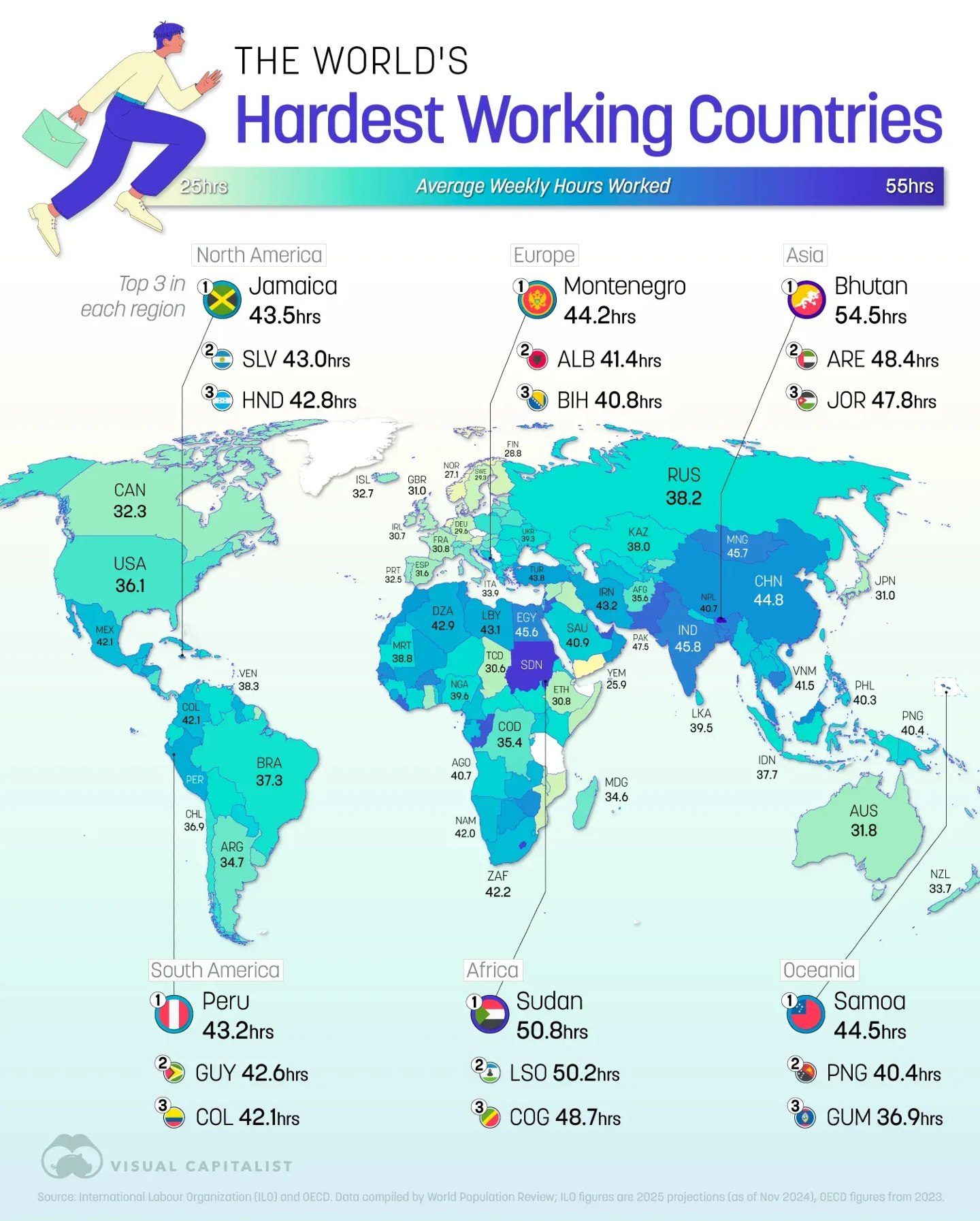
Weekly Working Hours by Country
Weekly working hours vary widely by country, with significant differences between regions and economies. In 2025, Bhutan tops the list of countries with the longest workweeks, averaging over 54 hours per week. This pattern is consistent across many Asian, Gulf, and African nations, which record much longer workweeks compared to their European and North American counterparts.
Why This Matters
Understanding the variance in work hours globally can provide insights into cultural norms, economic conditions, and labor regulations. For instance, developed European countries tend to have shorter workweeks, which is often linked to better work-life balance and productivity. Conversely, countries with longer workweeks may reflect different economic, social, and cultural factors.
The Global Landscape of Weekly Working Hours
Regional Trends
Asia
Asia exhibits a wide range of work hours. Bhutan leads with 54.5 hours per week, closely followed by the United Arab Emirates at 48.4 hours and China at 47.8 hours. This highlights the region's diverse economic and labor dynamics. The high work hours in these countries can be attributed to various factors, including economic pressures and cultural expectations.
Europe
In contrast, Europe generally has shorter workweeks. Countries like Russia and Albania work around 38.2 and 41.4 hours per week, respectively. Among European countries, Montenegro stands out with 54.5 hours per week, which is notably higher than the rest of the continent. These figures suggest a more balanced approach to work-life integration, albeit with some regional exceptions.
North America
North America displays a moderate range of work hours. Canada works around 43.5 hours per week, the United States around 42.1 hours, and Mexico around 36.9 hours. This variation can be influenced by labor laws, economic conditions, and industry-specific demands. The region’s mix of developed and developing economies contributes to this range.
Africa
Africa shows a high average of work hours, with countries like Sudan, Somaliland, and Lesotho working 50.8, 48.7, and 50.2 hours per week, respectively. These high numbers may reflect economic challenges and the need for multiple income sources in many households. The trend indicates a significant portion of the population working extended hours to meet basic needs.
South America
South America shows a moderate range of work hours, with Peru, Colombia, and Guyana working around 43.2, 42.1, and 42.0 hours, respectively. The region's work hours are influenced by a mix of economic and cultural factors, including labor regulations and cultural norms around work and family life. This reflects a balanced approach to labor, though variations exist.
Oceania
Oceania’s work hours vary, with Samoa working around 44.5 hours, Papua New Guinea around 40.4 hours, and Guam around 36.9 hours. The region’s diverse economies and cultural practices contribute to this range, with some countries leaning towards shorter workweeks.
Key Countries and Their Work Hours
Bhutan
Bhutan stands out for its exceptionally long workweek, averaging 54.5 hours. This reflects the country's unique economic and social context, where labor-intensive sectors may require extended hours. Bhutan's high work hours are consistent with other Asian countries that prioritize economic productivity.
Montenegro
Montenegro is another country with an exceptionally long workweek, averaging 54.5 hours. This is somewhat unusual within Europe, which generally has shorter workweeks. The high work hours in Montenegro may be due to economic pressures and labor market conditions. The country's unique position in the Balkans contributes to its distinct labor practices.
Sudan
Sudan has one of the highest average work hours globally, averaging 50.8 hours per week. This reflects the economic challenges and the need for multiple income sources in many households. Sudan's high work hours are typical of many African countries, where economic hardships drive long working hours.
Practical Tips for Managing Work Hours
Understanding global work hour trends can provide practical insights for managing work hours effectively. Here are some tips:
Set Clear Boundaries
Establishing clear boundaries between work and personal time can help manage work hours more effectively. This is particularly important in countries with longer workweeks, where the line between work and personal life can blur.
Prioritize Tasks
Prioritizing tasks based on importance and urgency can help manage work hours more efficiently. This approach ensures that the most critical tasks are completed first, reducing stress and improving productivity.
Use Technology
Technology can be a powerful tool for managing work hours. Time-tracking apps, project management software, and communication tools can help streamline work processes and improve time management.
Take Regular Breaks
Taking regular breaks throughout the workday can enhance productivity and reduce stress. This practice is especially beneficial in countries with longer workweeks, where the risk of burnout is higher.
Maintain Work-Life Balance
Maintaining a healthy work-life balance is crucial for overall well-being. This involves setting aside time for personal activities, hobbies, and family, which can help recharge and improve productivity during work hours.
Important Takeaways
Work Hours Reflect Economic and Cultural Factors
The variance in work hours globally reflects a mix of economic, cultural, and social factors. Countries with longer workweeks often face economic pressures or cultural norms that prioritize work. Conversely, countries with shorter workweeks may have labor laws and cultural norms that emphasize work-life balance.
Regional Differences
There are significant regional differences in work hours. Asia, Africa, and some Gulf countries tend to have longer workweeks, while Europe and North America generally have shorter workweeks. These differences highlight the diverse labor practices and economic conditions across regions.
The Impact of Work Hours on Well-being
Long work hours can have a significant impact on an individual's well-being. High work hours are often associated with increased stress, burnout, and reduced productivity. Conversely, shorter workweeks can lead to better work-life balance, improved productivity, and enhanced well-being.
Conclusion
The global landscape of weekly working hours is diverse and influenced by a range of economic, cultural, and social factors. Understanding these trends can provide valuable insights for individuals, businesses, and policymakers. Whether it's managing work hours effectively or advocating for better labor policies, recognizing the nuances of global work hours is crucial for a balanced and productive workforce.
Watch the Reel
Questions readers ask
Which country has the longest average weekly work hours in 2025?
Bhutan has the highest average weekly work hours in 2025, with workers putting in over 54 hours per week. This makes it one of the countries with the longest workweeks globally, particularly notable in comparison to other regions.
How do average weekly work hours in Asia compare to those in Europe and North America in 2025?
In 2025, Asian countries generally have longer average weekly work hours compared to Europe and North America. While Asian nations often exceed 45 hours per week, European and North American countries typically fall below this threshold, with averages closer to 37-40 hours.
What are the average weekly work hours in Gulf and African nations in 2025?
Gulf and African nations tend to have higher average weekly work hours, similar to many Asian countries. In 2025, these regions often see workers putting in more than 45 hours per week, reflecting the broader trend of longer workweeks in these areas.
Why do European countries generally have shorter workweeks?
European countries often have shorter workweeks due to cultural preferences, labor regulations, and a focus on work-life balance. These factors contribute to an average workweek closer to 37-40 hours, which is generally lower than in many other regions.
How do work hours in 2025 vary between different regions worldwide?
Work hours in 2025 vary significantly by region, with Asian, Gulf, and African countries generally logging more hours. European and North American nations, on the other hand, tend to have shorter workweeks, often influenced by cultural norms, economic conditions, and regulatory environments.
What insights can be gained from comparing weekly work hours across countries in 2025?
Comparing weekly work hours across countries in 2025 provides valuable insights into cultural norms, economic conditions, and labor regulations. For example, countries with shorter workweeks may prioritize work-life balance, while those with longer hours might reflect different economic or social priorities.
Recent articles
Fresh deep dives from the latest Reels we unpacked.




Comments
Be the first to comment.