Global Economic Outlook: GDP Projections for Key Economies
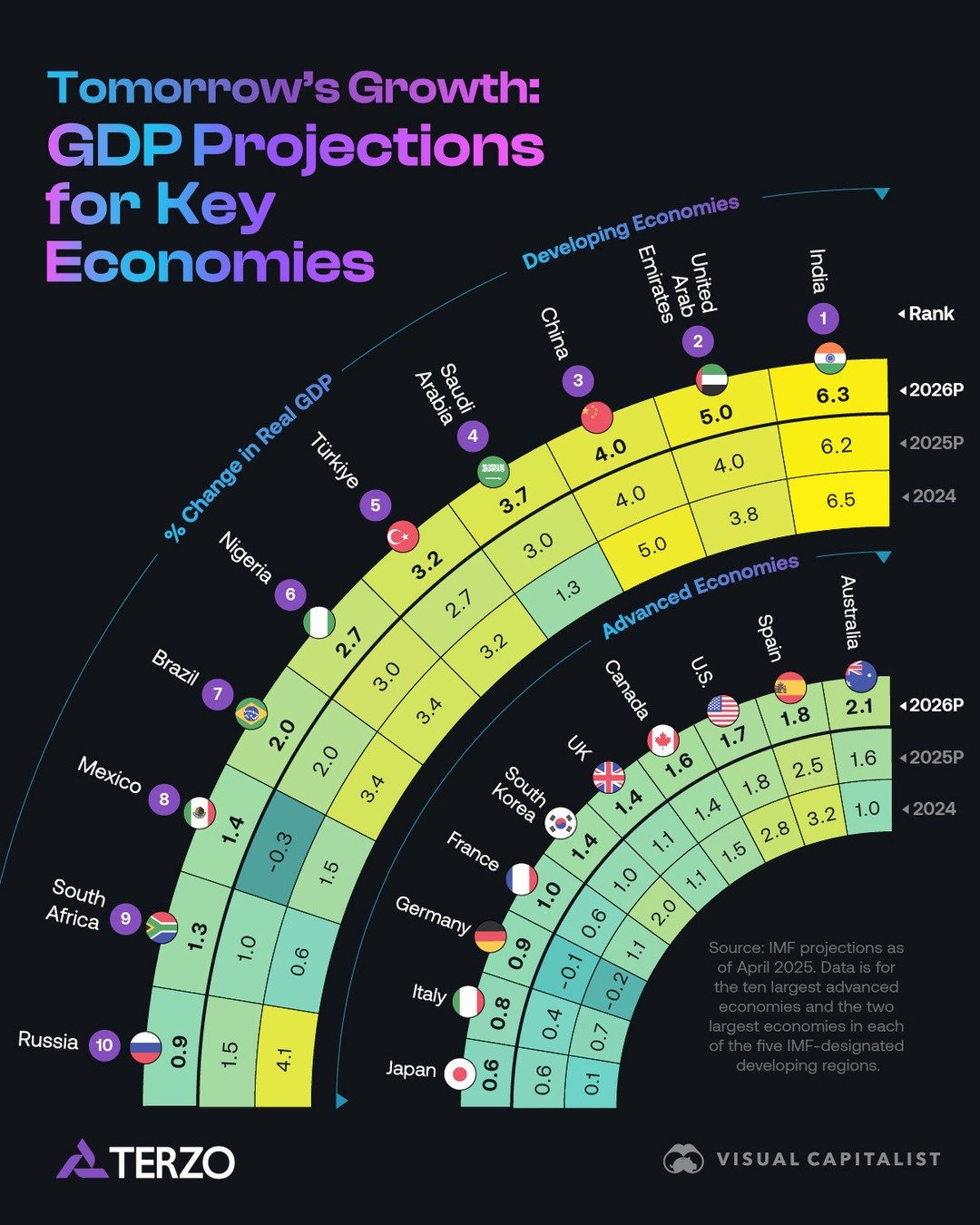
The International Monetary Fund (IMF) forecasts that Australia will lead major advanced economies with a 2.1% GDP growth in 2026. This projection highlights Australia's potential to outperform other developed nations in the near future. To understand the broader global economic landscape, let's delve into the projected changes in real GDP for both advanced and developing economies.
Why This Matters
GDP projections offer valuable insights into the economic health and growth potential of countries. These forecasts help businesses, investors, and policymakers make informed decisions about where to allocate resources, invest capital, and implement policies. Understanding the projected growth rates of key economies can provide a clearer picture of the global economic trends shaping our future.
Main Discussion
Advanced Economies
Advanced economies, characterized by high levels of industrialization and technological development, typically experience stable but moderate growth. The IMF's projections for 2026 reveal a mix of growth rates among these economies. Notably, Australia is expected to lead with a 2.1% GDP growth, slightly ahead of other major advanced economies.
- Australia: Projected to grow by 2.1%, Australia is expected to outpace other advanced economies. This growth is driven by a strong services sector, robust infrastructure investments, and a resilient housing market.
- U.S.: The United States, the world's largest economy, is projected to grow by 1.9%. This growth is supported by a diverse economy and ongoing technological advancements.
- Germany: Germany, Europe's largest economy, is expected to grow by 1.4%. The country's manufacturing sector and export-oriented economy are key drivers of this growth.
- Japan: Japan, another major advanced economy, is projected to grow by 1.2%. The country's focus on innovation and technological development is expected to sustain this growth.
- France, Spain, UK, and Italy: These European economies are expected to experience moderate growth, ranging from 1.1% to 1.5%. Factors such as fiscal policies, labor market reforms, and economic reforms are crucial for their GDP performance.
Developing Economies
Developing economies, often characterized by rapid industrialization and urbanization, tend to have higher growth rates. The IMF's projections indicate significant growth potential in various regions.
- India: India is projected to have the highest growth rate among developing economies, with a 6.3% increase in real GDP. This growth is driven by a large and growing workforce, increasing consumer demand, and a burgeoning services sector.
- China: China, the world's second-largest economy, is expected to grow by 3.7%. The country's continued investment in infrastructure, technology, and manufacturing is expected to drive this growth.
- Saudi Arabia: Saudi Arabia is projected to experience a 4.0% change in real GDP. This growth is supported by ongoing economic diversification efforts, particularly in the non-oil sectors.
- Nigeria, Brazil, and Mexico: These economies are projected to grow by 3.5%, 2.6%, and 2.3% respectively. Factors such as commodity prices, economic reforms, and domestic demand will play a significant role in their growth prospects.
- South Korea, Russia, and Turkey: South Korea and Turkey are expected to grow by 2.1% and 2.6% respectively. Russia is projected to experience a 2.0% change.
- United Arab Emirates: The UAE is projected to grow by 3.0%. The country's strategic investments in technology, tourism, and infrastructure are expected to drive this growth.
- Arab Region: The broader Arab region is expected to see varied growth rates, with a significant portion of the GDP growth coming from countries like Saudi Arabia and the UAE.
Practical Tips for Understanding GDP Projections
Understanding GDP projections can be simplified by focusing on a few key factors that influence economic growth. Here are some practical tips for interpreting GDP projections:
- Economic Indicators: Look at key economic indicators such as inflation, unemployment rates, and consumer confidence. These indicators provide insights into the current and future economic health of a country.
- Policy Environment: Evaluate the policy environment in a country. Fiscal and monetary policies play a crucial role in economic growth. For example, countries with stable fiscal policies and low inflation rates are more likely to experience steady growth.
- Sectoral Performance: Analyze the performance of key sectors such as manufacturing, services, and agriculture. A diverse and robust economy is more resilient and likely to experience stable growth.
- Global Trends: Consider global economic trends that can impact a country's growth. Factors such as trade policies, commodity prices, and global economic stability can significantly influence a country's GDP.
- Infrastructure and Technology: Investments in infrastructure and technology are crucial for sustainable economic growth. Countries that prioritize these areas are more likely to experience higher growth rates.
Important Takeaways
- Australia is expected to lead major advanced economies with a 2.1% GDP growth in 2026, driven by a strong services sector and robust infrastructure investments.
- The U.S., Germany, and Japan are projected to grow by 1.9%, 1.4%, and 1.2% respectively, supported by diverse economies and ongoing technological advancements.
- Developing economies like India and China are expected to have higher growth rates, with India projecting a 6.3% increase in real GDP and China at 3.7%.
- Factors such as economic indicators, policy environment, sectoral performance, global trends, and investments in infrastructure and technology are crucial for understanding and predicting GDP growth.
Conclusion
Australia's projected GDP growth of 2.1% in 2026 highlights its potential to lead major advanced economies in the near future. Understanding the projected changes in real GDP for both advanced and developing economies provides valuable insights into the global economic trends shaping our future. By considering key factors such as economic indicators, policy environment, sectoral performance, global trends, and investments in infrastructure and technology, we can better navigate the complex landscape of global economic growth.
Watch the Reel
Questions readers ask
What is the projected GDP growth rate for Australia in 2026?
According to the IMF, Australia is expected to have a GDP growth rate of 2.1% in 2026, making it a strong performer among advanced economies.
How does Australia's projected GDP growth compare to other major economies in 2026?
Australia's projected 2.1% GDP growth rate in 2026 is anticipated to outpace other major advanced economies, including the United States and Germany, which are likely to have slower growth rates.
What are the potential implications of Australia's projected economic growth in 2026?
Australia's strong projected economic growth can influence investment decisions, policy-making, and resource allocation. Businesses and investors may be encouraged to allocate more capital to Australia, while policymakers may focus on maintaining favourable conditions to sustain growth.
Which organization provides the GDP growth forecast for 2026?
The International Monetary Fund (IMF) provides the economic growth forecast that Australia is projected to lead major advanced economies in 2026.
How can understanding global GDP projections benefit businesses and investors?
Global GDP projections help businesses and investors understand the economic health and growth potential of different countries. This information assists in making informed decisions about investments, market expansion, and risk management.
What factors might influence Australia's GDP growth in 2026?
Factors that might influence Australia's GDP growth in 2026 include global economic conditions, domestic policy decisions, commodity prices, and developments in key trading partners. These elements can collectively impact Australia's economic performance and growth trajectory.
Related deep dives
Similar reads based on topic and creator.


Recent articles
Fresh deep dives from the latest Reels we unpacked.




Comments
Be the first to comment.