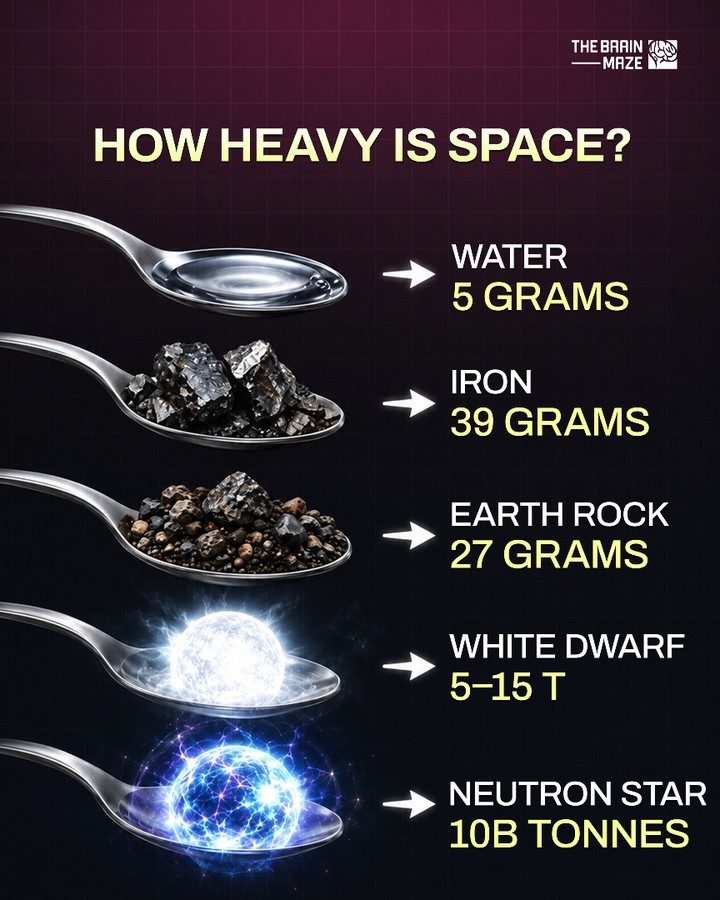
THE WEIGHT OF SPACE: FROM WATER TO NEUTRON STARS
A teaspoon may seem insignificant, but when it comes to the weight of celestial objects, density plays a pivotal role. Understanding the weight of different materials in space, from water to neutron stars, can be both fascinating and enlightening.
Context / Why This Matters
In the vast expanse of space, objects can differ dramatically in weight due to their composition and density. A teaspoon of water on Earth weighs a mere 5 grams, while a teaspoon of iron weighs 39 grams. Even ordinary Earth rocks, weighing around 27 grams per teaspoon, are heavier than water but lighter than iron. This comparison highlights the role of density in determining weight. Understanding these differences is essential for studies in astrophysics, planetary science, and even for designing spacecraft that can withstand the extreme conditions in space.
Main discussion
The Weight of Ordinary Materials
As mentioned, a teaspoon of water on Earth weighs about 5 grams. Iron, a denser material, weighs 39 grams for the same volume. Ordinary Earth rocks, which are less dense than iron, weigh around 27 grams. These weight differences are significant but manageable within Earth's environment. However, the story changes dramatically when we venture into the realm of compact stars.
White Dwarfs: The Intermediate Stage
White dwarfs are the stellar remnants of low- to medium-mass stars that have exhausted their nuclear fuel. These celestial bodies are incredibly dense. A teaspoon of white dwarf material can weigh between 5 and 15 tonnes. This extreme density is due to the gravitational collapse of the star, which compresses the matter into a much smaller volume.
The immense weight of white dwarf material is a result of the gravitational pressure that forces electrons to resist further compression, a phenomenon known as electron degeneracy pressure. This pressure supports the white dwarf against further gravitational collapse, making it one of the densest forms of matter in the universe.
Neutron Stars: The Ultimate Density
Neutron stars take the concept of density to an entirely new level. These are the remnants of massive stars that have undergone a supernova explosion. A teaspoon of neutron star matter can weigh an astounding 10 billion tonnes. This extreme density is achieved through the collapse of the star's core, where protons and electrons combine to form neutrons, supported by neutron degeneracy pressure.
The immense weight of neutron star matter is a result of the gravitational forces within the star, which are so strong that they compress the matter to densities far greater than those found in atomic nuclei. This makes neutron stars one of the most extreme environments in the universe, with gravitational fields so strong that they can warp spacetime itself.
Practical Tips
When studying the weight of celestial objects, it's essential to keep in mind the following tips:
- Understand Density: Density is a crucial factor in determining the weight of materials. Even small volumes of highly dense materials can weigh significantly more than larger volumes of less dense materials.
- Consider the Composition: The composition of a material plays a significant role in its weight. For example, iron is denser than water, which is why a teaspoon of iron weighs more than a teaspoon of water.
- Recognize the Context: The weight of materials can vary greatly depending on the context. For example, the weight of a teaspoon of water on Earth is significantly different from the weight of a teaspoon of neutron star matter in space.
- Use Visual Aids: Visual representations, such as spoons and corresponding weights, can help illustrate the vast differences in the weight of celestial objects.
- Research for Clarity: Always research and consult reliable sources when studying the weight of celestial objects to ensure accurate and up-to-date information.
Important Takeaways
- The Role of Density: Density is a crucial factor in determining the weight of materials, especially in extreme environments like space.
- Comparison of Materials: The weight of commonly known materials like water, iron, and rock is significantly different from the weight of celestial objects like white dwarfs and neutron stars.
- Extreme Environments: Compact stars, such as white dwarfs and neutron stars, are some of the most extreme environments in the universe, with densities and gravitational forces far beyond what we experience on Earth.
- The Importance of Context: Understanding the context in which different materials are found is essential for accurately assessing their weight and properties.
Conclusion
The weight of celestial objects, from water to neutron stars, is a fascinating and complex topic. While a teaspoon of water on Earth may seem insignificant, the weight of a teaspoon of neutron star matter is a staggering 10 billion tonnes. Understanding the differences in weight and density between these materials can provide valuable insights into the nature of the universe and the extreme environments found in space. Whether you're a space enthusiast, an aspiring scientist, or simply curious about the cosmos, delving into the weight of space is sure to captivate your imagination.
Watch the Reel
Questions readers ask
Why does a teaspoon of matter weigh differently in space compared to Earth?
The weight of a teaspoon of matter in space varies greatly due to the extreme densities of different celestial objects. For instance, a teaspoon of water weighs 5 grams, while a teaspoon of white dwarf matter can weigh up to 15 tonnes. This variation is crucial for understanding the behavior of materials in space and designing spacecraft that can withstand these extreme conditions.
What is the density of a neutron star and how does it affect weight?
Neutron stars are incredibly dense, with a density of approximately 10^17 kg/m³. This means that a teaspoon of neutron star matter would weigh around 10 million tonnes. Such extreme density significantly affects the weight of matter in space, making neutron stars some of the most massive objects in the universe despite their small size.
How does the density of white dwarf matter compare to other celestial objects?
White dwarf matter is extremely dense, with a density of around 10^9 kg/m³. This is significantly denser than other celestial objects, such as Earth rocks (about 2.7 g/cm³) and iron (7.87 g/cm³). As a result, materials like white dwarfs can have a teaspoon of matter weighing up to 15 tonnes, making them critical in understanding the variation in weight in space.
Why is understanding the weight of celestial objects important for spacecraft design?
Understanding the weight of celestial objects, which varies due to their extreme densities, is crucial for designing spacecraft. This knowledge helps in selecting appropriate materials and structures that can withstand the harsh conditions of space, ensuring the safety and functionality of spacecraft during missions.
How does the weight of a teaspoon of water in space compare to other materials?
A teaspoon of water in space weighs 5 grams, making it significantly lighter than a teaspoon of iron, which weighs 39 grams, and a teaspoon of Earth rocks (around 27 grams). However, it is much lighter than materials from celestial objects with extreme densities, such as white dwarfs and neutron stars, which can weigh up to 15 tonnes and 10 million tonnes, respectively.
What role does density play in determining the weight of materials in space?
Density is a key factor in determining the weight of materials in space. The higher the density, the more mass is packed into a given volume, resulting in a heavier weight. For example, a teaspoon of neutron star matter is much heavier than a teaspoon of water due to its significantly higher density, making density a crucial consideration in astrophysics and spacecraft design.
Related deep dives
Similar reads based on topic and creator.


Recent articles
Fresh deep dives from the latest Reels we unpacked.




Comments
Be the first to comment.