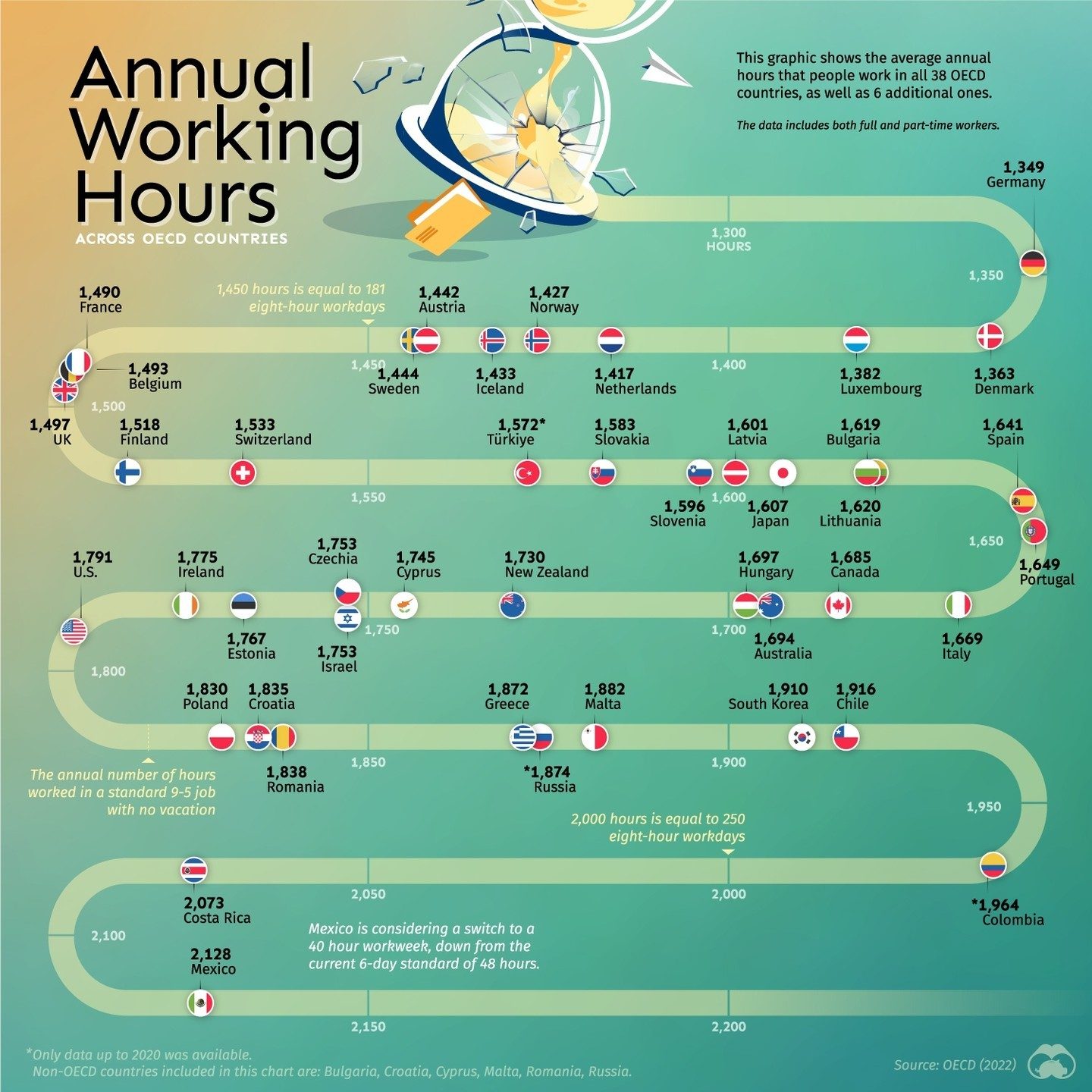
Annual Working Hours Across OECD Countries
Understanding the average annual working hours across different countries offers valuable insights into cultural work norms, economic productivity, and labor laws. This data, sourced from the Organisation for Economic Co-operation and Development (OECD), includes both full-time and part-time workers, providing a comprehensive view of work patterns in OECD countries and a few others. Let's dive into the details.
Context / Why This Matters
Work hours are a critical measure of a country's economic activity and labor market dynamics. They reflect societal norms, labor laws, and economic pressures. Whether you're an employee, employer, or policymaker, understanding these figures can inform decisions about work-life balance, productivity, and labor regulations.
Main Discussion
Top Countries with High Annual Working Hours
Several countries stand out for their high annual working hours. For instance, Mexico has one of the highest averages, with a 48-hour workweek.
Mexico's labor laws have traditionally favored a 6-day workweek, and although there is a recent push to switch to a 40-hour workweek, these changes are yet on the horizon.
Countries with Lowest Annual Working Hours
On the other end of the spectrum, some countries are known for their relatively low annual working hours. For example, France has a manageable average, often cited as a benchmark for work-life balance. France’s labor laws and cultural norms prioritize leisure time, which contributes to a lower average of annual working hours.
The United States
The United States has around 1,791 annual working hours. This places it in the mid-range among OECD countries. The U.S. work culture is often characterized by a strong emphasis on productivity and long working hours, particularly in industries like finance, technology, and healthcare.
Practical Tips
For Workers
-
Understand Your Rights: Knowing your country's labor laws can help you advocate for fair working hours and conditions.
-
Prioritize Work-Life Balance: Even in countries with high working hours, it's crucial to set boundaries to maintain your well-being.
-
Use Statistics to Negotiate: If you're in a position to negotiate your hours, data from the OECD can support your request for a healthier work schedule.
For Employers
-
Benchmark Best Practices: Look at countries with balanced work hours to model your own policies. This can improve employee satisfaction and productivity.
-
Encourage Efficiency: Instead of focusing on the number of hours worked, prioritize output and efficiency. This approach can lead to better results and happier employees.
-
Stay Compliant: Ensure your company adheres to local and international labor laws to avoid legal complications and maintain a positive reputation.
Important Takeaways
-
Cultural and Legal Factors: The average annual working hours are influenced significantly by cultural norms and legal frameworks.
-
Productivity vs. Hours Worked: Higher productivity doesn't always correlate with longer working hours. Countries with balanced work hours often have high productivity rates.
-
Global Trends: Understanding global trends can help policymakers and businesses make informed decisions about labor regulations and work practices.
Conclusion
Comparing the number of hours people work in different countries provides a multifaceted view of cultural, economic, and legal factors at play. Whether you're a worker seeking a better work-life balance, an employer aiming to optimize productivity, or a policymaker shaping labor laws, this data is invaluable. By examining the average annual hours worked in OECD countries, we gain insights that can influence decisions and practices, ultimately contributing to a more balanced and productive workforce globally.
Watch the Reel
Questions readers ask
What are the average annual working hours in OECD countries?
The average annual working hours in OECD countries vary significantly. For instance, Mexico has one of the highest averages, with workers putting in around 2,124 hours per year, while France has one of the lowest, with approximately 1,476 hours per year. These differences highlight the diverse approaches to work and leisure across these countries.
How are the average annual working hours calculated?
The average annual working hours are calculated by considering both full-time and part-time workers. This comprehensive approach, provided by the OECD, accounts for various work patterns and ensures a more accurate representation of work hours across different countries.
What factors contribute to the differences in working hours among OECD countries?
Several factors contribute to the differences in working hours, including cultural norms, economic pressures, and labor laws. For example, countries with stronger labor protections and cultural emphasis on leisure, like France, tend to have fewer annual working hours compared to countries with more demanding work environments, such as Mexico.
How do Germany's working hours compare to other OECD countries?
Germany's annual working hours typically fall in the mid-range compared to other OECD countries. As of recent data, Germans work around 1,384 hours per year, which is relatively balanced when compared to countries with either very high or very low annual working hours.
What insights can be gained from comparing work hours across different countries?
Comparing work hours across different countries offers valuable insights into societal norms, economic productivity, and labor market dynamics. This comparison can inform decisions about work-life balance, productivity, and labor policies, helping employees, employers, and policymakers make better choices based on global data.
Why is it important to consider both full-time and part-time workers when analyzing work hours?
Considering both full-time and part-time workers provides a more accurate and comprehensive view of work patterns in a country. This inclusive approach ensures that the data reflects the diverse nature of work arrangements and the overall labor market dynamics, rather than just focusing on a single segment of the workforce.
How can understanding OECD work hours data benefit employers?
Employers can benefit from understanding OECD work hours data by gaining insights into global work patterns and norms. This information can help in making informed decisions about hiring, scheduling, and creating policies that foster a balanced and productive work environment, ultimately contributing to better employee satisfaction and retention.
Recent articles
Fresh deep dives from the latest Reels we unpacked.




Comments
Be the first to comment.