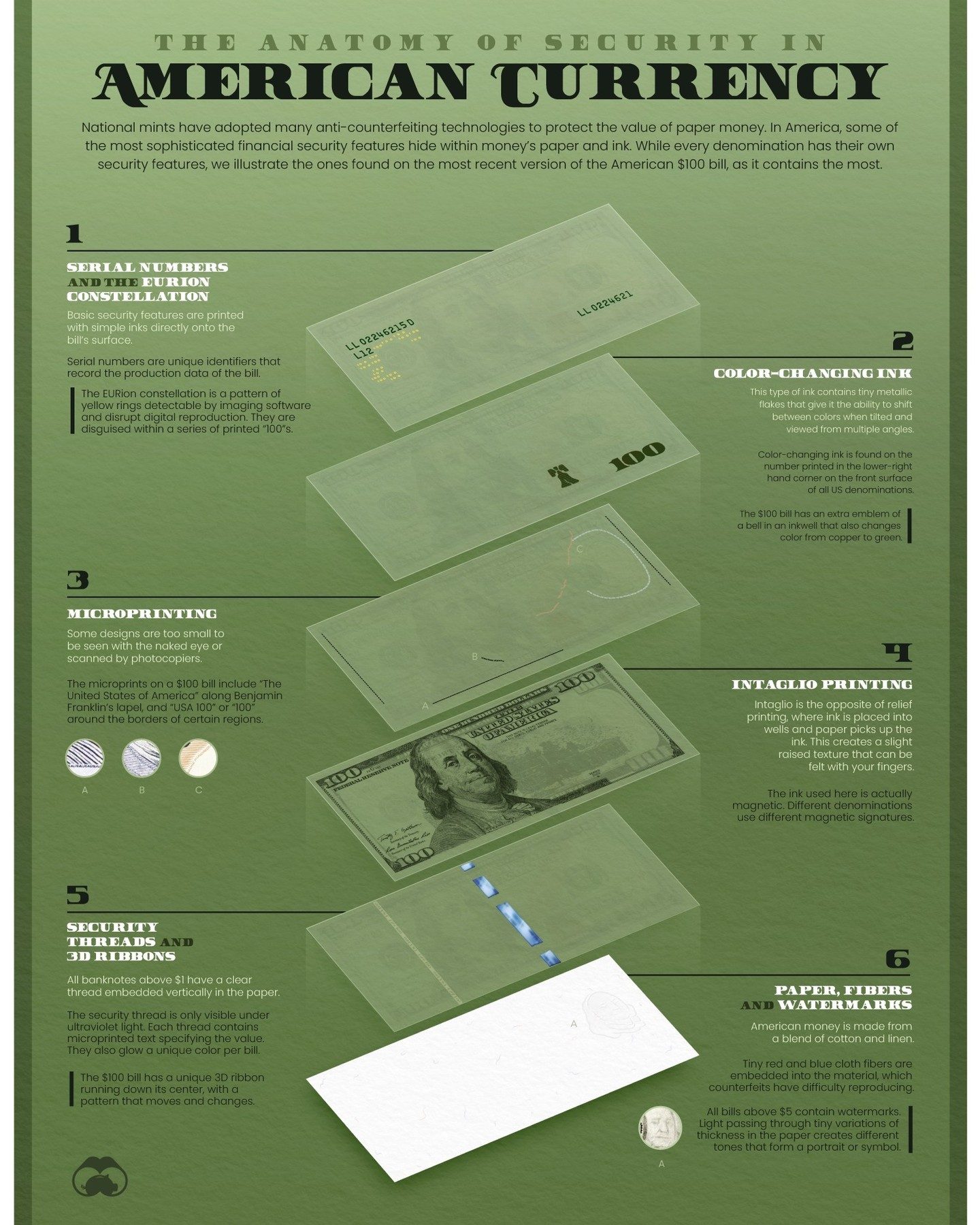
The $100 bill is one of the most secure forms of paper money, incorporating a variety of intricate security features designed to prevent counterfeiting. These features are meticulously integrated into the bill's paper and ink, making it a fascinating study in financial security.
Why This Matters
Understanding the security features of the $100 bill is crucial for anyone handling large sums of cash, whether in personal or professional settings. Recognizing these features can help in identifying genuine bills and detecting counterfeits, thereby safeguarding financial transactions.
The Anatomy of a $100 Bill
Serial Numbers
Serial numbers are unique identifiers printed on each bill. They consist of a combination of letters and numbers that record the production data of the bill. On a $100 bill, the serial number is typically found twice: once on the front and once on the back. These numbers are essential for tracking the bill's origin and circulation.
The Eurion Constellation
The Eurion constellation is a pattern of small circles that are strategically placed to prevent digital reproduction. This pattern is designed to be difficult to reproduce digitally, making it a critical deterrent against photocopying and scanning counterfeits. The Eurion constellation is a subtle but effective security measure, often overlooked by the casual observer.
Microprinting
Microprinting involves extremely small text that is nearly invisible to the naked eye. This text is so fine that it cannot be replicated by standard photocopiers or scanners. Microprinted text is often found around the borders of the bill and within certain design elements. It serves as a visible yet unobtrusive security feature that can be verified with magnification.
Intaglio Printing
Intaglio printing creates a raised texture that can be felt with your fingers. This technique involves pressing ink into the paper, resulting in a distinctive tactile quality. The texture is noticeable, especially around the portraits and denomination numerals. Intaglio printing adds a physical dimension to the bill's security, making it difficult to replicate with standard printing methods.
Security Threads and Ribbons
Security threads and ribbons are embedded vertically within the paper of the bill. These threads are visible when held up to the light and often contain microprinted text or other identifying features. They are designed to be hard to replicate and add an extra layer of security by making it difficult to alter or counterfeit the bill.
Paper, Fibers, and Watermarks
The paper used in American currency, including the $100 bill, is made from a blend of cotton and linen fibers. These fibers are visible when the bill is held up to the light and give the paper a unique texture. Watermarks are embedded within the paper and are visible as light and dark areas when held up to the light. The watermarks often feature the denomination and other identifying details, adding another layer of security.
Practical Tips for Identifying Genuine $100 Bills
Feel the Texture
Run your fingers over the surface of the bill. The intaglio printing should be noticeable, especially around the portraits and denomination numerals. If the texture feels smooth or inconsistent, it could be a sign of counterfeiting.
Check the Serial Numbers
Ensure that the serial numbers are consistent and match on both the front and back of the bill. The letters and numbers should be clear and evenly spaced. Any discrepancies could indicate a counterfeit.
Look for the Eurion Constellation
Hold the bill up to the light and look for the small circles arranged in a pattern. This constellation is a critical feature that is difficult to reproduce digitally. Its presence is a good indicator of an authentic bill.
Use a Magnifying Glass
Examine the microprinted text around the borders and within certain design elements. The text should be clear and legible under magnification. Any blurriness or inconsistencies could indicate a counterfeit.
Hold Up to the Light
Check for security threads and watermarks by holding the bill up to a light source. The threads should be visible as vertical lines running through the paper, often containing microprinted text. The watermarks should be clear and visible, featuring the denomination and other identifying details.
Important Takeaways
Recognizing the security features of a $100 bill is essential for anyone handling large sums of cash. By understanding and verifying these features, you can help prevent the circulation of counterfeit money and ensure the integrity of financial transactions.
Conclusion
The $100 bill is a marvel of financial security, incorporating a variety of sophisticated features designed to prevent counterfeiting. From serial numbers and the Eurion constellation to microprinting, intaglio printing, security threads, and watermarks, each element plays a crucial role in safeguarding the authenticity of the bill. By familiarizing yourself with these features and knowing how to verify them, you can contribute to the security and integrity of financial transactions.
Watch the Reel
Questions readers ask
What are serial numbers and why are they important on a $100 bill?
Serial numbers are unique combinations of letters and numbers printed on each $100 bill. They serve as identifiers for each bill, recording production details. These numbers help in tracking and verifying the authenticity of the bill, aiding in the detection of counterfeits.
What is the Eurion constellation and how does it help in detecting counterfeits?
The Eurion constellation is a distinctive pattern of symbols used on various currencies, including the $100 bill. It is designed to prevent photocopying and scanning, making it harder for counterfeiters to replicate the bill. The pattern disrupts the scanning process, aiding in the detection of counterfeit attempts.
What is microprinting and where can it be found on a $100 bill?
Microprinting refers to extremely small text that is integrated into the design of the $100 bill. This text is often placed in areas such as the borders, portraits, and other intricate designs. It is nearly impossible to replicate accurately with standard printing methods, making it a key security feature.
How does intaglio printing contribute to the security of a $100 bill?
Intaglio printing is a technique that creates raised surfaces on the paper by pressing ink into the surface. This method is used on the $100 bill to create a unique texture that is difficult to replicate. The raised ink provides a tactile security feature, allowing people to feel the authenticity of the bill.
What are security threads and how do they enhance the security of a $100 bill?
Security threads are thin strips of plastic embedded within the paper of the $100 bill. These threads are visible when held up to the light and often contain microprinting and other security features. They help to verify the bill's authenticity and are designed to be extremely difficult to replicate accurately.
What are security fibers and what role do they play in the $100 bill's security?
Security fibers are tiny, colorful threads embedded within the paper of the $100 bill. They are visible under ultraviolet light and help to authenticate the bill. These fibers are designed to be unique and difficult to replicate, adding an extra layer of security to the bill.
What steps can I take to check the authenticity of a $100 bill?
To check the authenticity of a $100 bill, look for unique security features such as the watermark, security thread, and color-shifting ink. Feel the texture created by intaglio printing, and use a magnifying glass to examine the microprinting. Additionally, hold the bill up to the light to check for the security thread and watermark visibility.
Related deep dives
Similar reads based on topic and creator.


Recent articles
Fresh deep dives from the latest Reels we unpacked.




Comments
Be the first to comment.