America's Critical Mineral Import Dependence
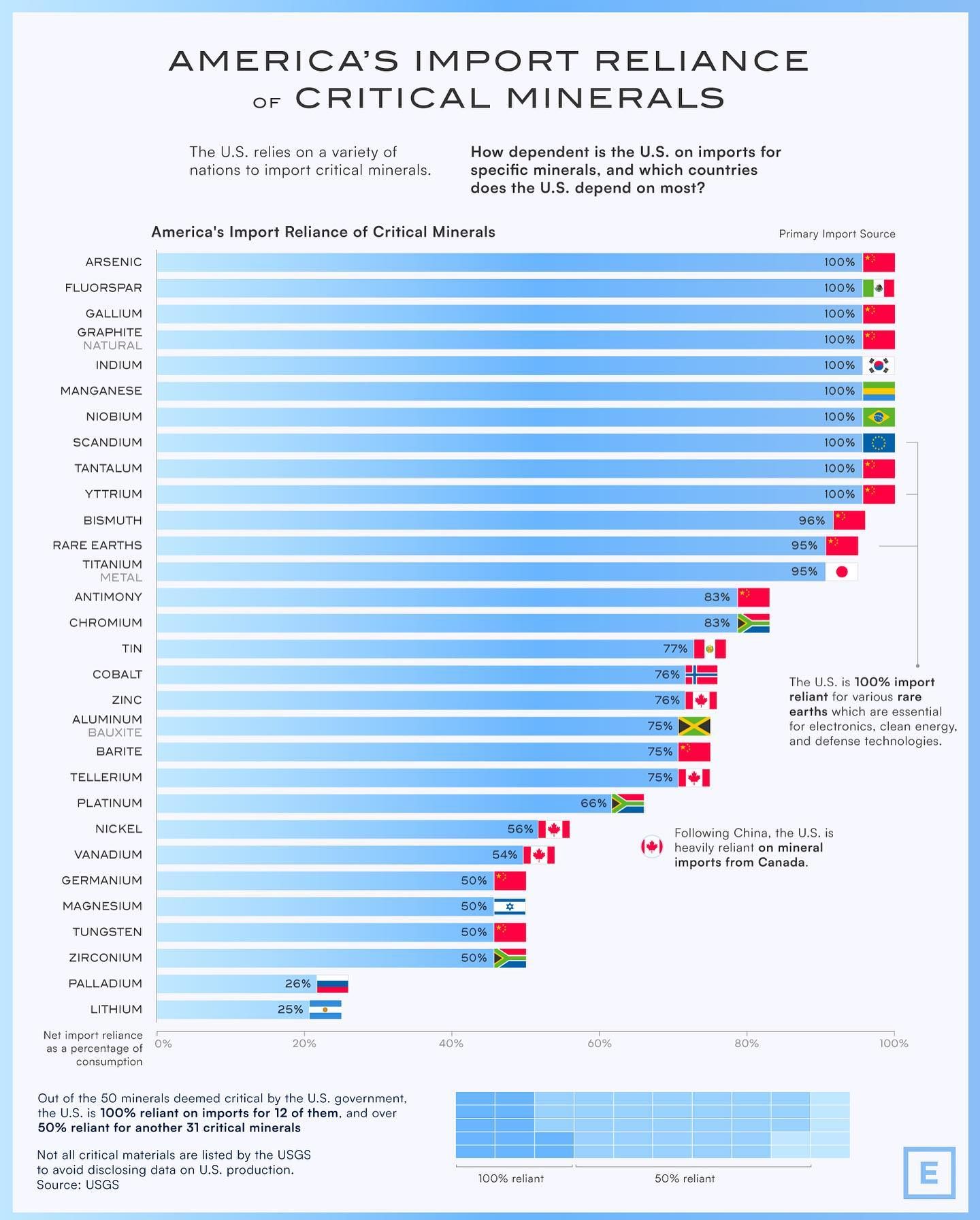
The United States' push towards a sustainable future relies on a variety of key minerals to build the infrastructure of the green economy. However, the nation faces significant challenges due to its heavy reliance on nonfuel mineral imports, which introduces potential vulnerabilities in the supply chain. This dependency is particularly pronounced for critical minerals, with the U.S. being 100% reliant on imports for at least 12 of these key minerals. China is the primary import source for many of these critical minerals, along with others that are essential for various industries.
Why This Matters
The transition to a green economy involves a wide range of technologies, from electric vehicles to renewable energy systems, all of which require specific minerals. The U.S.'s reliance on imports for these critical minerals poses several risks. These include supply disruptions, price volatility, and geopolitical tensions that could affect the nation's ability to maintain a stable and secure supply of these essential resources.
Economic and Strategic Implications
The economic implications of this reliance are significant. Fluctuations in the global market for these minerals can lead to higher costs for industries that depend on them, potentially hindering innovation and competitiveness. Additionally, the strategic importance of these minerals means that any disruption in supply can have broader national security implications. For example, rare earth elements are crucial for military technologies, and a disruption in their supply could compromise national defense capabilities.
Environmental and Geopolitical Considerations
Environmental concerns also come into play. Mining these minerals often involves environmentally damaging practices, and relying on imports means that the environmental impact is largely outsourced to other countries. This can lead to issues related to resource depletion, pollution, and environmental degradation in the countries where these minerals are extracted.
Geopolitical tensions add another layer of complexity. The primary import sources for many of these critical minerals are countries that may not always align with U.S. interests. For instance, China's dominance in the rare earth market raises concerns about potential trade restrictions or political leverage that could be used to disrupt supplies. This makes it crucial for the U.S. to diversify its supply sources and develop domestic mining capabilities.
Main Discussion
Key Minerals and Their Uses
The minerals in question include a variety of elements that are essential for modern technologies. For example, lithium is crucial for batteries in electric vehicles and energy storage systems. Cobalt is used in rechargeable batteries and superalloys. Rare earth elements, such as neodymium and dysprosium, are vital for magnets used in electric motors and wind turbines.
Import Reliance Breakdown
The U.S. is 100% reliant on imports for several critical minerals, including various rare earth elements. This extreme level of dependence highlights the vulnerability of the nation's supply chain. For many other minerals, the reliance is significant but not as extreme. For instance, the U.S. imports a large portion of its fluorospar, gallium, graphite, arsenic, niobium, scandium, tantalum, and yttrium. These minerals are essential for a range of applications, from electronics to aerospace to renewable energy technologies.
Primary Import Sources
China is the primary import source for many of these critical minerals. This includes rare earth elements, where China has a near-monopoly on global production. Other important sources include Canada, which is a significant supplier of minerals like niobium and scandium. The diversification of supply sources is a critical aspect of reducing dependence on any single country.
Visualizing the Import Dependence
Graphs and charts detailing the import reliance for various minerals provide a clear visual representation of the issue. These visualizations can help policymakers, industry leaders, and the public understand the scale of the problem and the specific areas where action is needed. For example, a bar graph showing the percentage of import reliance for different minerals can illustrate the extent of dependence on foreign sources. An added layer of information in these visualizations is the identification of the primary import source for each mineral, which highlights the geopolitical implications.
Practical Tips
Diversifying Supply Chains
One of the most practical steps to mitigate the risks associated with mineral import reliance is to diversify supply chains. This involves identifying and developing new sources of these critical minerals, both domestically and internationally. For instance, the U.S. could invest in domestic mining operations and explore partnerships with other countries that have significant mineral reserves.
Domestic Mining and Recycling
The U.S. should also focus on increasing domestic mining and recycling efforts. This would not only reduce reliance on imports but also create jobs and stimulate the economy. Recycling technologies for critical minerals can help recover valuable resources from end-of-life products, reducing the need for new mining operations and conserving natural resources.
Research and Development
Investing in research and development is crucial for finding alternative materials and technologies that can reduce the reliance on critical minerals. For example, developing new battery technologies that use less cobalt or finding substitutes for rare earth elements in magnets can help secure the supply chain and enhance national security.
Policy and Regulation
Government policies and regulations play a vital role in addressing mineral import reliance. This includes providing incentives for domestic mining, supporting recycling initiatives, and fostering international partnerships. Regulatory frameworks should also ensure that mining practices are environmentally sustainable and socially responsible.
Important Takeaways
The U.S.'s reliance on mineral imports for building a sustainable future is a significant challenge that requires a multi-faceted approach. Diversifying supply chains, increasing domestic mining and recycling, investing in research and development, and implementing supportive policies are all crucial steps. The visual representation of import reliance provides a clear picture of the problem and highlights the need for urgent action. By taking proactive measures, the U.S. can secure its supply of critical minerals and build a more resilient and sustainable future.
Conclusion
The push towards a sustainable future requires a reliable supply of key minerals. The U.S.'s heavy reliance on imports for these critical minerals poses significant risks to the nation's supply chains, economy, and national security. By understanding the extent of this reliance and taking practical steps to address it, the U.S. can build a more secure and sustainable future. This involves diversifying supply sources, investing in domestic mining and recycling, fostering research and development, and implementing supportive policies. Addressing these challenges will enhance the nation's ability to build a green economy and ensure a stable supply of essential resources.
Watch the Reel
Questions readers ask
What are critical minerals and why are they important for the U.S.?
Critical minerals are non-fuel, naturally occurring elements or compounds that are essential for modern technologies, including those needed for a sustainable future. They are important for the U.S. because they are used in a wide range of industries, from renewable energy to national defense, and many of these minerals are currently imported, making the supply vulnerable to disruptions.
Which country is the primary source for U.S. critical mineral imports?
China is the primary import source for many of the critical minerals that the U.S. relies on. This dependence can lead to potential risks, such as supply chain disruptions and geopolitical tensions, which can impact both the economy and national security.
How many critical minerals does the U.S. rely solely on imports for?
The U.S. is 100% reliant on imports for at least 12 critical minerals. This level of dependency underscores the importance of addressing supply chain vulnerabilities and seeking alternative sources for these essential resources.
What industries are most affected by the U.S. dependence on critical mineral imports?
The industries most affected include renewable energy, electric vehicles, and national defense. These sectors rely heavily on critical minerals for their technologies and operations, making them particularly vulnerable to supply disruptions.
What are the potential risks associated with U.S. reliance on imported critical minerals?
The potential risks include supply disruptions, geopolitical tensions, and economic competitiveness. These risks can negatively impact the transition to a green economy and undermine the nation's security and technological advancement.
What steps can the U.S. take to reduce its dependence on critical mineral imports?
The U.S. can explore domestic mining and processing, diversify its import sources, and invest in recycling and technology to increase the efficiency and sustainability of critical mineral use, as well as form strategic partnerships and alliances with other countries.
How does the U.S. reliance on critical mineral imports affect its push towards a green economy?
The reliance on critical mineral imports can hinder the U.S. push towards a green economy by creating vulnerabilities in supply chains that are crucial for green technologies. This can slow down the adoption of renewable energy and sustainable practices, making it more challenging to achieve environmental goals.
Recent articles
Fresh deep dives from the latest Reels we unpacked.




Comments
Be the first to comment.