ETF Market Breakdown
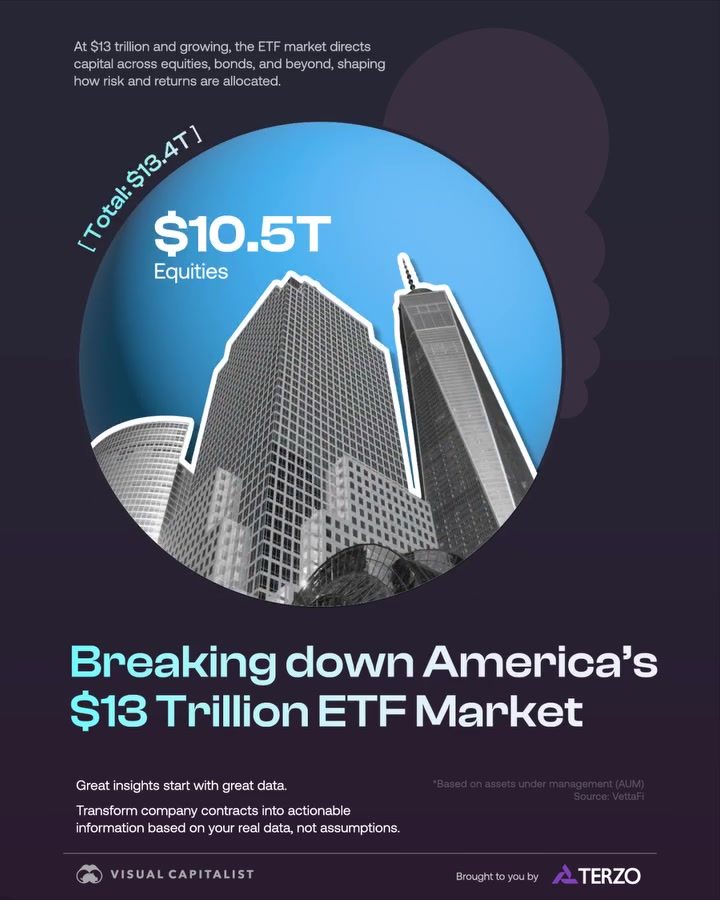
The exchange-traded fund (ETF) market has become a critical component of U.S. investing, with a staggering $13.4 trillion in assets under management (AUM). This significant market size and its diverse allocation across various investment categories make it a pivotal area to understand for anyone involved in finance.
Context / Why this matters
The ETF market's impact extends beyond its sheer size. By directing capital across equities, bonds, and other investment categories, ETFs play a crucial role in shaping how risk and returns are allocated. This distribution has significant implications for market dynamics, investor strategies, and overall economic stability. Understanding the composition of the ETF market can provide valuable insights into where capital is flowing and how it is being managed.
Main discussion
The Composition of the ETF Market
The ETF market is primarily composed of equities, bonds, and other asset classes. Equities make up the largest portion, with approximately $10.5 trillion AUM, followed by bonds at $2.2 trillion. Other significant categories include commodities, currencies, and real estate, which collectively contribute billions to the market.
Equities
Equities dominate the ETF market with $10.5 trillion in assets. This segment includes a broad range of stocks from various sectors and geographies, providing investors with diverse exposure to the global equity market. However, this dominance comes with its own set of risks and benefits.
-
Pros: Equities offer the potential for high returns, making them an attractive option for investors looking to grow their wealth. They provide a way to participate in the success of individual companies and broader market trends.
-
Cons: Equities are generally more volatile than other asset classes, which can lead to significant fluctuations in value. This volatility can be both an opportunity and a risk, depending on the investor's strategy and risk tolerance.
Bonds
Bonds are the second-largest category, with $2.2 trillion in assets. This segment includes various types of fixed-income securities, such as government bonds, corporate bonds, and municipal bonds. Bonds are generally considered to be less risky than equities, making them a popular choice for investors seeking stable returns.
-
Pros: Bonds offer steady income through regular interest payments and are less susceptible to market volatility. They can provide a hedge against equity market downturns and add stability to an investment portfolio.
-
Cons: Bonds typically offer lower returns compared to equities, and they are sensitive to changes in interest rates. Rising interest rates can lead to a decline in bond prices, which can impact the overall value of a bond portfolio.
Commodities
Commodities, such as gold, oil, and agricultural products, represent $318 billion of the ETF market. These assets are often used as a hedge against inflation and market volatility.
-
Pros: Commodities can offer diversification benefits and can perform well during periods of economic uncertainty. They can also provide exposure to various sectors, such as energy, agriculture, and precious metals.
-
Cons: Commodities can be highly volatile and are subject to supply and demand dynamics. Prices can fluctuate significantly, making them a risky investment for some.
Currencies
Currencies account for $160 billion in the ETF market. Currency ETFs allow investors to gain exposure to foreign exchange markets and can be used for hedging against currency risk.
-
Pros: Currency ETFs can provide diversification and can be used to hedge against currency fluctuations. They can also offer opportunities for speculative trading and profit from changes in exchange rates.
-
Cons: Currency markets are highly volatile and subject to geopolitical events, economic policies, and other external factors. Trading currencies can be complex and risky, requiring a deep understanding of the market.
Real Estate
Real estate ETFs make up $102 billion of the market. These funds invest in a variety of real estate assets, including residential and commercial properties, and real estate investment trusts (REITs).
-
Pros: Real estate ETFs offer exposure to the real estate market without the need for direct property ownership. They can provide steady income through dividends and potential capital appreciation.
-
Cons: Real estate investments can be sensitive to economic conditions, interest rates, and changes in the housing market. They may also have lower liquidity compared to other asset classes.
Other
The "other" category includes a variety of asset classes, such as alternative investments and emerging markets. These assets represent $77 billion and offer unique opportunities for diversification and potential returns.
-
Pros: Alternative investments can provide exposure to niche markets and sectors, potentially offering higher returns and diversification benefits.
-
Cons: Alternative investments can be complex and risky, requiring a higher level of expertise and understanding. They may also have lower liquidity and higher fees.
Data-Driven Insights
The ETF market is driven by data, and understanding this data can provide valuable insights for investors. Data-driven insights can help identify trends, evaluate performance, and make informed investment decisions. By leveraging data, investors can gain a competitive edge in the market and achieve better outcomes.
Practical tips
Diversify Your Portfolio
Diversification is a critical strategy for managing risk and optimizing returns. By spreading investments across various asset classes, sectors, and geographies, investors can reduce their exposure to any single risk factor.
Stay Informed
Staying informed about market trends, economic indicators, and global events can help investors make better decisions. Regularly reviewing market data and staying up-to-date with the latest news can provide valuable insights and help identify opportunities.
Utilize Technology
Technology plays a crucial role in modern investing. Utilizing data visualization tools, investment platforms, and analytics software can enhance decision-making and improve performance. Investors should leverage the latest technology to gain a competitive edge.
Consider Professional Advice
Consulting with financial advisors or investment professionals can provide valuable guidance and help navigate the complexities of the ETF market. Professionals can offer personalized advice, risk management strategies, and investment recommendations tailored to individual needs.
Monitor Performance
Regularly monitoring the performance of your investments is essential for achieving long-term success. Tracking key metrics, such as returns, risk, and diversification, can help identify areas for improvement and optimize your investment strategy.
Important takeaways
-
Diversification: Diversifying your portfolio across various asset classes, sectors, and geographies can help manage risk and optimize returns.
-
Data Utilization: Leverage data-driven insights to identify trends, evaluate performance, and make informed investment decisions. Visualizations can help understand complex data more easily.
-
Stay Informed: Regularly review market data, economic indicators, and global events to stay informed and make better investment decisions.
-
Utilize Technology: Use data visualization tools, investment platforms, and analytics software to enhance decision-making and improve performance.
-
Consult Professionals: Consider seeking advice from financial advisors or investment professionals to gain personalized guidance and recommendations.
Conclusion
The ETF market, with its $13.4 trillion in assets, is a cornerstone of U.S. investing. Understanding the distribution of assets across equities, bonds, and other investment categories is crucial for navigating this complex landscape. By utilizing data-driven insights, staying informed, and employing effective strategies, investors can better position themselves to achieve their financial goals.
Watch the Reel
Questions readers ask
What are the primary asset classes in the ETF market?
The primary asset classes in the ETF market include equities, bonds, commodities, and currencies. Equities are the most popular, followed by bonds. Other asset classes like commodities and currencies also have a significant presence, contributing to the diverse investment landscape of the ETF market.
What is the significance of the $13.4 trillion in assets under management in the ETF market?
The $13.4 trillion in assets under management (AUM) signifies the immense size and influence of the ETF market. It indicates the vast amount of capital invested through ETFs, which in turn impacts market dynamics, investor strategies, and overall economic stability in the U.S.
How do ETFs allocate capital across different investment categories?
ETFs allocate capital across various investment categories such as equities, bonds, commodities, and currencies. This allocation helps distribute risk and returns, influencing market trends and investor portfolios. ETFs provide investors with broad exposure to different asset classes, making them a versatile tool for portfolio diversification.
Why is understanding the ETF market important for investors?
Understanding the ETF market is crucial for investors as it provides insights into capital flows and risk distribution. By knowing the composition and trends of the ETF market, investors can make informed decisions about their portfolios, adapt to market changes, and align their investment strategies with broader economic trends.
How do ETFs impact the U.S. economy?
ETFs impact the U.S. economy by channeling capital into various asset classes, thereby influencing market dynamics and investor behavior. The allocation of capital through ETFs affects the pricing and liquidity of assets, contributing to overall economic stability and growth.
What role do commodities and currencies play in the ETF market?
Commodities and currencies are important components of the ETF market, offering investors exposure to asset classes beyond equities and bonds. These ETFs help diversify portfolios, hedge against inflation, and provide opportunities for profit in fluctuating markets, enhancing the overall investment landscape.
How can investors use ETF data to inform their investment strategies?
Investors can use ETF data to gain insights into market trends, capital flows, and risk allocation. By analyzing ETF data, investors can identify opportunities, manage risks, and optimize their portfolios. This information helps in making data-driven decisions to enhance investment performance and adapt to changing market conditions.
Recent articles
Fresh deep dives from the latest Reels we unpacked.




Comments
Be the first to comment.