Public Opinion of Billionaires
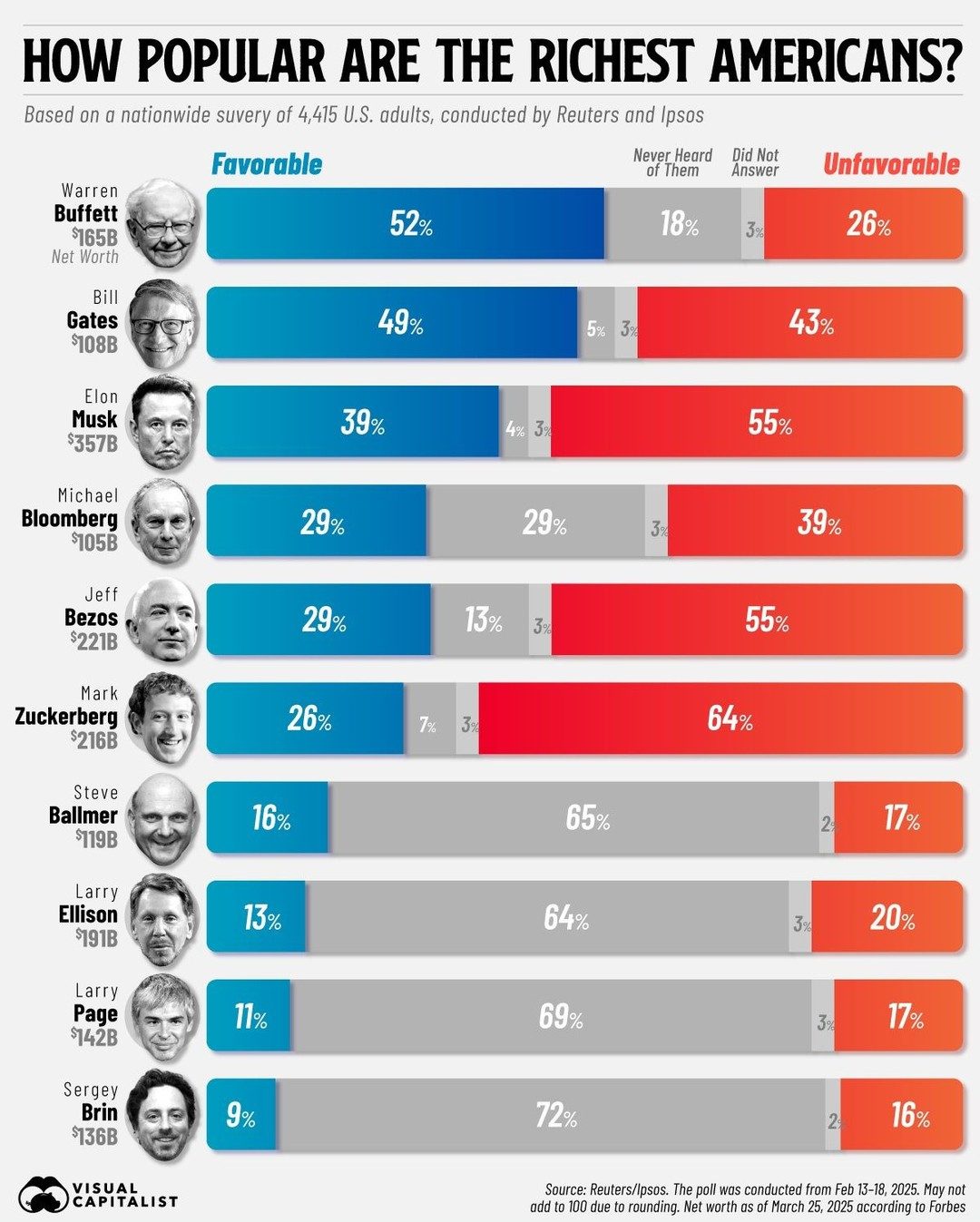
Favorability ratings of the wealthiest Americans provide a fascinating glimpse into how the public perceives the ultra-wealthy. The survey, conducted by Reuters and Ipsos in February 2025, offers insights into the public's views on some of the most prominent billionaires. Here, we rank the 10 richest Americans by their popularity, based on this survey.
Context / Why this matters
Understanding public opinion about billionaires is important because these individuals often influence public policy, philanthropy, and even societal norms. Their decisions can impact industries, economies, and communities at large. Therefore, knowing how the public views these influential figures can help shape future narratives and policies.
Main discussion
The top three: Warren Buffett, Bill Gates, and Elon Musk
Warren Buffett tops the list with a 52% favorable rating, making him the most liked billionaire in the survey. Buffett's reputation for philanthropy and his down-to-earth persona likely contribute to his high standing. Bill Gates follows closely with a 49% favorable rating. Gates' extensive philanthropic work through the Bill & Melinda Gates Foundation has undoubtedly earned him public admiration. Elon Musk, on the other hand, has a 39% favorable rating, which is notably lower. Musk's innovative ventures, particularly in electric vehicles and space exploration, are widely recognized, but his public persona and controversial statements may contribute to his less favorable rating.
The middle tier: Michael Bloomberg, Jeff Bezos, and Mark Zuckerberg
Michael Bloomberg, with a net worth of $105 billion, has a 29% favorable rating. Bloomberg's political career and philanthropic efforts are well-known, but his public image may be influenced by his polarizing political stances. Jeff Bezos, the founder of Amazon, has a similar 29% favorable rating. Despite Amazon's global reach and Bezos' philanthropic initiatives, his reputation has been affected by critiques of Amazon's labor practices and market dominance. Mark Zuckerberg, the co-founder of Meta (formerly Facebook), has a 26% favorable rating. Zuckerberg's platform has faced significant public scrutiny due to privacy concerns and the spread of misinformation.
The lower tier: Steve Ballmer, Larry Ellison, Larry Page, and Sergey Brin
Steve Ballmer, with a 16% favorable rating, is one of the least favored billionaires in the survey. The former Microsoft CEO's public persona and outspoken nature may contribute to his lower favorability. Larry Ellison, the co-founder of Oracle, has a 13% favorable rating. Ellison's high-profile legal battles and controversial statements may influence public opinion. Larry Page and Sergey Brin, the co-founders of Google, have 11% and 9% favorable ratings, respectively. While Google's products are ubiquitous, the company has faced significant backlash over privacy concerns, antitrust issues, and allegations of political bias.
The 'never heard of' factor
The survey also reveals a significant percentage of respondents who have never heard of some of these billionaires. For instance, 31% of respondents have never heard of Larry Ellison, and 35% have never heard of Larry Page. This highlights the disconnect between public recognition and the actual influence and wealth of these individuals.
Practical tips
For billionaires and public figures
Navigating public opinion can be challenging, especially for those in the public eye. Here are a few tips for managing public perception:
- Transparency and communication: Be open about your goals, decisions, and the impact of your work. Clear and consistent communication can help build trust and understanding.
- Philanthropy and social responsibility: Invest in causes that align with your values and benefit society. This not only enhances your public image but also creates a positive impact.
- Authemtic and consistent social media presence: Engage with your audience authentically. Address controversies and misinformation promptly and honestly.
- Collaboration and partnerships: Partner with organizations and individuals who share your values. This can help amplify your positive influence and mitigate negative perceptions.
For the general public
- Stay informed: Keep up with the latest developments and controversies involving these influential figures.
- Engage in dialogue: Participate in discussions and debates about the role of billionaires in society. This can help shape public opinion and policy.
- Hold them accountable: Encourage transparency and social responsibility from billionaires and public figures.
Important takeaways
The power of public perception
Public opinion can significantly influence the reputations and actions of billionaires. Understanding these dynamics can help shape how these influential figures engage with the public and address societal issues.
The role of philanthropy
Philanthropic efforts play a crucial role in shaping public opinion about billionaires. Many of the most favorably viewed billionaires are known for their significant philanthropic contributions. This highlights the importance of giving back to society and addressing social issues.
The impact of media and public scrutiny
Billionaires often face intense public scrutiny and media attention, which can significantly impact their public image. Navigating this landscape requires careful communication and strategic engagement with the public.
The significance of public awareness
The survey reveals that a significant portion of the public is unaware of some of the wealthiest and most influential individuals. This underscores the importance of raising public awareness about the role and impact of these figures in society.
The influence of controversies and scandals
Controversies and scandals can significantly affect public opinion about billionaires. Addressing these issues promptly and transparently is crucial for maintaining a positive public image.
The importance of authenticity
Authenticity and consistency in public engagement can help build trust and enhance public perception. Engaging with the public honestly and authentically can foster a more positive relationship.
Conclusion
The public opinion of billionaires provides valuable insights into how society views the ultra-wealthy. Understanding these dynamics can help shape future narratives, policies, and public engagement. Whether you are a billionaire navigating public opinion, a member of the public seeking to understand these influential figures, or a policymaker shaping societal norms, recognizing the importance of public perception, philanthropy, media scrutiny, and authenticity is crucial. By engaging with the public authentically and addressing societal issues, billionaires can foster a more positive relationship with society and contribute to a more equitable and just world.
Watch the Reel
Questions readers ask
Who are the most favorably viewed billionaires in America according to the 2025 survey?
According to the 2025 survey by Reuters and Ipsos, Warren Buffett and Bill Gates top the list of the most favorably viewed billionaires in America. Their substantial philanthropic efforts and long-standing public personas contribute to their high favorability ratings.
Why is Elon Musk viewed with more skepticism compared to other billionaires?
Elon Musk's innovative ventures, while admired by some, are met with more skepticism due to his controversial public statements and actions. His public image is seen as more divisive, leading to a mixed reception among Americans.
What role do philanthropy and public persona play in shaping Americans' views on billionaires?
Philanthropy and public persona are crucial factors in shaping Americans' views on billionaires. Those who are actively involved in charitable giving and maintain a positive public image tend to be viewed more favorably. Conversely, controversy or a lack of public engagement can lead to more skepticism.
How do Americans perceive the wealth of prominent figures like Jeff Bezos?
The public's view of Jeff Bezos' wealth is complex. While some admire his business acumen and the impact of Amazon on the economy, others express concern over wealth inequality and his company's labor practices. These mixed perceptions contribute to a varied net worth perception.
What is the significance of understanding public opinion about billionaires?
Understanding public opinion about billionaires is important because their decisions can significantly influence public policy, philanthropy, and societal norms. Knowing how the public views these influential figures can help shape future narratives and policies, making it a crucial aspect of societal discourse.
Related deep dives
Similar reads based on topic and creator.


Recent articles
Fresh deep dives from the latest Reels we unpacked.




Comments
Be the first to comment.