Time Allocation Across Age Groups
The way Americans allocate their time across different age groups reveals fascinating insights into the changing dynamics of social interactions. The data from various surveys and studies provide a quantitative understanding of how our social circles evolve as we age.
Context
Understanding who Americans spend the most time with at various stages of life provides a lens into societal norms and personal growth. By examining how time is allocated among different age groups through the American Time Use Survey and Our World in Data, we can gain a deeper understanding of our social connections and the reasons behind these changes. These insights are crucial for recognizing societal trends and the evolving nature of human relationships.
Main discussion
The Evolution of Social Circles
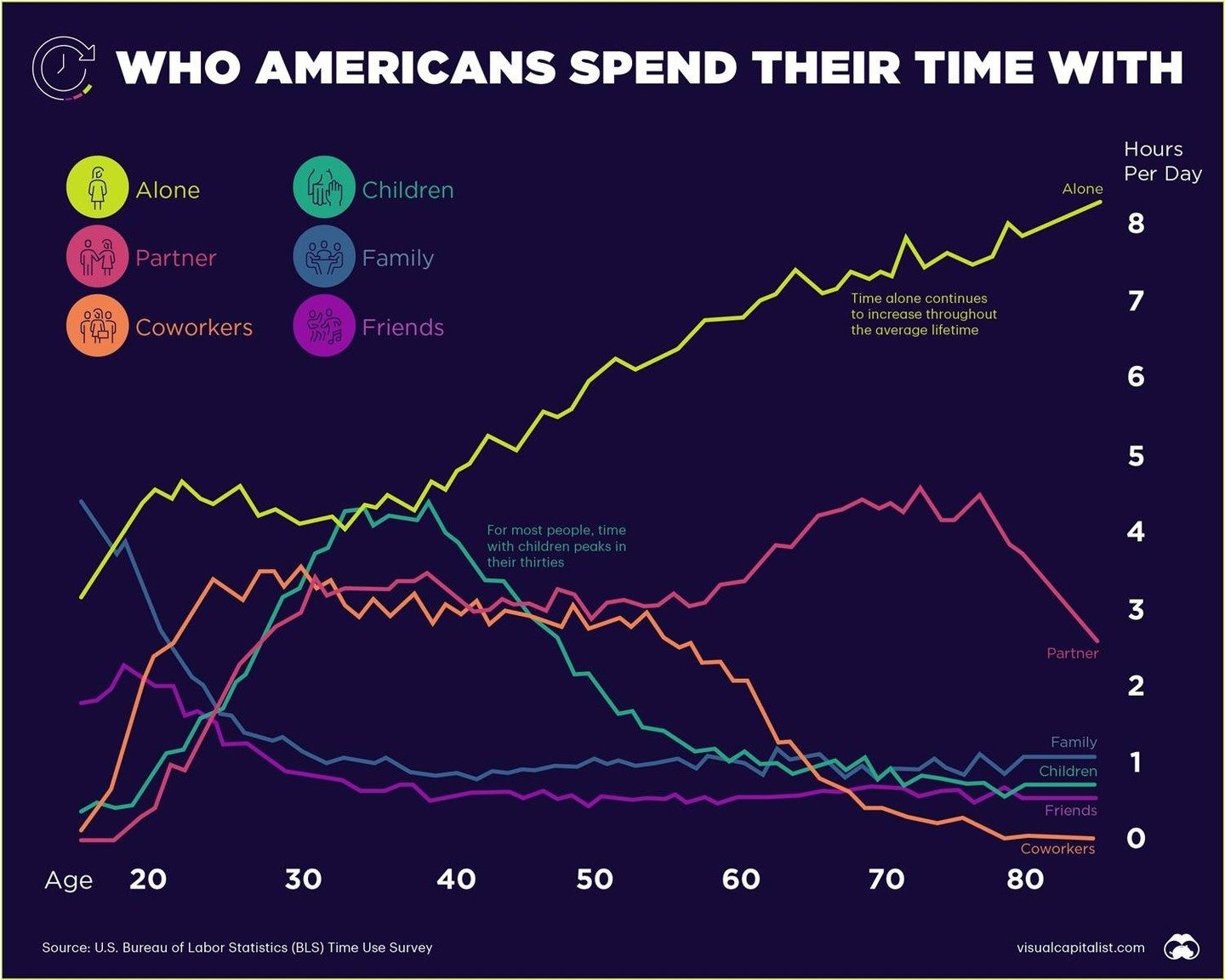
From the youngest to the oldest, the people we spend time with significantly change. In their twenties, Americans tend to spend a considerable amount of time with friends and coworkers, often balancing work, social life, and personal interests. As people enter their thirties, the dynamics shift. Time spent with children peaks, reflecting the responsibilities and joys of parenthood. This trend continues into the forties, where family time remains a priority.
Time Alone
One of the most noticeable trends in the data is the increasing amount of time Americans spend alone. As people age, more hours per day are dedicated to solitude. While this can be attributed to various factors, such as retirements and the empty nest syndrome, it underscores the significance of personal time in our lives. Americans spend an average of 8 hours a day alone, a trend that continues to grow throughout the average lifetime.
Time with Children
Time with children follows a distinct pattern. It peaks in one's thirties, reflecting the intense focus on child-rearing during these years. This period is marked by significant involvement in children's activities, education, and overall well-being, leading to an accumulation of shared hours. The data highlights the importance of these formative years in shaping both parents' and children's lives, as well as the potential long-term impacts on familial bonds.
Time with Partners
The dynamics of time spent with partners also evolve with age. In the early years, partners often share significant portions of the day, reflecting the intensity of a new relationship. However, as life progresses, this time tends to stabilize, with fluctuations depending on family responsibilities and individual priorities. For many, the stability of a long-term partnership brings a sense of consistency in daily interactions, even if the quantity of shared time decreases.
Time with Coworkers
Workplace interactions are another significant aspect of time allocation. Coworkers play a crucial role in daily life, especially in younger and middle-aged adults. Employees in their twenties and thirties often spend a substantial portion of their day with colleagues, contributing to both professional growth and social connections. The time spent with coworkers tends to decrease with age, often attributed to a change in career focus, retirement, or reduced work hours.
Practical tips
Understanding these trends can be beneficial for various reasons, from personal time management to fostering strong social connections.
Managing Your Time
By being aware of the average time spent with different groups, individuals can better plan their days. This can help in maintaining a healthy balance between personal, professional, and family life. For example, knowing that time alone increases with age can prompt younger adults to be more deliberate about their solitude, while those in their thirties might plan more quality time with their children.
Strengthening Social Connections
Recognizing the peaks and troughs in social interactions can help in strengthening relationships. Individuals can make conscious efforts to spend quality time with friends, especially if they realize that these interactions might decrease in the future. Similarly, partners can work on maintaining their bond, even when work and family responsibilities increase.
Leveraging Data for Personal Insights
The data from the American Time Use Survey and Our World in Data can provide valuable insights for anyone looking to understand their social behaviors better. By analyzing personal time allocation and comparing it with national trends, individuals can identify areas for improvement and make informed decisions about their social and personal life.
Important takeaways
Understanding these trends can help us appreciate the evolving nature of our social connections. The data reveal that the amount of time spent with various groups changes significantly over the years, reflecting the importance of different relationships at different stages of life. By recognizing these patterns, individuals can make more informed choices about their time, leading to a more balanced and fulfilling social life.
Conclusion
The allocation of time across different age groups provides a comprehensive view of how Americans spend their days. The insights from the American Time Use Survey and Our World in Data reveal the evolving nature of social interactions, highlighting the importance of understanding these trends for personal growth and connection. By being aware of these patterns, individuals can better plan their days, strengthen their social connections, and leverage the data for personal insights.
Watch the Reel
Questions readers ask
How does the time Americans spend with friends change as they age?
In their twenties, Americans tend to spend a significant amount of time with friends. However, as they enter their thirties and forties, this time often decreases due to increased responsibilities such as work and family. By the time Americans reach their fifties and sixties, the time spent with friends may stabilize, but it is often less than in their younger years.
Why do Americans in their thirties and forties spend more time with their family?
Americans in their thirties and forties often have young children and may be balancing work and family. This is a time where many are focused on building a home, spending time with children, and managing family life. These responsibilities can shift attention away from friends and towards family and personal time.
What kinds of personal time do Americans spend more time on as they age?
As Americans age, they often spend more time alone or on personal time activities, such as exercise, hobbies, and relaxation. This is often due to increased independence, less reliance on social circles, and a greater appreciation for solitude. This can also be due to retirement or other life changes.
How does the time spent with coworkers change throughout a lifetime?
In their twenties and thirties, Americans spend a significant amount of time with coworkers. However, as they advance in their careers, they may spend less time with coworkers as they take on more responsibilities, and work from home or remote work becomes an option. This is especially true for those in their forties and fifties, who may be in leadership roles or have more flexible schedules.
What is the significance of the time Americans spend alone?
Time spent alone allows for personal growth, self-reflection, and a sense of accomplishment. It also allows for more time to spend on hobbies and other personal interests. In addition, it can be a way to recharge and recharge after a long day of work or family time. It also provides a sense of independence and a sense of self-awareness.
What are some reasons for the changes in Americans’ social habits as they age?
Changes in social habits can be attributed to various factors, including life stage, responsibilities, and personal interests. For instance, younger Americans may prioritize friendships and social connections, while older adults might focus more on family, work, and personal time. Life events, such as marriage, parenthood, and retirement, also play a significant role in shaping these changes.
Do Americans spend more time with their partner as they age?
Americans often spend more time with their partner as they age, especially after children have grown and left the house. This is a time when many couples are able to focus on their relationship and spend more time together. This can also be a time when couples are able to travel and explore new experiences together. Couples may also take on new hobbies or activities together, such as golfing, hiking, or volunteering.
Related deep dives
Similar reads based on topic and creator.




Recent articles
Fresh deep dives from the latest Reels we unpacked.




Comments
Be the first to comment.