A Star on the Horizon
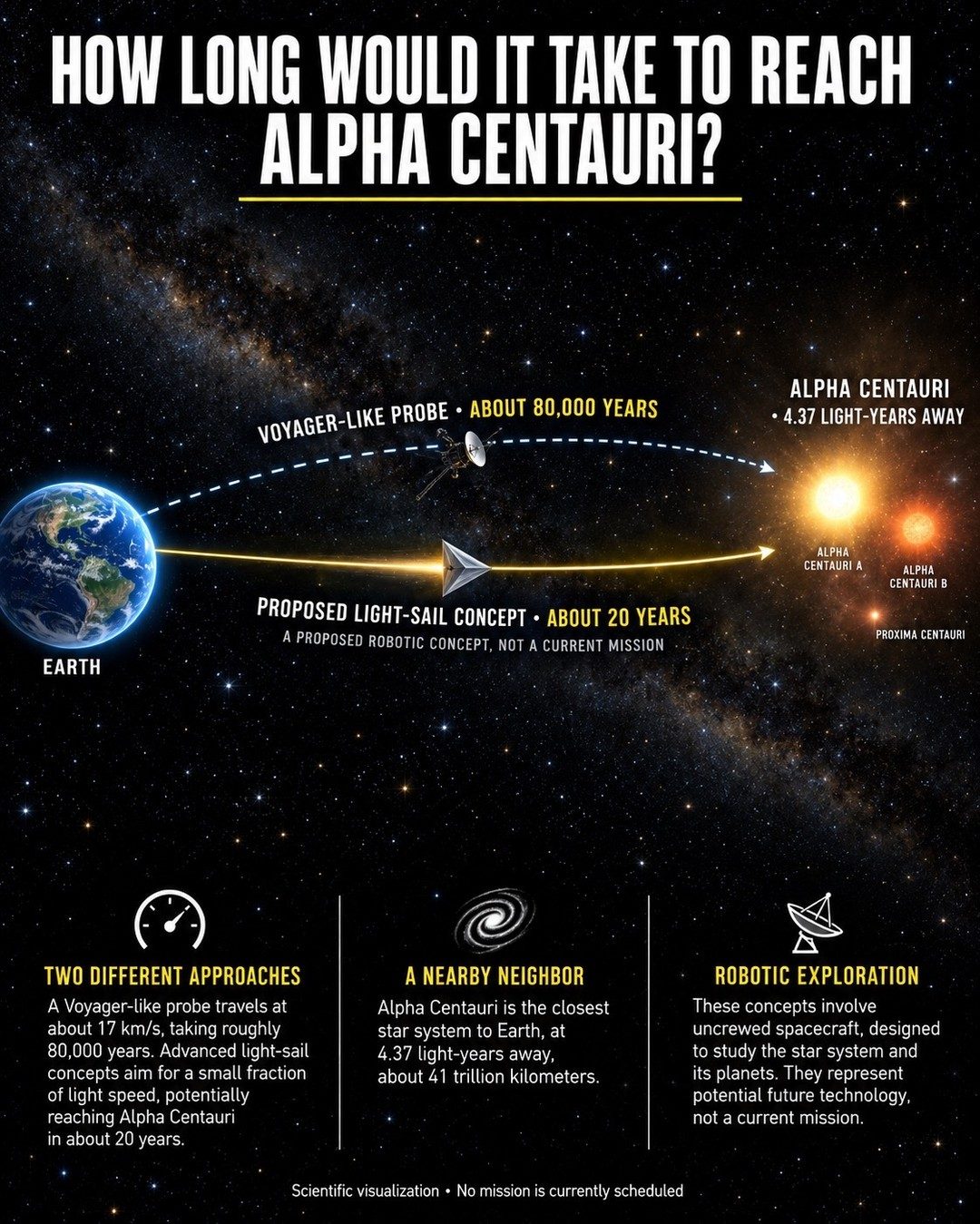
Alpha Centauri is not just a distant collection of stars. It's the nearest stellar neighbor. Located an astonishing 4.37 trillion kilometers from our pale blue dot, Alpha Centauri is a system of three stars — Alpha Centauri A, Alpha Centauri B, and Proxima Centauri. Proxima Centauri is the closest of the three, a point that distinguishes it even further from the other two stars. This trifecta star system offers astronomers a tantalizing mission. Robotic exploration is under active consideration, but nothing is scheduled. However, this is no reason to despair. These concepts represent potential future technological advancements, designed to study the star system and its planets. But when it comes to travel time, there are different approaches. The revelations are a mixture of what we have done in the past and what we think we can build. It makes envisioning our own Proxima Centauri exploration a distant concept — like the stars themselves. Yet the concept of “Alpha Centauri” is embedded in the consciousness of the human race. And the visualizations will hold the audience’s imagination captive.
Why Voyager Couldn’t Do It
Voyager's success story shouldn't be ignored. Indeed, it is a testament to the durability and endurance of our spacecraft. A Voyager-like probe travels at approximately 17 kilometers per second. This remarkable speed is barely fast enough to travel through the cosmos. And we know this because it has left our neighborhood and is traveling away from us. But for the speediest spacecraft ever made, it would take about 80,000 years to reach the Alpha Centauri system. The reason is both simple and profound. The distances themselves are so immense and so alien to our everyday experience. The Voyager mission has shown us the beauty of the solar system. However, this mission may never send back such beauties from its journey to Alpha Centauri.
Light Sail Mission Could Be an Engineering Milestone
The second approach is a proposed light-sail concept. This would potentially reach Alpha Centauri in a fraction of the time. It could do it in a mere 20 years. This is a huge improvement over 80,000 years. The concept relies on the use of a sail of sorts, which would be pushed along by radiation pressure from a star. This would be the first time that human beings ever used a sail to travel between the stars. The concept itself is a testament to the imagination of our finest scientists. The proposed light-sail concept is an exciting alternative. It is also a testament to the human spirit. Our quest to explore our solar system is just another step in our journey toward the stars. The concept is simple and profound. In a nutshell, it could take 20 years to reach Alpha Centauri. That's a drastic improvement over the previous estimate of 80,000 years. The concept itself is a testament to the imagination of the scientists who have proposed it. It is also a testament to the human spirit. Our quest to explore the universe is just another step in our journey toward the stars. The concept of “alpha Centauri” is embedded in the consciousness of the human race. And the visualizations will hold the audience’s imagination captive.
Watch the Reel
Related deep dives
Similar reads based on topic and creator.
Recent articles
Fresh deep dives from the latest Reels we unpacked.




Comments
Be the first to comment.