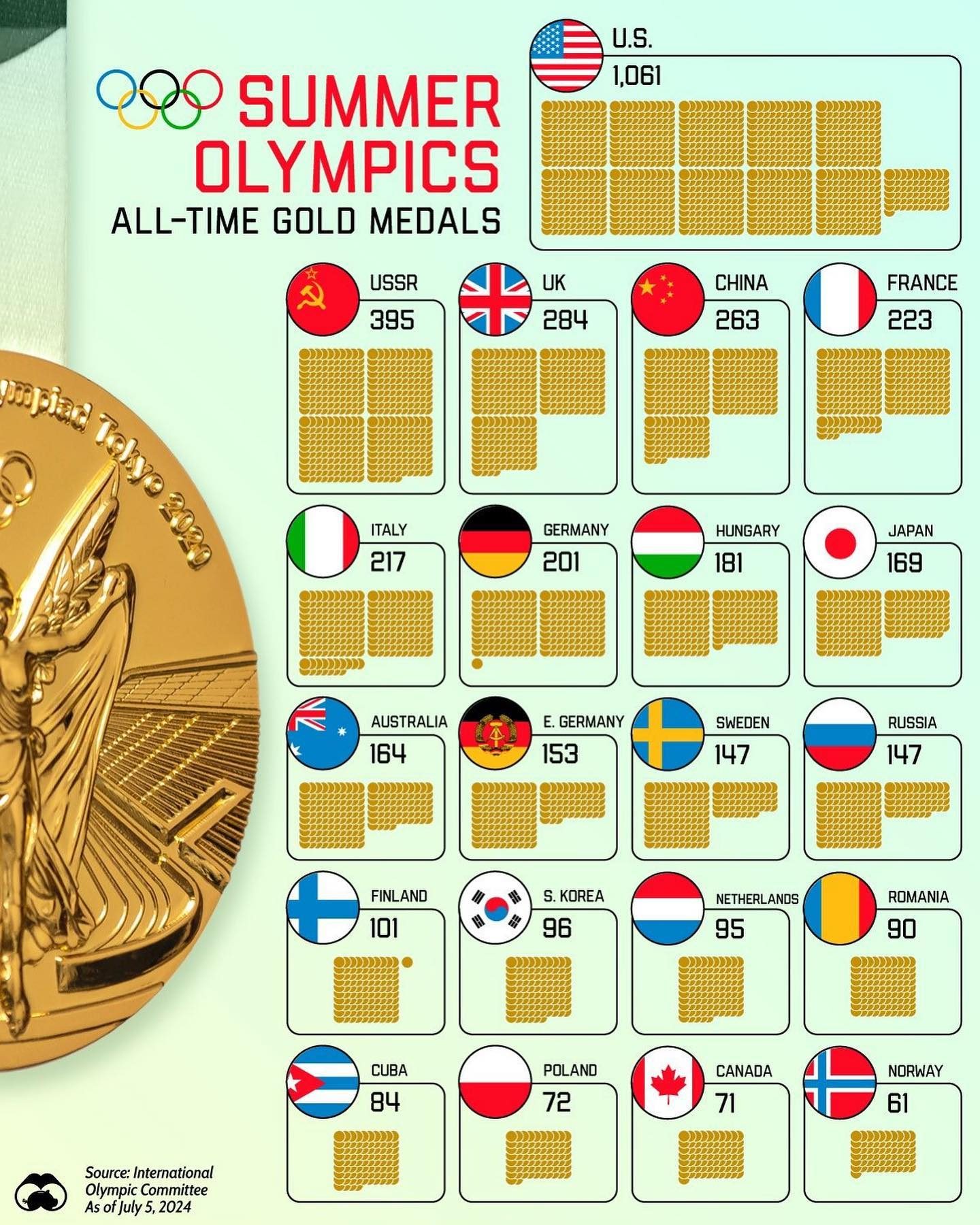
The All-Time Gold Medal Count in the Summer Olympics
The Summer Olympics have long been a showcase of athletic prowess and national pride, with countries vying for the top spots in the medal count. The United States, in particular, has had an impressive run, dominating the games throughout the 20th century by winning around 10% of the medals. Track and field, along with swimming, have been standout sports for American athletes, with swimmer Michael Phelps leading the pack with a record-breaking 23 gold medals.
Context / Why This Matters
The all-time gold medal count provides a fascinating perspective on the historical performance of different nations in the Summer Olympics. This data, sourced from the International Olympic Committee (IOC), not only highlights the competitive spirit but also reflects the historical, social, and political contexts of the participating countries.
The infographic, updated as of July 3, 2024, offers a detailed look at the achievements of various nations. It includes data from the USSR, China, the UK, France, Italy, Germany, Hungary, Japan, and many other countries. This data is invaluable for understanding the evolution of sports and the factors that contribute to a nation's success in the Olympics.
Main Discussion
The Leading Nations
The USSR leads the tally with an impressive 395 gold medals, showcasing the country's dominance in various Olympic sports over the decades. Following closely is China with 263 gold medals, reflecting its rising prowess in international sports. The UK and France also feature prominently with 284 and 223 gold medals, respectively, highlighting their historic contributions to the Olympic Games. Germany, with 201 gold medals, and Italy, with 217, are other notable contenders.
The Rise of New Powers
Japan's success with 169 gold medals underscores the country's growing influence in the sporting world. Similarly, Sweden's 147 gold medals and Australia's 164 gold medals reflect their strong commitment to athletic excellence. These countries, along with others like East Germany (with 153 gold medals) and Finland (with 96 gold medals), demonstrate the diverse range of athletic talents and the competitive nature of the games.
Emerging Contenders
Countries like South Korea, the Netherlands, Poland, and Canada also have significant medal counts, with 96, 95, 72, and 71 gold medals, respectively. These numbers highlight the growing competitiveness and the spread of athletic talent across the globe. Even smaller nations, such as Cuba with 84 gold medals, show that success in the Olympics is not limited to the most populous countries.
The American Legacy
The United States, while not explicitly mentioned in the infographic, has a rich history in the Olympics. American athletes have excelled in a variety of disciplines, particularly in track and field and swimming. The dominance of the U.S. in the 20th century, winning around 10% of the medals, is a testament to the country's investment in sports and the dedication of its athletes. Michael Phelps, with his 23 gold medals, stands as a symbol of this legacy.
Practical Tips
For Athletes
For athletes aspiring to compete at the highest levels, understanding the historical performance of different countries can provide valuable insights. It can help in identifying trends, strengths, and areas for improvement. Athletes can study the techniques and training regimens of successful athletes from these countries to enhance their performance.
For Sports Enthusiasts
Sports enthusiasts can use this data to deepen their appreciation for the Olympics. By learning about the historical achievements of different countries, enthusiasts can gain a broader perspective on the sporting world and understand the cultural and political factors that influence athletic success. This knowledge can enhance the viewing experience and foster a deeper connection with the games.
For Researchers and Analysts
Researchers and analysts can utilize this data to conduct in-depth studies on the factors contributing to a nation's success in the Olympics. By examining the socio-economic, political, and cultural contexts of these countries, researchers can uncover valuable insights that can inform athletic training, policy-making, and future research in sports science.
Important Takeaways
Historical Significance
The all-time gold medal count reveals the historical significance of the Summer Olympics. It shows how nations have evolved their athletic programs and how the games have influenced global sports.
Competitive Spirit
The data underscores the competitive spirit of the Olympics, where countries strive to outperform each other in various disciplines. It highlights the dedication, hard work, and talent required to achieve success at this level.
Global Influence
The diversity of nations represented in the medal count reflects the global influence of the Olympics. It demonstrates how sports can bring together people from different backgrounds and foster a sense of unity and camaraderie.
Conclusion
The all-time gold medal count in the Summer Olympics provides a comprehensive view of the achievements of different nations over the years. From the dominance of the USSR to the rising stars like China and the legacy of countries like the United States, this data offers a fascinating glimpse into the world of sports. It serves as a reminder of the hard work, dedication, and talent that go into achieving athletic excellence and the enduring appeal of the Olympics as a global event.
Watch the Reel
Questions readers ask
Which country has won the most gold medals in the Summer Olympics?
The United States has won the most gold medals in the Summer Olympics. With a significant lead, the U.S. has dominated the games, particularly throughout the 20th century, securing around 10% of all gold medals awarded.
How many gold medals has Michael Phelps won?
Michael Phelps, an American swimmer, has won a record-breaking 23 gold medals in the Summer Olympics, making him the most successful athlete in Olympic history.
Which countries have shown a rise in their Olympic performances recently?
Japan and Australia have emerged as new powers in international sport, showing a notable rise in their Olympic performances. This shift demonstrates the evolving strengths and competitiveness of these nations in the Summer Olympics.
Where does the International Olympic Committee (IOC) publish the all-time gold medal count?
The International Olympic Committee (IOC) publishes the all-time gold medal count on their official website. This data provides a comprehensive look at the historical performance of different nations in the Summer Olympics.
Which sports have been most successful for the United States in the Summer Olympics?
The United States has excelled in track and field, as well as swimming, in the Summer Olympics. These two sports have consistently contributed to the U.S.'s impressive medal count, with numerous Olympic gold medal winners emerging from these disciplines.
How do the Olympic gold medal rankings reflect the changing landscape of international sports?
The Olympic gold medal rankings reflect the changing landscape of international sports by showcasing the rise and fall of nations' performances over time. Countries like Japan and Australia have made significant strides, while traditional powerhouses like the United States, the USSR, and China continue to maintain their positions.
Recent articles
Fresh deep dives from the latest Reels we unpacked.




Comments
Be the first to comment.