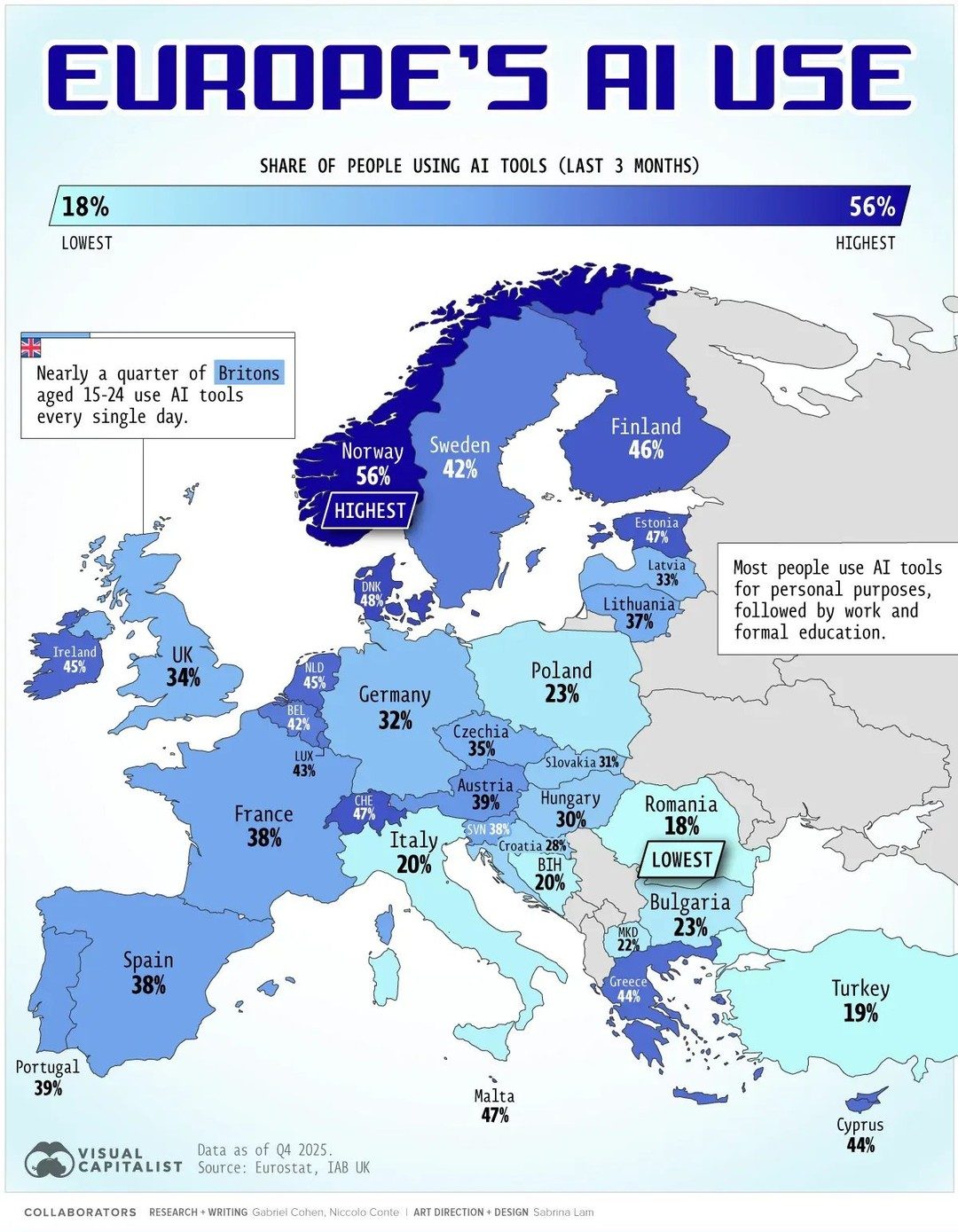
AI Tool Usage in Europe
Artificial Intelligence (AI) tools are increasingly integrated into various sectors across Europe, with significant variations in adoption rates among different countries. From Norway's high of 56% to rates around one-third in the UK and Germany, the landscape of AI usage in Europe is diverse and dynamic.
AI Week, sponsored by terzo.ai and highlighted by visualcap, provides a comprehensive look at how AI is transforming business, technology, and society. This article delves into the current state of AI tool usage across the continent, examining key trends and providing context on why these numbers matter.
Why This Matters
Understanding the widespread adoption of AI tools in Europe is crucial for several reasons. It offers insights into how different regions are leveraging technology to drive innovation and efficiency. Moreover, it highlights the potential for further growth and the areas where investments and policies could foster greater adoption.
AI Usage Across Europe
High Adoption Rates
Countries like Norway, Sweden, and Malta lead the way with high AI tool usage rates. Norway, for example, boasts a 56% adoption rate, showcasing a robust integration of AI into various industries. Sweden and Malta follow closely, with adoption rates that reflect a strong emphasis on digital transformation.
Moderate Adoption
In countries such as the UK, Germany, and France, AI tool usage hovers around one-third. This moderate adoption indicates a growing interest and investment in AI, but also suggests there is room for further integration and development. The UK, in particular, shows a notable statistic: nearly a quarter of Britons aged 15-24 use AI tools every single day, highlighting the technology's appeal to younger demographics.
Lower Adoption Rates
Bulgaria and Greece have the lowest reported usage rates, at 18% and 46% respectively. This lower adoption could be attributed to various factors, including economic constraints, limited access to technology, or slower digital transformation initiatives.
Key Drivers of Adoption
Several factors influence the varying adoption rates of AI tools across Europe. Economic stability, infrastructure, and government policies play significant roles. Countries with advanced digital infrastructure and supportive policies tend to have higher adoption rates. For instance, Norway's high adoption rate can be linked to its strong digital infrastructure and government initiatives promoting AI integration.
Regional Disparities
The visual map highlights regional disparities, with Northern and Central Europe generally showing higher adoption rates compared to Southern and Eastern Europe. This disparity underscores the need for targeted strategies to bridge the gap and ensure equitable access to AI technologies across the continent.
Practical Tips for Enhanced AI Adoption
Government Initiatives
Governments can play a pivotal role in promoting AI adoption by investing in digital infrastructure and providing incentives for businesses to integrate AI tools. Policies that support research and development in AI, along with funding for education and training programs, can also drive adoption.
Public and Private Sector Collaboration
Collaboration between the public and private sectors can accelerate AI adoption. Public-private partnerships can help in developing AI solutions tailored to specific needs, whether in healthcare, education, or industry. Such collaborations can also facilitate the sharing of best practices and resources.
Education and Training
Investing in education and training programs is essential for enhancing AI adoption. These programs can equip the workforce with the necessary skills to leverage AI tools effectively. Tailored training initiatives, especially for younger generations, can foster a culture of innovation and digital literacy.
Access to Technology
Ensuring widespread access to AI technology is crucial. This includes providing affordable and reliable internet access, as well as making AI tools accessible to small and medium-sized enterprises (SMEs). Government subsidies and grants can help SMEs to adopt AI, leading to increased productivity and competitiveness.
Important Takeaways
The adoption of AI tools across Europe is diverse, with countries like Norway and Sweden leading the way. Factors such as economic stability, digital infrastructure, and government policies significantly influence these adoption rates. Enhanced collaboration between public and private sectors, along with targeted government initiatives and education programs, can drive further AI integration.
Conclusion
AI tool usage in Europe varies widely, reflecting a complex interaction of economic, infrastructural, and policy factors. As AI continues to reshape business, technology, and society, understanding these variations is crucial for fostering a more equitable and innovative digital future. By leveraging the strengths and addressing the challenges in different regions, Europe can harness the full potential of AI to drive growth and innovation.
Watch the Reel
Questions readers ask
Which European countries are leading in AI adoption?
Countries such as Norway and Sweden are at the forefront of AI adoption in Europe. Norway, in particular, has the highest adoption rate at 56%.
How does AI usage in Germany and the UK compare?
Germany and the UK have similar AI adoption rates, both around one-third. This is significantly lower than the leaders, but still indicates a notable level of integration.
Why do AI adoption rates vary so widely across Europe?
The variation in AI adoption rates across Europe can be attributed to factors such as investment in technology, government policies, and the readiness of businesses to integrate new tools. Regions with higher economic development and technological infrastructure tend to have higher adoption rates.
What is the current state of AI usage in Bulgaria and Greece?
Bulgaria and Greece are among the countries with the lowest AI adoption rates in Europe. This indicates a slower integration of AI tools and potential areas for growth and development.
What is AI Week and why is it significant?
AI Week is an event sponsored by tercero.ai and highlighted by visualcap, which offers a comprehensive look at how AI is transforming various sectors. It provides insights into the latest trends and developments in AI technology across Europe, making it a significant event for understanding the European AI landscape.
Why is it important to understand regional AI adoption rates in Europe?
Understanding regional AI adoption rates provides valuable insights into technological advancements and potential areas for growth. This can help identify trends, inform policy decisions, and guide investments in AI technology across the continent.
Which sectors are seeing significant AI integration in Europe?
AI tools are increasingly integrated into various sectors across Europe, including business, technology, and society. This wide range of applications underscores the transformative potential of AI across different industries.
Related deep dives
Similar reads based on topic and creator.


Recent articles
Fresh deep dives from the latest Reels we unpacked.




Comments
Be the first to comment.