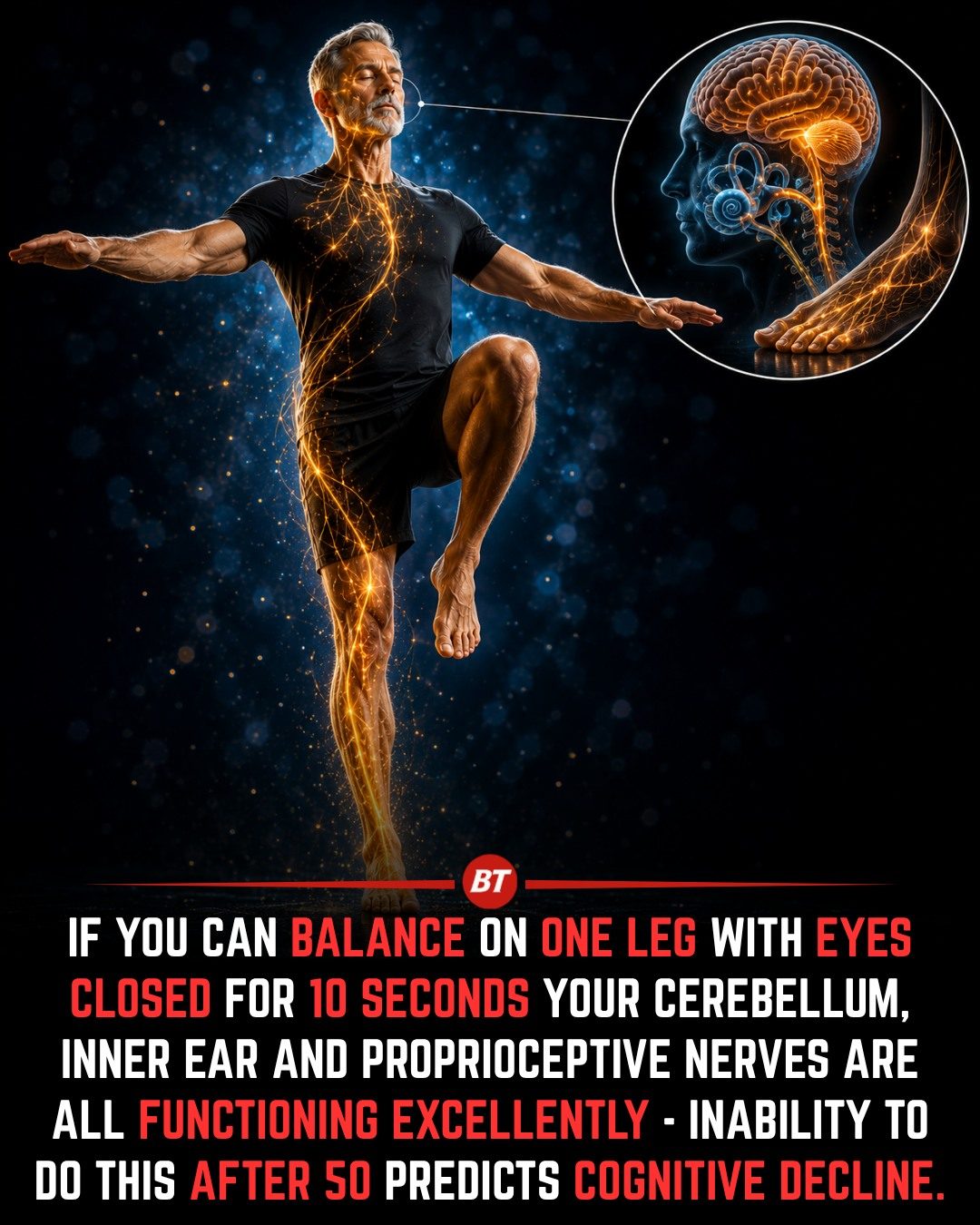
Balance and Cognitive Health
Balancing on one leg with your eyes closed is more than just a party trick; it's a powerful indicator of your overall neurological health. This simple test engages several critical systems in your body, making it a valuable marker of healthy aging and cognitive function.
Context / Why this matters
Maintaining balance is a complex task that involves multiple parts of the nervous system working in harmony. When you close your eyes and try to stand on one leg, your brain can no longer rely on vision to keep you upright. Instead, it must integrate information from three key systems:
- Cerebellum: This part of the brain fine-tunes movement and coordination, helping you to maintain balance and control your body's position in space.
- Vestibular system: Located in the inner ear, this system detects head position and motion, providing essential information about your body's orientation and movement.
- Proprioceptive nerves: These nerves constantly send signals to the brain about the position and movement of your joints and muscles, allowing your brain to create a mental map of your body's position in space.
If any of these systems are not functioning optimally, maintaining balance becomes much more challenging. This is why the ability to balance on one leg with your eyes closed is considered a strong indicator of overall neurological health.
Main discussion
The interplay between balance and cognitive health is well-documented in scientific research. A study published in Frontiers in Aging Neuroscience found that older adults who could maintain a one-leg stance with their eyes closed for a longer duration had a significantly lower risk of developing cognitive impairment over the following years. This suggests that balance tests, such as the one-leg stance, may serve as a simple screening tool for identifying individuals at increased risk of cognitive decline.
The significance of balance after 50
After the age of 50, the ability to balance on one leg with eyes closed becomes an even more critical marker of neurological health. Difficulty with this task may indicate an early sign of cognitive decline. While occasional wobbling or loss of balance is normal and can happen to anyone at any age, a noticeable decline in balance over time should not be ignored. It may reflect changes in strength, nerve function, or the brain's ability to process sensory information.
Balance is a complex task that requires the coordination of multiple systems in the body. When you close your eyes and try to stand on one leg, your brain must integrate information from various sources to maintain stability. If any of these systems are not functioning optimally, maintaining balance becomes much more challenging. This is why the ability to balance on one leg with your eyes closed is considered a strong indicator of overall neurological health.
The role of the cerebellum, inner ear, and proprioceptive nerves
The cerebellum, inner ear, and proprioceptive nerves all play a crucial role in maintaining balance. The cerebellum is responsible for fine-tuning movement and coordination, while the vestibular system in the inner ear detects head position and motion. Proprioceptive nerves constantly tell the brain where your joints and muscles are in space. Together, these systems work to keep you upright and stable.
If any of these systems are not functioning properly, maintaining balance becomes much more challenging. This is why the ability to balance on one leg with your eyes closed is considered a strong indicator of overall neurological health. Difficulty with this task may indicate an early sign of cognitive decline, particularly in individuals over the age of 50.
Practical tips
Incorporating balance exercises into your daily routine can help improve your overall neurological health and reduce the risk of cognitive decline. Here are some practical tips to help you get started:
Start with a simple test
Begin by trying to balance on one leg with your eyes open for 10-20 seconds. As you become more comfortable, try closing your eyes for a few seconds to safely challenge your brain, inner ear, and proprioception. Remember to stand near a sturdy chair or countertop for support. This will help you build confidence and improve your balance over time.
Incorporate balance exercises into your daily routine
Balance exercises can be incorporated into your daily routine in various ways. For example, you can try standing on one leg while brushing your teeth or waiting in line. As you become more comfortable, you can try more challenging exercises, such as standing on one leg with your eyes closed or balancing on an unstable surface.
Consistency is key
Consistency is crucial when it comes to balance exercises. Aim to practice for at least 10-15 minutes each day, and gradually increase the duration and difficulty of your exercises as you become more comfortable. Over time, you should notice improved balance, coordination, and overall neurological health.
Consider working with a professional
If you have concerns about your balance or are at risk of falls, consider working with a physical therapist or other healthcare professional. They can provide personalized guidance and support to help you improve your balance and reduce your risk of injury.
Important takeaways
The ability to balance on one leg with your eyes closed is a powerful indicator of overall neurological health and cognitive function. This simple test engages multiple systems in the body, making it a valuable marker of healthy aging. By incorporating balance exercises into your daily routine, you can improve your overall neurological health and reduce your risk of cognitive decline.
Pay attention to changes in balance
While occasional wobbling or loss of balance is normal, a noticeable decline in balance over time should not be ignored. It may reflect changes in strength, nerve function, or the brain's ability to process sensory information. If you notice a decline in your balance, it is essential to consult with a healthcare professional to rule out any underlying medical conditions.
Regular balance exercises can improve neurological health
Regular balance exercises can help improve your overall neurological health and reduce the risk of cognitive decline. By incorporating balance exercises into your daily routine, you can improve your coordination, stability, and overall well-being.
Start with simple exercises and gradually increase the difficulty
Start with simple balance exercises, such as standing on one leg with your eyes open, and gradually increase the difficulty as you become more comfortable. This will help you build confidence and improve your balance over time.
Conclusion
Balancing on one leg with your eyes closed is a simple yet powerful indicator of neurological health and cognitive function. This test engages multiple systems in the body, making it a valuable marker of healthy aging. By incorporating balance exercises into your daily routine, you can improve your overall neurological health and reduce the risk of cognitive decline.
Watch the Reel
Questions readers ask
What is the one leg balance test and why is it important for seniors?
The one leg balance test involves standing on one leg with your eyes closed. It is important for seniors as it assesses neurological health and cognitive function by engaging the cerebellum, vestibular system, and proprioceptive nerves, providing insights into overall brain health and aging. Regular practice can help maintain and improve these systems.
How does the one leg balance test assess neurological health?
This test assesses neurological health by challenging the brain to integrate information from the cerebellum, vestibular system, and proprioceptive nerves. When you close your eyes and stand on one leg, your brain must rely on these systems to maintain balance, offering a snapshot of their functional status and overall neurological integrity.
What are the benefits of regularly practicing standing on one leg with eyes closed?
Regularly practicing this balance exercise can enhance coordination, improve proprioception, and boost confidence in maintaining stability. It also serves as a proactive approach to slowing cognitive decline by stimulating the cerebellum and vestibular system, both crucial for healthy aging.
Can the one leg balance test help identify inner ear issues?
Yes, the one leg balance test can indirectly indicate inner ear issues. The vestibular system, which is located in the inner ear, plays a significant role in maintaining balance. If you struggle with this test, it might suggest vestibular dysfunction, which can be further evaluated by a healthcare professional.
How can I improve my vestibular system through balance exercises?
To improve your vestibular system, incorporate balance exercises into your routine, such as the one leg balance test, tai chi, or yoga. These activities challenge and strengthen the vestibular system, enhancing its ability to maintain equilibrium. Start with simple exercises and gradually increase the difficulty as your balance improves.
What should I do if I fail the one leg balance test?
If you fail the one leg balance test, do not be alarmed. Consult a healthcare professional for a thorough assessment. They can provide personalized advice and refer you to appropriate interventions, such as vestibular rehabilitation therapy or physical therapy, to improve your balance and overall health. Regular practice of balance exercises can also help.
Related deep dives
Similar reads based on topic and creator.




Recent articles
Fresh deep dives from the latest Reels we unpacked.




Comments
Be the first to comment.