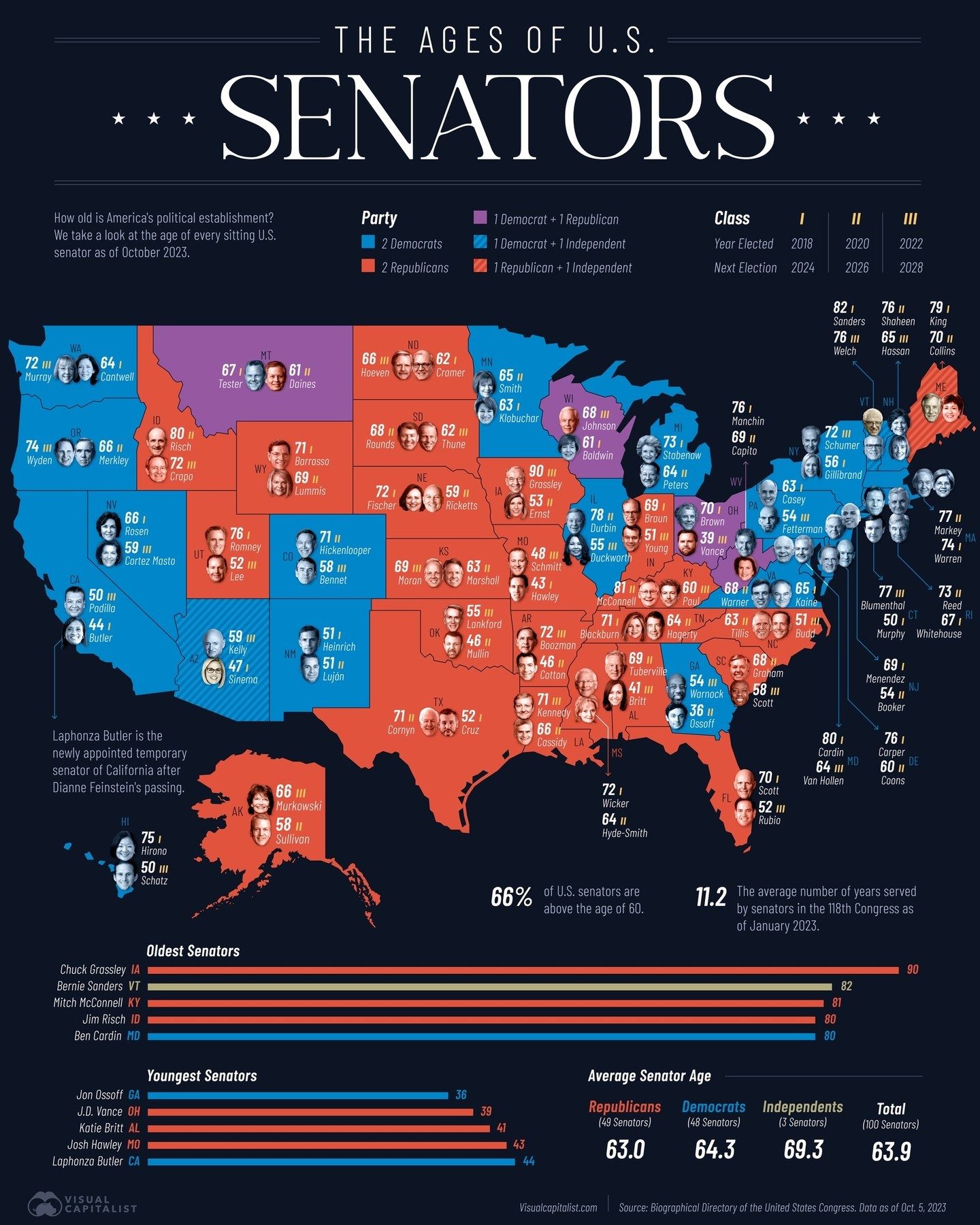
The Ages of U.S. Senators
Senators have always been older than the average American. 66% of U.S. Senators are over 60 — more than twice the national median age of 39. This age gap is a persistent feature of the Senate, and it raises important questions about the demographics of America's political leadership.
Context / Why This Matters
This discussion is about more than just numbers; it touches on the broader demographics of political leadership. The Senate's age distribution, with a median age of 65, reflects a significant generational gap between lawmakers and the general population. This disparity can influence policy priorities, generational representation, and the overall direction of legislative decisions.
Age Distribution in the Senate
By the Numbers
As of October 5, 2023, the ages of U.S. senators vary widely, but the majority fall into the 60-70 age range. For instance, Senators Lisa Murkowski (76) and Chuck Grassley (90) are among the oldest, while Jon Ossoff (38) and John Fetterman (55) represent the younger end of the spectrum. This wide range of ages is a critical factor in understanding the Senate's dynamics.
Party Breakdown
The age distribution varies by political party. The oldest senator, Chuck Grassley (R-IA), is 90, while the youngest, Jon Ossoff (D-GA), is 38. Notably, the average age of Republican senators is slightly higher than that of Democrats. For example, Senator Mike Lee (R-UT) is 52, while Senator Jon Ossoff (D-GA) is 38. This age difference can influence policy perspectives and legislative tactics.
Key Senators and Their Ages
Oldest Senators
- Chuck Grassley (R-IA): 90
- Dianne Feinstein (D-CA): 90
- Patty Murray (D-WA): 72
- John Thune (R-SD): 81
Youngest Senators
- Jon Ossoff (D-GA): 38
- Marjorie Taylor Greene (R-GA): 44
- Sarah McBath (D-GA): 45
Election Cycles and Age
The Impact of Election Years on Senate Age
Election years play a crucial role in shaping the Senate's age distribution. For example, more senators will be up for re-election in 2024, which could bring in a new cohort of younger representatives. Among the senators up for re-election are Jon Ossoff (38) and John Fetterman (55), both of whom could influence the Senate's generational dynamics in the coming years.
Trends in Election Results
The 2024 elections are particularly noteworthy because a significant number of senators will be up for re-election. Notably, 33 Republicans, 32 Democrats, and 1 Independent are set to face the voters. This election cycle could potentially shift the age demographics of the Senate, given the mix of younger and older candidates running for office.
Practical Tips
For those interested in the political landscape, understanding the age dynamics of the Senate can provide valuable insights. Here are some practical tips to stay informed:
- Follow Key Senators: Keep an eye on the activities and statements of key senators, especially those who are up for re-election. Their actions can significantly influence policy outcomes.
- Track Election Data: Pay attention to the upcoming 2024 Senate elections. The age and background of the newly elected senators could reshape the Senate's demographics and priorities.
- Engage with Policy Debates: Understand how the Senate's age distribution affects policy debates. Older senators might have different perspectives on issues such as healthcare, retirement benefits, and generational challenges compared to their younger counterparts.
Important Takeaways
- Generational Representation: The significant age gap between senators and the general population highlights the need for more generational representation in the Senate.
- Policy Perspectives: The age of senators can influence their policy perspectives, affecting issues such as retirement benefits, healthcare, and generational challenges.
- Election Dynamics: Upcoming elections, particularly in 2024, will play a crucial role in shaping the Senate's demographics and could potentially bring in a new cohort of younger representatives.
Conclusion
The age distribution of U.S. Senators provides a unique lens through which to view the Senate's dynamics. With a median age of 65, the Senate is significantly older than the general population, raising important questions about generational representation and policy priorities. As the 2024 elections approach, the age dynamics of the Senate could shift, potentially bringing in a new cohort of younger representatives who will influence the legislative landscape for years to come.
Watch the Reel
Questions readers ask
Why is the median age of U.S. Senators significantly higher than the national average?
The median age of U.S. Senators is 65, while the national average is 39. This disparity can be attributed to several factors, including the time and resources required to build a political career, as well as the tendency for older individuals to have more established networks and financial backing. Younger Americans often lack the experience and connections needed to run for the Senate.
How does the age distribution of U.S. Senators compare to the national average?
The age distribution in the Senate skews much older than the national average. Approximately 66% of U.S. Senators are over 60, compared to only 16% of the national population. This significant difference can impact the perspectives and priorities reflected in Senate debates and decisions.
What impact does the age of U.S. Senators have on policy and legislative decisions?
The older demographic in the Senate can influence policy priorities, as senators may have different experiences and perspectives compared to younger Americans. This generational gap can affect how issues like technology, healthcare, and economic policies are addressed, potentially leading to policies that may not fully represent the needs and interests of younger generations.
How does the age of U.S. Senators compare between political affiliations?
The age distribution among Senate Democrats and Republicans is relatively similar, with both parties having a median age close to 65. However, the specific age breakdown can vary, with some younger senators in both parties. This similarity in age distribution suggests that the issue of an older Senate is not solely tied to one political affiliation, but a broader trend across the Senate.
What does the age of U.S. Senators mean for generational representation in the Senate?
The high median age of U.S. Senators raises concerns about generational representation. With the majority of senators being over 60, younger Americans may feel underrepresented in policy decisions. This demographic imbalance can lead to policies that are more reflective of the experiences and needs of older adults, rather than the diverse population of the United States.
What are the implications of the Senate's age distribution for the 2024 elections?
The 2024 elections present an opportunity for younger candidates to challenge the status quo and potentially increase the diversity of age in the Senate. However, running for Senate is a complex and resource-intensive process, which can be a barrier for younger candidates. It will be important to watch how age factors into the political landscape as the elections approach.
How does the Senate's age impact issues related to technology and innovation?
The older demographic in the Senate can lead to differing views on issues related to technology and innovation. Younger generations are often more attuned to technological advancements and digital trends, which can influence their perspectives on policy decisions related to tech industries, cybersecurity, and digital infrastructure. The generational gap can affect the Senate's approach to these critical areas, potentially leading to policies that may not fully align with the needs of a more tech-savvy population.
Recent articles
Fresh deep dives from the latest Reels we unpacked.




Comments
Be the first to comment.