Financial Fraud Trends in 2025: Overview and Implications
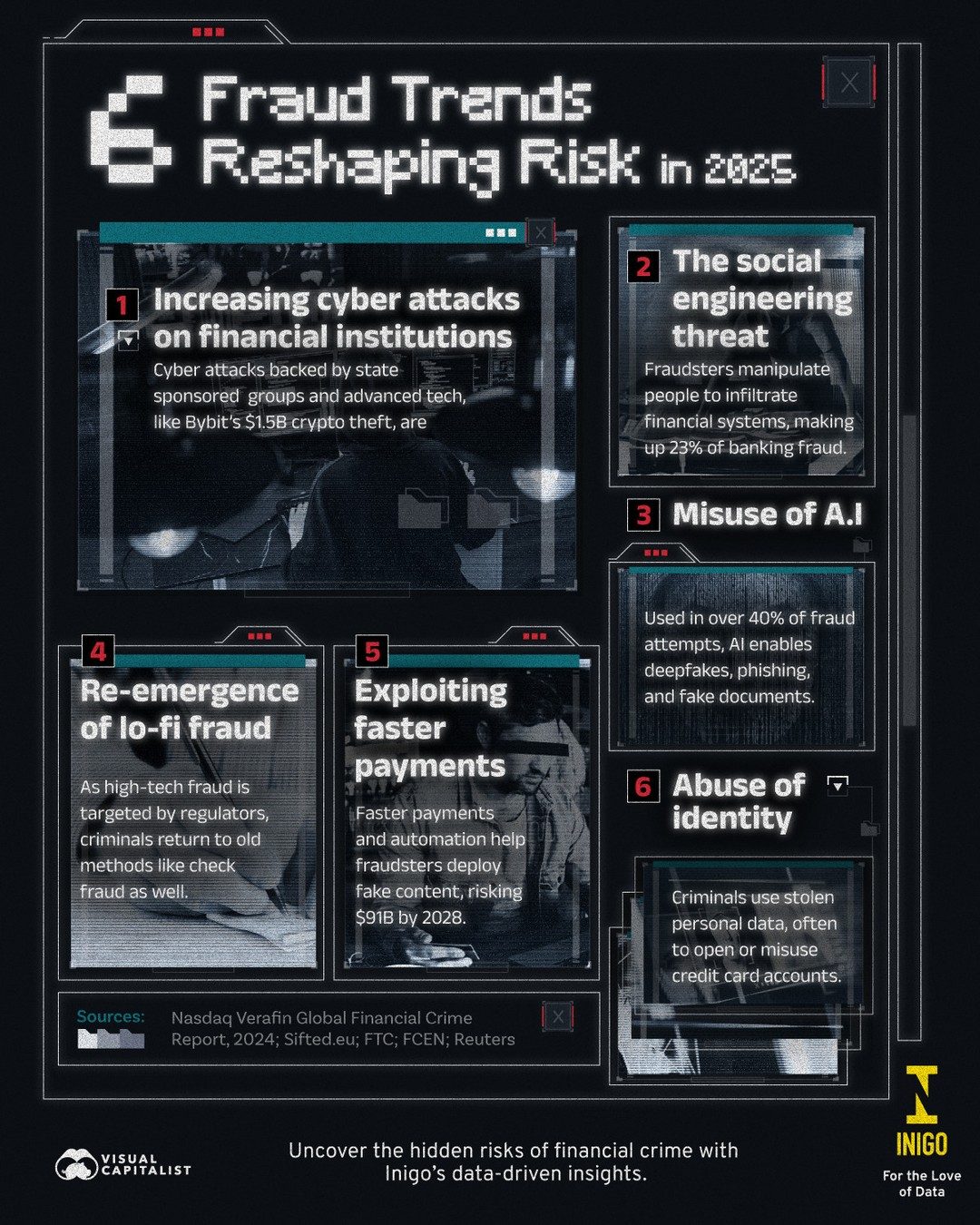
Financial fraud and financial crime are evolving rapidly, particularly as AI and other advanced technologies become more pervasive. It’s crucial to stay ahead of these trends to protect financial systems and personal data. Here, we delve into six key fraud trends that are reshaping the risk landscape in 2025, highlighting the growing threat of cyber attacks, social engineering, AI misuse, and more.
Context / Why This Matters
Financial institutions and individuals alike face significant risks from evolving fraud tactics. Understanding these trends can help in developing better defenses and mitigating potential threats.
Financial Fraud Trends in 2025
1. Increasing Cyber Attacks
Cyber attacks on financial institutions are on the rise, driven by state-sponsored groups and advanced technology. These attacks are becoming more sophisticated and damaging. For instance, Bybit experienced a $1.5B crypto theft, underscoring the scale of potential losses. Financial institutions must enhance their cybersecurity measures to counteract these threats.
2. The Threat of Social Engineering
Social engineering remains a potent tool for fraudsters. They manipulate individuals to gain access to financial systems, accounting for 23% of banking fraud. This tactic exploits human vulnerability and trust, making it a persistent and evolving threat.
3. Misuse of AI
Artificial Intelligence is increasingly being used in fraud attempts, making up over 40% of such efforts. AI enables deepfakes, sophisticated phishing schemes, and the creation of fake documents. While AI offers many benefits, its misuse poses significant risks to financial security.
4. The Return of Lo-Fi Fraud
As high-tech fraud becomes a focus for regulators, criminals are returning to more traditional methods. Check fraud and similar older tactics are making a comeback, highlighting the need for robust, multi-layered security systems that address both new and old forms of fraud.
5. Exploiting Faster Payments and Automation
Faster payments and automated systems, while beneficial for efficiency, can also be exploited by fraudsters. Criminals use these systems to deploy fake payments, taking advantage of speed and automation to evade detection. Financial institutions must ensure that their automated systems are secure and can detect fraudulent activities in real time.
6. Abuse of Identity
Identity theft remains a critical issue, with criminals using stolen personal data to open or misuse credit card accounts. This trend underscores the importance of robust identity verification and fraud detection systems. Financial institutions must prioritize customer data protection and implement stringent security measures.
Practical Tips
Enhancing Cybersecurity
- Regular Updates and Patches: Ensure that all systems and software are regularly updated to protect against known vulnerabilities.
- Advanced Threat Detection: Implement advanced threat detection systems that can identify and respond to sophisticated cyber attacks in real time.
- Employee Training: Train employees to recognize and respond to cyber threats, including phishing and social engineering attempts.
Combating Social Engineering
- Employee Awareness: Conduct regular training sessions to educate employees about the tactics used in social engineering attacks.
- Verification Protocols: Establish strict verification protocols for any requests involving sensitive information or financial transactions.
- Reporting Mechanisms: Implement easy-to-use reporting mechanisms for employees to report suspicious activities.
Mitigating AI-Mediated Fraud
- AI Security Measures: Develop and implement AI-based security measures that can detect and counter AI-mediated fraud attempts.
- Regulatory Compliance: Ensure compliance with regulatory guidelines to minimize the misuse of AI in fraudulent activities.
- Continuous Monitoring: Continuously monitor AI systems for anomalies and unauthorized access.
Addressing Lo-Fi Fraud
- Traditional Security Measures: Reinforce traditional security measures such as manual verifications and physical security protocols.
- Employee Training: Train employees to recognize and respond to older fraud tactics.
- Regular Audits: Conduct regular audits to identify and address weaknesses in traditional security measures.
Securing Faster Payments and Automation
- Real-Time Monitoring: Implement real-time monitoring systems to detect and respond to fraudulent activities in faster payment systems.
- Advanced Analytics: Use advanced analytics to identify patterns and anomalies in automated transactions.
- Customer Education: Educate customers about the risks associated with faster payments and automation, and how to protect themselves.
Protecting Identity
- Robust Verification: Implement robust identity verification processes to prevent the misuse of personal data.
- Data Encryption: Encrypt sensitive customer data to prevent unauthorized access.
- Fraud Detection Systems: Develop and use advanced fraud detection systems that can identify and respond to identity theft.
Important Takeaways
Financial fraud trends are rapidly evolving, driven by advancements in technology. It is essential to understand these trends and take proactive measures to mitigate risks. Financial institutions must enhance their cybersecurity, address social engineering threats, mitigate AI-mediated fraud, secure faster payment systems, and protect customer identity to stay ahead of these evolving risks.
Conclusion
The landscape of financial fraud is dynamic and complex, with new and old threats coexisting. By understanding these trends and implementing the right measures, financial institutions and individuals can protect themselves from the evolving risks. Staying informed and proactive is key to navigating the challenges posed by financial fraud.
Watch the Reel
Questions readers ask
What are the main financial fraud trends expected in 2025?
The main financial fraud trends expected in 2025 include the increasing threat of cyber attacks, the rise of social engineering tactics, and the misuse of AI to perpetrate financial crimes. Other notable trends involve evolving payment fraud methods and data breaches, which collectively reshape the risk landscape for financial institutions and individuals.
How is AI contributing to the evolution of financial fraud?
AI is being misused by fraudsters to create sophisticated phishing attacks, deepfakes, and automated bots that can mimic human behavior. These AI-driven tactics make it easier for criminals to bypass traditional security measures and target victims more effectively. To combat this, financial institutions are investing in advanced AI-driven fraud detection systems.
What measures can individuals take to protect themselves from social engineering fraud?
To protect themselves from social engineering fraud, individuals should be cautious of unsolicited communications, avoid sharing personal information over the phone or email, and verify the authenticity of requests through official channels. Regularly updating passwords and enabling two-factor authentication can also provide an additional layer of security.
What is the current state of cybersecurity in banking, and how is it evolving?
Cybersecurity in banking is facing increased challenges due to the rise of sophisticated cyber attacks. Banks are responding by adopting advanced cybersecurity measures, including AI-driven threat detection, blockchain technology for secure transactions, and enhanced encryption methods. Regular security audits and employee training are also crucial in maintaining robust defenses against evolving threats.
How can financial institutions mitigate the risk of data breaches in 2025?
Financial institutions can mitigate the risk of data breaches by implementing comprehensive cybersecurity protocols, regularly updating software and systems, and conducting thorough security audits. Employee training on identifying and responding to potential threats is also essential. Additionally, adopting advanced encryption technologies and multi-factor authentication can help protect sensitive data from unauthorized access.
Why are cyber attacks becoming more prevalent in the financial sector in 2025?
Cyber attacks are becoming more prevalent in the financial sector due to the increasing reliance on digital transactions and the vast amount of sensitive data held by financial institutions. Cybercriminals are leveraging advanced technologies, such as AI and machine learning, to launch more sophisticated and targeted attacks, making it crucial for institutions to enhance their cyber defenses continually.
What steps should financial institutions take to enhance their fraud prevention strategies in the face of these trends?
Financial institutions should focus on integrating AI-driven fraud detection systems, conducting regular security audits, and enhancing employee training on cybersecurity best practices. Additionally, adopting advanced encryption methods, multi-factor authentication, and real-time transaction monitoring can significantly improve fraud prevention strategies. Collaborating with industry peers and regulatory bodies can also provide valuable insights and resources for staying ahead of emerging threats.
Related deep dives
Similar reads based on topic and creator.


Recent articles
Fresh deep dives from the latest Reels we unpacked.




Comments
Be the first to comment.