U.S. Economic Projections for 2024
The U.S. economic outlook for 2024 is a topic of great interest, especially in light of the recent shifts in sentiment regarding recession fears. Throughout much of the past year, the economy has faced significant challenges, including a sharp rise in interest rates and market uncertainty. However, recent data and expert opinions suggest a growing likelihood of a soft landing, where the Federal Reserve can raise interest rates to combat inflation without triggering a recession.
Why This Matters
Understanding the economic projections for 2024 is crucial for investors, businesses, and consumers alike. The ability to anticipate economic trends can help in making informed decisions about investments, business strategies, and personal finance. The resilience of the U.S. economy has been a key factor in the recent shift in sentiment, with many investors now optimistic about the possibility of a soft landing. However, caution remains, as the economic landscape is still fraught with uncertainty.
Main Discussion
The Resilience of the U.S. Economy
The U.S. economy has shown remarkable resilience in the face of rising interest rates and market volatility. This resilience is evident in the growing optimism among investors who see a higher likelihood of a soft landing. A soft landing occurs when the Federal Reserve successfully raises interest rates to control inflation without causing a recession. This scenario is particularly important for maintaining economic stability and growth.
The Federal Reserve's Role
The Federal Reserve plays a pivotal role in managing the economy through its monetary policies, which include setting interest rates. As of the latest projections, the Fed is expected to continue raising interest rates to combat inflation. The goal is to achieve a balance where inflation is controlled without stifling economic growth. This delicate balancing act is crucial for achieving a soft landing and avoiding a recession.
Economic Forecasts Across Different Sectors
Wall Street
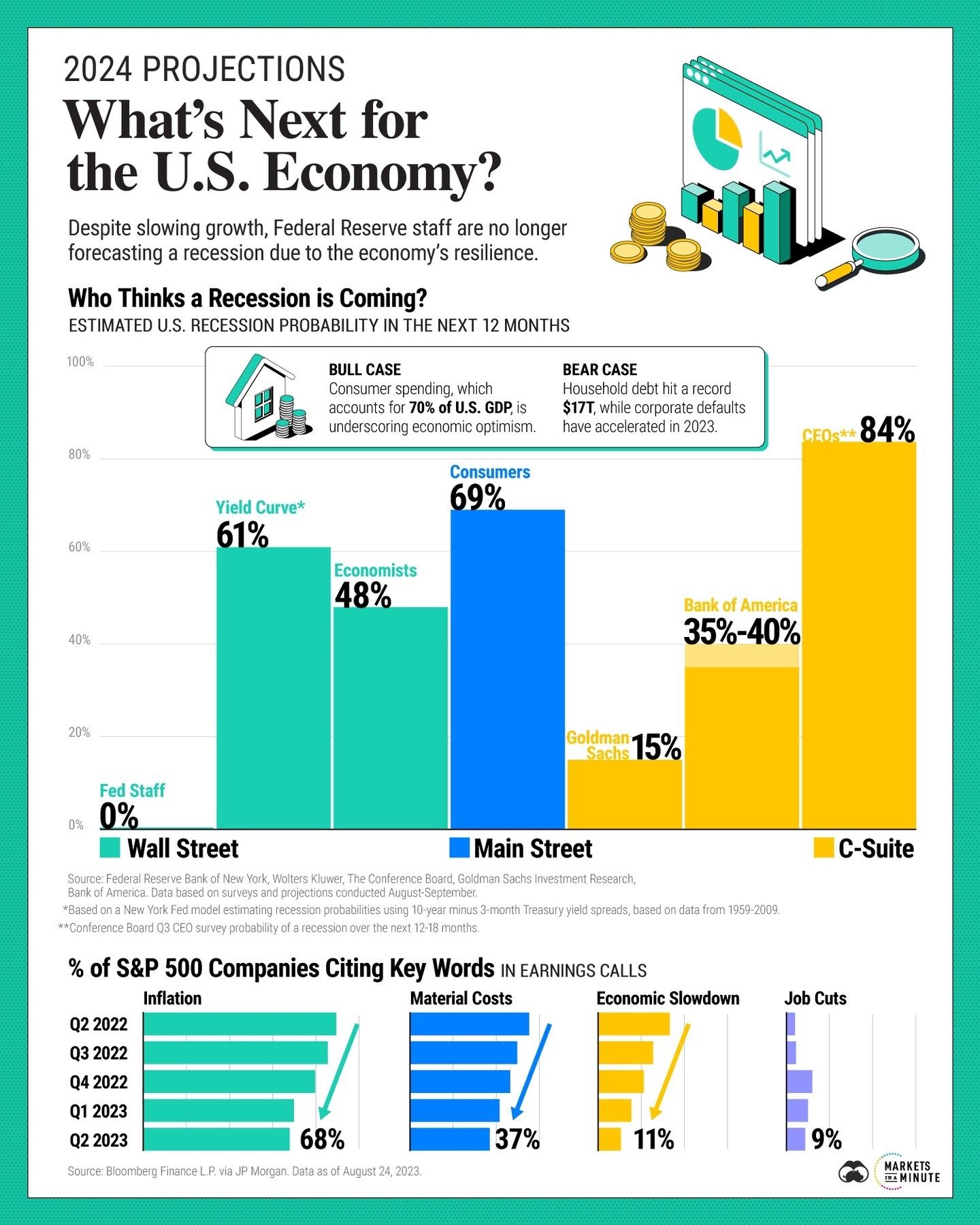
Wall Street analysts have been closely monitoring economic indicators. As of the latest projections, there is a 69% likelihood of a recession within the next 12 months. This projection is based on various economic indicators, including the yield curve, consumer spending, and household debt. The yield curve is particularly significant, with a 61% probability of a recession based on its current shape.
Main Street
Main Street, representing the general public and small businesses, has a different perspective. According to Main Street projections, there is a 48% chance of a recession. This lower probability reflects the optimism among consumers and small businesses, who are seeing continued spending and economic activity.
C-Suite Executives
C-Suite executives, who oversee the strategic direction of major corporations, have a more pessimistic outlook. They estimate an 84% chance of a recession. This high probability is likely driven by concerns over material costs, economic slowdowns, and potential job cuts, all of which are frequently mentioned in earnings calls.
Key Economic Indicators
Consumer Spending
Consumer spending is a critical indicator of economic health. Projections suggest that consumers are expected to continue spending, which could underscore economic optimism. However, household debt has reached a record $17 trillion, potentially accelerating defaults and impacting consumer spending in the long run.
Inflation and Material Costs
Inflation and material costs are significant concerns for the economy. Economic slowdowns and job cuts are also areas of focus, with many companies mentioning these factors in their earnings calls. The interplay between these factors will significantly influence the economic outlook for 2024.
Goldman Sachs' Projections
Goldman Sachs, a leading financial services firm, provides valuable insights into the economic outlook. According to Goldman Sachs, there is a 15% probability of a recession. This estimate is based on a comprehensive analysis of economic indicators and market trends. Goldman Sachs' projections are particularly influential due to their reputation and expertise in financial analysis.
Practical Tips
Navigating the economic landscape in 2024 requires a proactive approach. Here are some practical tips to help you stay informed and prepared:
Monitor Economic Indicators
Keep an eye on key economic indicators such as the yield curve, consumer spending, and household debt. These factors provide valuable insights into the economic outlook and can help you make informed decisions.
Diversify Your Portfolio
Diversifying your investment portfolio can help mitigate risks associated with economic uncertainty. Consider allocating your investments across different sectors and asset classes to protect against potential market volatility.
Stay Informed
Stay updated on the latest economic news and expert opinions. Follow reputable sources and financial analysts to gain a comprehensive understanding of the economic landscape. Goldman Sachs and other leading financial institutions often provide insightful analyses and projections.
Plan for Uncertainty
Prepare for potential economic slowdowns or recessions by maintaining a financial cushion. This can help you weather economic storms and ensure financial stability during challenging times.
Important Takeaways
Understanding the economic projections for 2024 is essential for making informed decisions. Key takeaways include:
- The U.S. economy has shown resilience, leading to growing optimism about a soft landing.
- The Federal Reserve's actions will be crucial in managing inflation and avoiding a recession.
- Economic forecasts vary across different sectors, with Wall Street, Main Street, and C-Suite executives having different perspectives.
- Key economic indicators such as consumer spending, inflation, and material costs will significantly influence the economic outlook.
- Goldman Sachs' projections provide valuable insights into the economic landscape, with a 15% probability of a recession.
Conclusion
The economic projections for 2024 present a mixed outlook, with both optimism and caution. The resilience of the U.S. economy, coupled with the Federal Reserve's actions, will play a crucial role in determining the economic trajectory. By staying informed and proactive, you can navigate the economic landscape with confidence and make informed decisions. Whether you are an investor, business owner, or consumer, understanding the economic projections for 2024 will help you prepare for the future and achieve your financial goals.
Watch the Reel
Questions readers ask
What are the main factors contributing to the uncertainty in the 2024 U.S. economic outlook?
The primary factors contributing to the uncertainty in the 2024 U.S. economic outlook include the Federal Reserve's interest rate policies, inflation rates, and market volatility. These elements are interconnected and can significantly influence economic stability and growth.
What is a 'soft landing' and why is it important for the 2024 economy?
A 'soft landing' refers to a scenario where the economy slows down just enough to curb inflation without entering a recession. It is important for the 2024 economy because it allows for stability and growth, preventing the severe economic downturns associated with a hard landing or recession.
How do Federal Reserve interest rate policies affect the 2024 economic forecast?
Federal Reserve interest rate policies play a pivotal role in the 2024 economic forecast by influencing inflation, borrowing costs, and overall market sentiment. Higher interest rates can curb inflation but may also slow economic activity, while lower rates can stimulate growth but risk fueling inflation.
What are the key economic indicators to watch in 2024?
Key economic indicators to watch in 2024 include GDP growth, unemployment rates, consumer spending, and inflation rates. These indicators provide valuable insights into the overall health of the economy and can help predict potential economic shifts and challenges.
What do economists predict about the 2024 recession probability?
Economists' views on the 2024 recession probability vary, but recent data and expert opinions suggest a growing likelihood of a soft landing. This means while there is still a risk of a recession, the economy may slow down without entering a full-blown downturn.
Why should businesses and investors pay attention to the 2024 U.S. economic projections?
Businesses and investors should pay attention to the 2024 U.S. economic projections to make informed decisions about investments, business strategies, and personal finance. Understanding these projections can help them anticipate economic trends, manage risks, and capitalize on opportunities.
What role does inflation play in the 2024 U.S. economic outlook?
Inflation is a critical factor in the 2024 U.S. economic outlook as it directly impacts purchasing power, borrowing costs, and consumer spending. High inflation can erode savings and reduce economic growth, while low inflation can signal a stable but stagnant economy.
Recent articles
Fresh deep dives from the latest Reels we unpacked.




Comments
Be the first to comment.