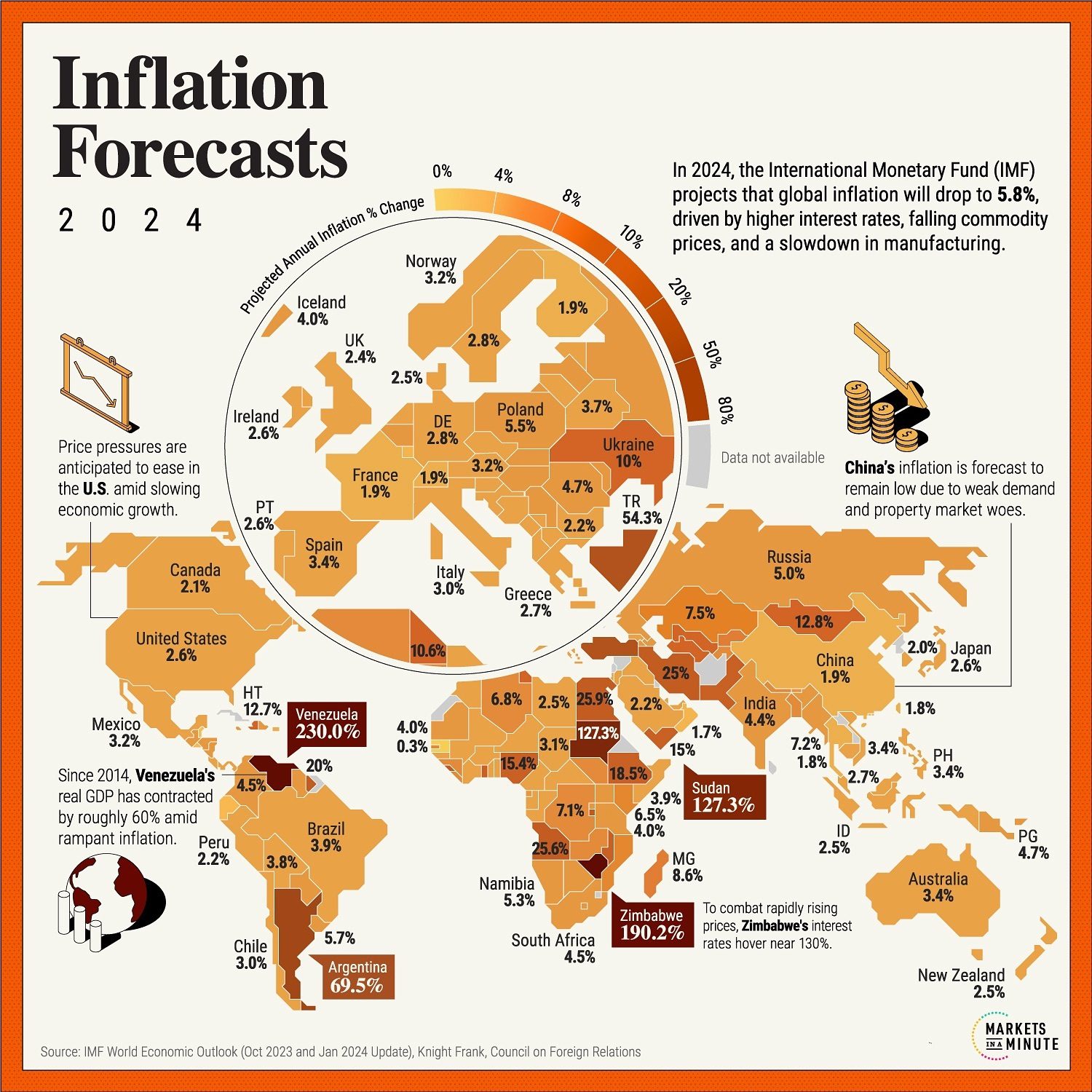
Inflation Forecasts for 2024
Global inflation is projected to decline to 5.8% in 2024, down from a 6.8% estimated annual average in 2023. This forecast is based on data from the International Monetary Fund (IMF) and includes projections for 190 countries. Economic indicators are a key area of interest for individuals and businesses alike, and understanding inflation projections can help in making informed financial decisions.
Why This Matters
Inflation is a critical economic indicator that affects everything from personal finances to global trade. When inflation is high, the purchasing power of money decreases, making goods and services more expensive. Conversely, low inflation can signal economic stability but may also indicate slow growth. Understanding these projections can help individuals and businesses plan their financial strategies more effectively.
Main Discussion
Global Inflation Trends
The IMF projects that global inflation will decrease from 6.8% in 2023 to 5.8% in 2024. This decline is a positive sign, indicating that economic pressures are easing. However, the rate of decline varies significantly across different countries. High inflation rates in some nations can lead to economic instability, impacting global trade and investment.
Specific Country Projections
Venezuela
Venezuela, with the largest oil reserves globally, is expected to see inflation reach 230% in 2024, the highest among all countries. Venezuela's economic situation has been volatile since 2014, with rampant inflation and a significant contraction in real GDP. The country's economic woes, including weak demand and property market issues, are key factors contributing to its high inflation rate.
China
China’s inflation is forecast to remain low due to weak demand and property market woes. The IMF projects that China's inflation will be relatively stable but low, reflecting the country's economic challenges and efforts to manage inflation through various monetary policies.
United States
In the United States, price pressures are anticipated to ease amid slowing economic growth. The projected inflation rate for the U.S. is 2.6%, which is lower than the global average. This indicates a more stable economic environment compared to other countries facing higher inflation rates.
Other Countries
Other notable projections include:
- Zimbabwe: With a very high inflation rate of 190.6%, Zimbabwe faces severe economic challenges. High inflation rates can lead to hyperinflation, where the value of money devalues rapidly, impacting the daily lives of citizens.
- Iceland and France: Both countries have relatively low inflation rates, with Iceland at 1.9% and France at 1.9%. This indicates stable economic conditions and effective monetary policies.
- Norway and Iceland: These countries have relatively low inflation rates, with Norway at 3.2% and Iceland at 1.9%. This indicates stable economic conditions and effective monetary policies.
- Poland and TR: Poland and Turkey (TR) have inflation rates of 3.7% and 4.7% respectively, indicating moderate inflation pressures.
Key Economic Indicators
Inflation projections are influenced by various economic indicators, including:
- Interest Rates: Central banks use interest rates to control inflation. Higher interest rates can reduce inflation by making borrowing more expensive, which can slow economic activity and reduce demand for goods and services.
- Commodity Prices: The prices of commodities like oil, metals, and agricultural products significantly impact inflation. For example, a drop in oil prices can reduce inflation, while an increase can drive it up. For instance, Venezuela’s reliance on oil makes it particularly vulnerable to fluctuations in global commodity prices.
- Monetary Policy: Central banks implement monetary policies to manage inflation. These policies can include controlling the money supply, setting interest rates, and using quantitative easing or tightening measures.
Practical Tips
Understanding inflation forecasts can help individuals and businesses make informed decisions. Here are some practical tips:
- Invest Wisely: High inflation can erode the value of investments. Consider investing in assets that are likely to perform well during inflationary periods, such as real estate or commodities.
- Review Budgeting: Inflation can impact daily expenses, so revisit your budget to account for potential price increases.
- Plan for Savings: With inflation, the value of money decreases over time. Consider savings vehicles that offer interest rates higher than the inflation rate to preserve your money's purchasing power.
- Stay Informed: Keep an eye on economic indicators and inflation forecasts. This can help you anticipate changes in the economy and adjust your financial strategies accordingly.
Important Takeaways
- Global inflation is projected to decline to 5.8% in 2024, down from 6.8% in 2023. This decline indicates easing economic pressures.
- Venezuela is expected to have the highest inflation rate, reaching 230%, due to its economic challenges and reliance on oil.
- China’s inflation is forecast to remain low due to weak demand and property market issues.
- Price pressures in the United States are expected to ease amid slowing economic growth, with a projected inflation rate of 2.6%.
- Countries like Iceland and France have relatively low inflation rates, indicating stable economic conditions.
- Stay informed about economic indicators and inflation forecasts to make better financial decisions.
Conclusion
Inflation forecasts are crucial for understanding the broader economic landscape and making informed decisions. As we move into 2024, understanding the projected inflation rates, particularly for key countries, can provide valuable insights into potential economic trends. By staying informed and adaptable, individuals and businesses can navigate through inflationary pressures more effectively, ensuring financial stability and growth.
Watch the Reel
Questions readers ask
Why is the global inflation rate expected to decrease in 2024?
The global inflation rate is projected to decrease to 5.8% in 2024 due to various factors such as monetary policy adjustments, supply chain improvements, and potential decreases in energy prices. The International Monetary Fund (IMF) has analyzed these trends to provide this forecast, which covers 190 countries.
Which countries are expected to face the highest inflation rates in 2024?
While the global average is projected to decrease, some countries will continue to grapple with high inflation rates. For instance, Venezuela is expected to have one of the highest inflation rates in the world, although specific numbers can vary. It is important for individuals and businesses to stay informed about country-specific projections.
How does the 2024 inflation forecast compare to previous years?
The 2024 inflation forecast of 5.8% represents a decrease from the estimated annual average of 6.8% in 2023. This downward trend is a positive sign for economic stability, as it indicates a slowdown in the rapid inflation experienced in recent years.
What are the key factors influencing the 2024 inflation projections?
Several factors influence the 2024 inflation projections, including global economic policies, supply chain dynamics, and commodity prices. Monetary policies implemented by central banks and changes in consumer demand also play significant roles in shaping the inflation trends for the coming year.
How will the 2024 inflation forecasts impact personal finances?
The inflation forecasts for 2024 can significantly impact personal finances by affecting the cost of living and purchasing power. Individuals should consider adjusting their savings, investments, and spending habits in response to these projections to maintain financial stability.
What can businesses expect from the 2024 inflation outlook?
Businesses should prepare for potential changes in operational costs, supply chain disruptions, and consumer spending habits. Understanding the inflation outlook can help businesses make strategic decisions about pricing, inventory management, and long-term investments to navigate the economic landscape effectively.
How accurate are the IMF's inflation forecasts, and what should we expect in 2024?
The IMF's inflation forecasts are based on extensive data and analysis, providing a reliable baseline for what to expect. However, unexpected events such as geopolitical tensions or natural disasters can cause deviations from these projections. For 2024, the IMF expects a gradual decrease in global inflation, but it is important to monitor ongoing economic developments.
Recent articles
Fresh deep dives from the latest Reels we unpacked.




Comments
Be the first to comment.