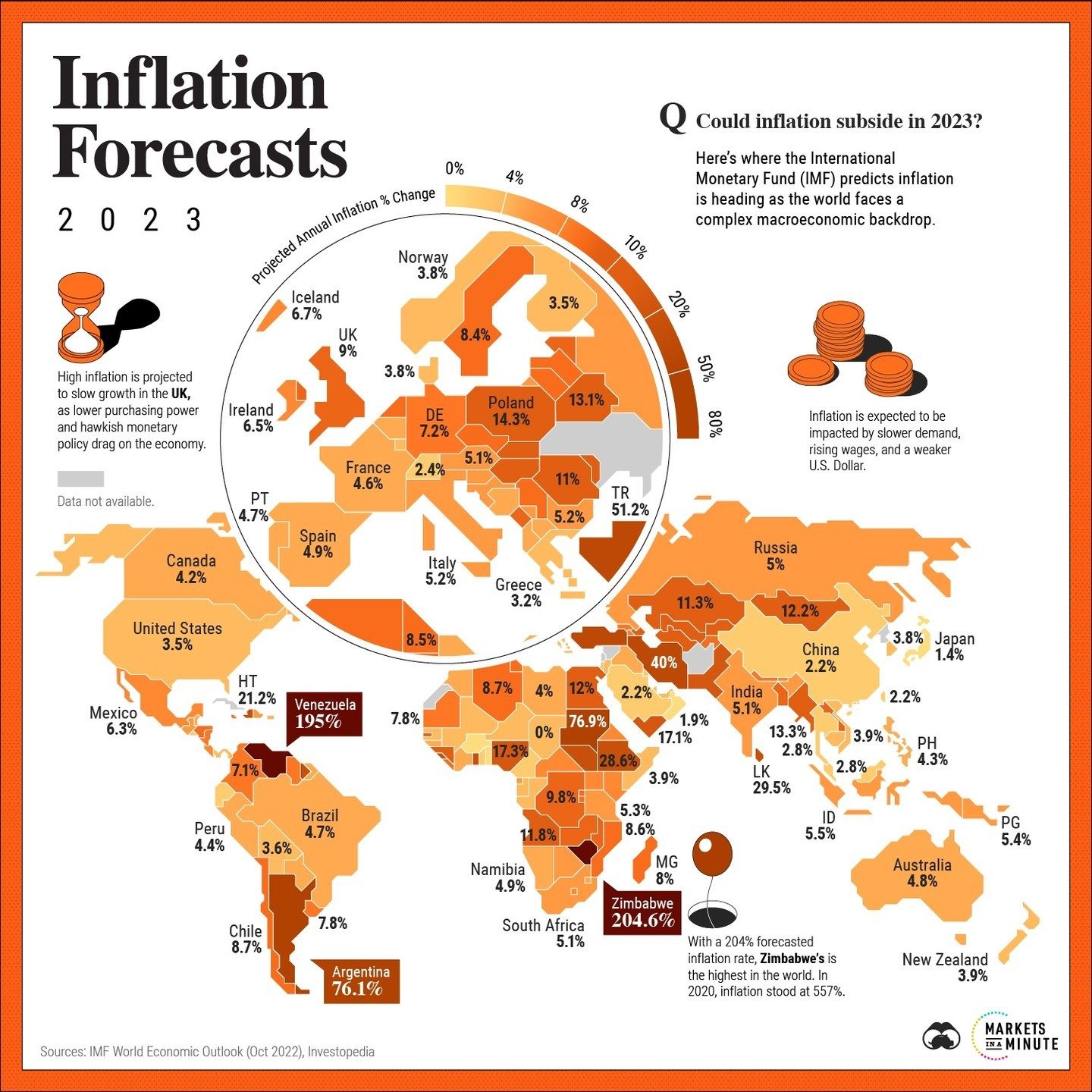
Inflation Forecasts for 2023
Inflation surged on a global scale in 2022, reaching record-level highs in many countries. Core inflation, which excludes volatile sectors like food, energy, transport, and housing, is now a significant driver of high inflation rates worldwide. As we look ahead to 2023, understanding the projected inflation rates across different countries will be crucial for economic planning and decision-making.
Why This Matters
Inflation forecasts are essential for businesses, investors, and policymakers. They help in anticipating price changes, adjusting financial strategies, and managing economic risks. The International Monetary Fund (IMF) and other economic bodies release inflation forecasts to guide policymakers and provide a global economic outlook. By focusing on core inflation, economists can better understand underlying price trends, separating the effects of volatile factors.
Inflation Forecasts by Country
North and South America
- United States: The U.S. is projected to have an inflation rate of 3.5%, which is relatively lower compared to many other countries. This projection is influenced by the Federal Reserve's monetary policy and the overall economic stability of the U.S. economy.
- Canada: Canada's forecasted inflation rate is 4.2%, slightly higher than the U.S. This is likely due to differences in economic policies and market conditions.
- Brazil: Brazil's inflation rate is predicted to be 3.7%, reflecting the country's efforts to stabilize its economy after periods of high inflation.
- Argentina: Argentina faces a projected inflation rate of 7.8%, highlighting the country's ongoing economic challenges and volatility.
- Peru: Peru is also expected to have an inflation rate of 7.8%, indicating similar economic pressures.
- Mexico: Mexico's forecast is 6.3%, reflecting moderate economic growth and inflationary pressures.
- Venezuela: Venezuela stands out with the highest projected inflation rate at 195%, a stark reminder of the country's severe economic crisis and hyperinflation.
- Chile: Chile's inflation rate is projected to be 5.4%, influenced by global commodity prices and domestic economic policies.
Europe
- United Kingdom: The UK is expected to have an inflation rate of 8.4%, driven by post-Brexit economic adjustments and global supply chain disruptions.
- Ireland: Ireland's projected inflation rate is 9%, reflecting its open economy and exposure to global market fluctuations.
- Spain: Spain is forecasted to have an inflation rate of 7.2%, impacted by energy prices and economic recovery from the COVID-19 pandemic.
- France: France's inflation rate is predicted to be 5.1%, influenced by monetary policies and economic resilience.
- Germany: Germany, Europe’s largest economy, is forecasted to have a 6.1% inflation rate, reflecting robust manufacturing and export sectors.
- Italy: Italy's projected inflation rate is 5.2%, affected by rising energy costs and economic recovery efforts.
- Greece: Greece is expected to have a 3.2% inflation rate, indicating stabilizing economic conditions post-crisis.
- Poland: Poland's inflation rate is forecasted to be 13.1%, reflecting higher energy prices and economic growth.
- Russia: Russia's inflation rate is expected to be 5.0%, influenced by the country's economic policies and global energy markets.
Asia and Africa
- China: China's inflation rate is projected to be 3.8%, reflecting stable economic growth and controlled inflation through government policies.
- Japan: Japan's forecast is 3.9%, influenced by economic recovery efforts and monetary policies.
- India: India is expected to have a 2.2% inflation rate, reflecting stable economic conditions and prudent monetary policies.
- South Africa: South Africa's inflation rate is forecasted to be 8.0%, driven by rising commodity prices and economic recovery efforts from the pandemic.
- Nigeria: Nigeria's projected inflation rate is 17.3%, reflecting economic challenges, currency fluctuations, and rising prices of essential goods.
- Zimbabwe: Zimbabwe faces an astronomical projected inflation rate of 204.6%, highlighting severe economic instability and hyperinflation.
- Turkey: Turkey’s inflation rate is forecasted to be 40.0%, reflecting economic instability and currency devaluation.
- Sri Lanka: Sri Lanka’s inflation rate is projected to be 29.5%, driven by economic crisis and soaring prices of essential commodities.
- Papua New Guinea: Papua New Guinea is forecasted to have a 5.4% inflation rate, influenced by global commodity prices and domestic economic policies.
- Madagascar: Madagascar’s inflation rate is projected to be 8.0%, reflecting economic recovery efforts and rising prices.
- Namibia: Namibia’s projected inflation rate is 4.9%, driven by global commodity prices and economic policies.
- Australia: Australia is expected to have a 3.9% inflation rate, reflecting stable economic growth and monetary policies.
- New Zealand: New Zealand’s inflation rate is forecasted to be 3.9%, influenced by economic recovery and global market conditions.
- Indonesia: Indonesia’s inflation rate is projected to be 2.2%, reflecting economic stability and prudent monetary policies.
- Philippines: The Philippines is expected to have a 4.3% inflation rate, influenced by economic recovery and global market conditions.
Practical Tips for Navigating High Inflation
- Diversify Investments: Spread investments across different asset classes to hedge against inflation and market volatility.
- Monitor Core Inflation: Keep an eye on core inflation rates to understand underlying price trends and make informed financial decisions.
- Consider Inflation-Indexed Bonds: These bonds are designed to protect investors against inflation by adjusting their principal and interest payments based on changes in the Consumer Price Index (CPI).
- Adjust Savings Strategies: Inflation can erode savings over time. Consider investing in assets that have the potential to outpace inflation, such as real estate or commodities.
- Review and Adjust Budgets: Regularly review and adjust budgets to account for rising prices and ensure financial stability.
Important Takeaways
- Global Trends: Inflation is a global phenomenon, affecting countries across different continents and economic conditions.
- Core Inflation: Core inflation provides a clearer picture of underlying price trends by excluding volatile sectors.
- Economic Policies: Government and central bank policies play a crucial role in managing inflation and stabilizing economies.
- Diversification: Diversifying investments and savings strategies can help mitigate the risks associated with high inflation.
Conclusion
Inflation forecasts for 2023 highlight the importance of understanding economic trends and their potential impact on global markets. By focusing on core inflation and considering practical tips, individuals and businesses can better navigate the challenges posed by high inflation. Staying informed about global economic conditions and adjusting financial strategies accordingly will be essential for managing economic risks and achieving financial stability in the coming year.
Watch the Reel
Questions readers ask
Which countries are expected to have the highest inflation rates in 2023?
Countries with the highest inflation rates in 2023 are likely to include Argentina, Venezuela, and Sudan. These countries have historically faced significant economic challenges that contribute to high inflation. For instance, Argentina's inflation rate is projected to reach around 100% in 2023, making it one of the highest in the world.
How is core inflation different from general inflation, and why is it important?
Core inflation excludes volatile sectors like food, energy, and housing from its calculations. It provides a more stable measure of inflation trends. This makes it a crucial metric for policymakers and businesses to make informed decisions about economic strategies and long-term planning.
What role do IMF forecasts play in understanding global inflation trends?
The International Monetary Fund (IMF) provides key insights into global economic trends, including inflation forecasts. These forecasts help policymakers, businesses, and investors anticipate price changes, adjust their financial strategies, and manage economic risks. The IMF's inflation forecasts are a significant tool for global economic planning.
How can businesses and investors use 2023 inflation forecasts to their advantage?
By understanding the inflation forecasts for 2023, businesses can adjust their pricing strategies, manage costs, and make informed investment decisions. Investors can also use this information to allocate resources, hedge against inflation risks, and identify opportunities in countries with stable inflation rates.
What are the global inflation trends expected in 2023?
In 2023, global inflation is expected to remain high, although it may vary significantly by region and country. Core inflation, which excludes volatile sectors, will be a key driver of these trends. Countries with high inflation rates will likely continue to face economic challenges, while those with lower rates may experience more stable economic conditions.
Which countries are projected to have the lowest inflation rates in 2023?
Countries like Japan, Switzerland, and Singapore are expected to have lower inflation rates in 2023. These countries are known for their stable economic policies and effective monetary controls. For example, Japan's inflation rate is projected to be around 2.0% in 2023, reflecting its longstanding commitment to price stability.
What factors contribute to the variation in inflation rates across countries in 2023?
Several factors contribute to the variation in inflation rates, including monetary policies, fiscal policies, exchange rates, and global economic conditions. Countries with strong economic fundamentals and effective policy measures are likely to experience lower inflation rates, while those facing economic instability and high levels of debt may see higher inflation.
Recent articles
Fresh deep dives from the latest Reels we unpacked.




Comments
Be the first to comment.