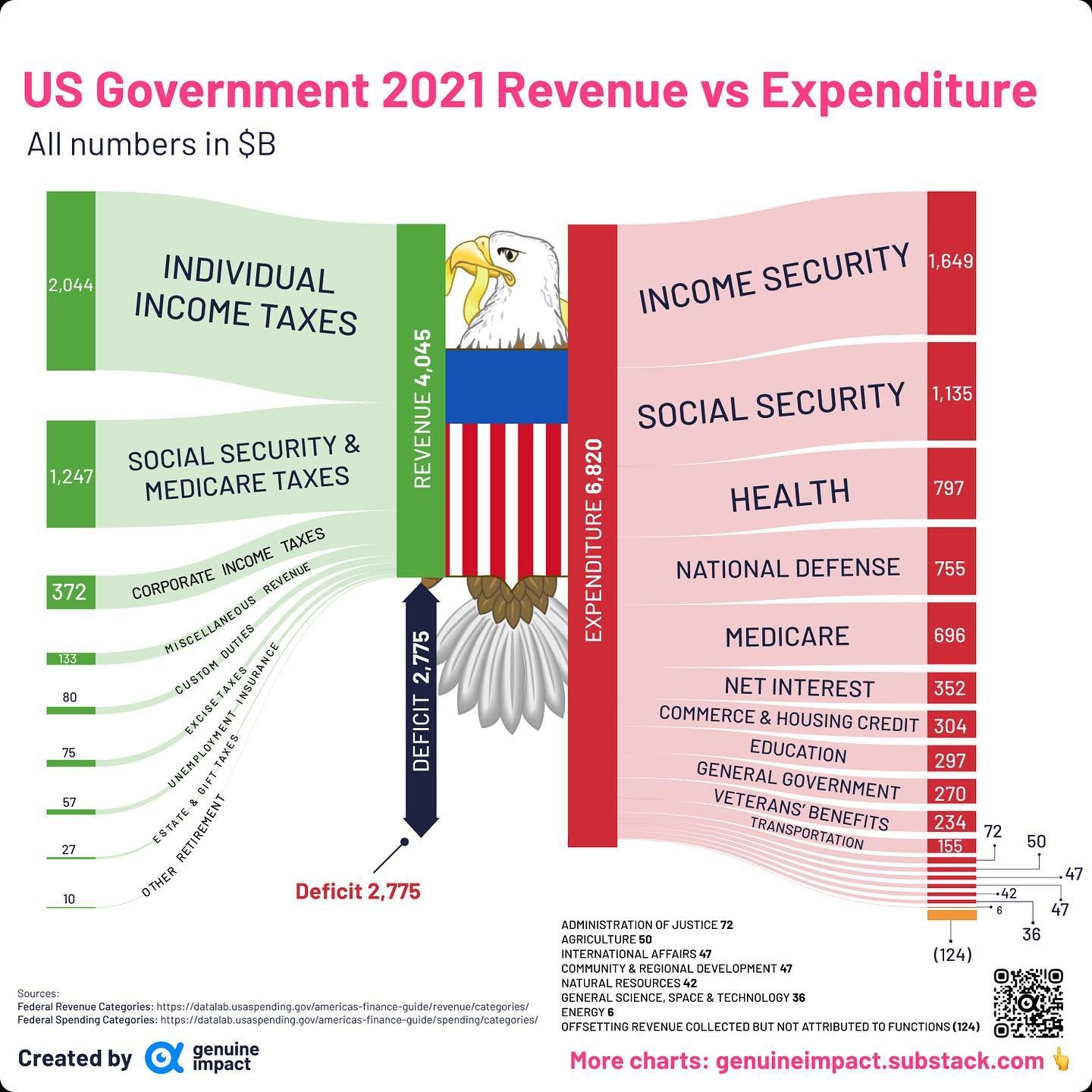
The Breakdown of US Government Revenue and Expenditure in 2021
U.S. federal spending in 2021 amounted to a staggering $6.82 trillion. This enormous sum was allocated to various expenditures and government-aided programs. Understanding where this money came from and how it was spent provides valuable insight into the financial mechanics of the U.S. government.
Why This Matters
Federal spending directly impacts the economy, public services, and the lives of citizens. Diving into the specifics of 2021's financial data can help individuals and policymakers grasp the scope of government activities and the role of taxpayer dollars. This knowledge can foster informed discussions about budget priorities and the future direction of government funding.
Main Discussion
Revenue Sources
Federal revenue in 2021 totaled $4.004 trillion. The primary source of income was individual income taxes, which accounted for $2.044 trillion. This represents more than half of the total revenue, highlighting the significant role that individual taxpayers play in funding government programs.
Other substantial revenue streams include Social Security and Medicare taxes, which contributed $1.247 trillion and $75 billion respectively. Corporate taxes added $297 billion to the coffers, while other taxes and duties rounded out the total revenue with $352 billion.
Expenditure Categories
Spending in 2021 was categorized into major areas:
- National Defense: $797 billion was allocated for national defense, making it one of the largest expenditure categories.
- Medicare: $696 billion was spent on Medicare, reflecting the significant investment in healthcare for the elderly.
- Social Security: $1.135 trillion was dedicated to Social Security, ensuring that millions of Americans receive retirement, disability, and survivor benefits.
- Health and Human Services: $304 billion was allocated to this sector, which covers a wide range of programs aimed at improving public health and social services.
- Agriculture: $270 billion was spent on agricultural programs, which include subsidies, food assistance, and conservation efforts.
- Veterans Benefits and Services: $270 billion was directed toward supporting veterans, including healthcare, pensions, and other benefits.
Deficit and Surplus
The deficit for 2021 stood at $2.775 trillion. This figure represents the shortfall between what the government spent and what it earned through taxes and other revenues. It underscores the significant financial challenges faced by the government and the need for strategic budgeting and financial planning.
Practical Tips
Understanding federal spending and revenue can be complex, but breaking it down into manageable components can make it more accessible. Here are some practical tips for interpreting this data:
- Focus on Major Categories: Concentrate on the largest expenditure and revenue categories to get a clear picture of where the government spends the most. For example, individual income taxes and Social Security are key areas.
- Look at Trends: Comparing data across multiple years can reveal trends. For instance, how did the deficit change from previous years, and what factors contributed to these changes?
- Consider the Impact of Policies: Understand how specific policies, such as tax cuts or increased spending in healthcare, affect overall revenue and expenditure.
- Explore Interactive Tools: If available, utilize interactive visualizations or tools that can break down the data by category, year, or other metrics. These can provide a more detailed and personalized view of the financial landscape.
Important Takeaways
- Individual Income Taxes: These are the largest source of revenue, emphasizing the importance of individual taxpayers in funding government operations.
- Major Expenditures: Significant portions of the budget go to national defense, Social Security, and healthcare, reflecting the government's priorities.
- Deficit: The large deficit indicates the financial challenges faced by the government, which have significant implications for future budgets and fiscal policy.
Conclusion
The 2021 breakdown of U.S. federal revenue and expenditure offers a comprehensive view of the government's financial landscape. By examining where the money comes from and how it is spent, we can gain a better understanding of the economic and social priorities of the nation. This insight is invaluable for policymakers, economists, and citizens alike, as it informs discussions about future budget allocations and the efficient use of taxpayer dollars. For a deeper dive into this data, explore resources, such as genuineimpact.substack.com, which offer detailed analyses and visualizations.
Watch the Reel
Questions readers ask
What were the top areas of expenditure in the 2021 U.S. federal budget?
The 2021 U.S. federal budget allocated the most funds to social security, healthcare, and national defense. Social security, including benefits for retirees and disabled individuals, consumed the largest portion of the budget. Healthcare spending, primarily through Medicare and Medicaid, was also substantial. National defense, encompassing military spending and veterans' benefits, was the third-largest area of expenditure.
How does the U.S. government generate revenue to fund its expenditures?
The U.S. government generates revenue primarily through individual and corporate income taxes, as well as payroll taxes for social security and Medicare. Other significant sources include excise taxes, customs duties, and the Federal Reserve's earnings. These funds are used to support the wide range of programs and services provided by the government.
What was the total amount spent by the U.S. government in 2021?
In 2021, the U.S. government spent a total of $6.82 trillion. This substantial sum reflects the extensive role of the federal government in supporting various programs, services, and initiatives across the nation.
How does federal spending on healthcare compare to other major expenditures?
Federal spending on healthcare, primarily through Medicare and Medicaid, was a significant portion of the 2021 budget. It ranked as the second-largest expenditure after social security. Healthcare spending is crucial for supporting the health and well-being of millions of Americans, particularly the elderly and low-income individuals.
How does federal spending on national defense contribute to the economy?
Federal spending on national defense supports not only military operations and veterans' benefits but also stimulates economic activity. This spending creates jobs, drives innovation in defense technology, and contributes to the infrastructure of communities where military bases and defense contractors are located.
What is the significance of understanding the federal budget breakdown?
Understanding the federal budget breakdown is essential for citizens and policymakers to evaluate how public funds are utilized. It provides transparency into government priorities and helps inform debates about resource allocation and future funding decisions. This knowledge enables individuals to participate meaningfully in discussions about the government's financial influence on the economy and public services.
How does federal spending on social services impact the economy?
Federal spending on social services, including programs like Medicaid and Social Security, supports a substantial portion of the U.S. population. This spending helps maintain the economic stability of families and communities by providing financial support and essential services. Additionally, it stimulates economic activity by generating jobs in the healthcare and service sectors.
Recent articles
Fresh deep dives from the latest Reels we unpacked.




Comments
Be the first to comment.