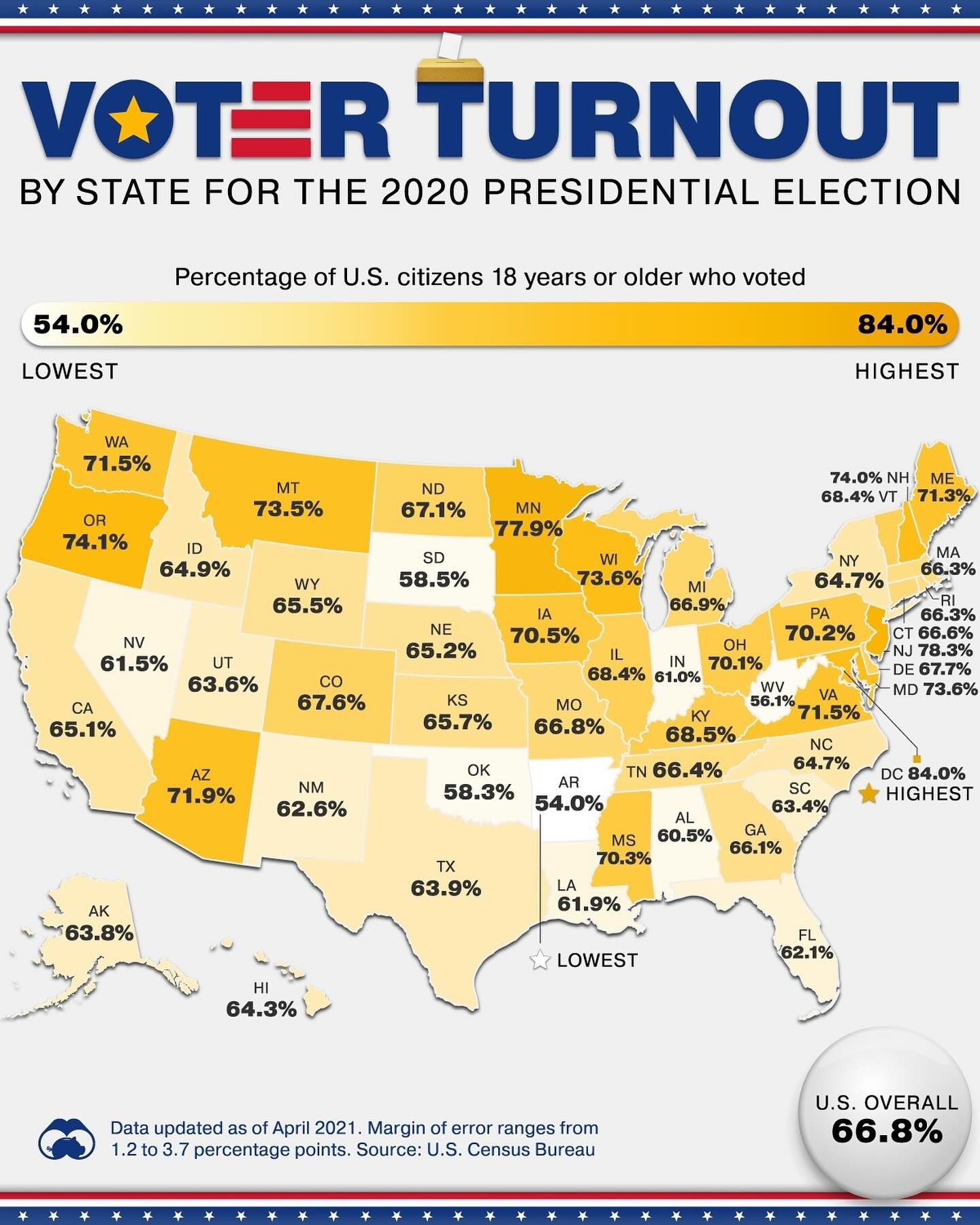
Voter Turnout by State for the 2020 Presidential Election
The 2020 U.S. Presidential Election set a significant record with the highest voter turnout of the 21st century. As another pivotal election approaches, understanding past voter turnout trends can provide valuable insights. This article reflects on the state-by-state voter turnout data from the 2020 election, sourced from the U.S. Census Bureau.
Context / Why This Matters
Voter turnout is a critical indicator of public engagement in the democratic process. The 2020 election saw unprecedented participation, with 66.8% of eligible voters casting their ballots. This level of engagement underscores the importance of understanding regional variations in voter participation. By examining the state-by-state data, we can identify patterns and factors that influence voter turnout, which can inform future electoral strategies and policies aimed at increasing civic engagement.
Main Discussion
Highest and Lowest Turnouts
The 2020 election saw wide variation in voter turnout across the states. Maine and Vermont led the nation, with 71.3% and 74.0% of eligible voters participating, respectively. These states have historically high turnout rates, often attributed to strong civic engagement, robust voting infrastructure, and inclusive voting policies. At the other end of the spectrum, Arkansas had the lowest turnout at 54.0%, followed closely by Oklahoma and South Dakota. These states faced challenges such as voter suppression, lack of voter outreach, and limited resources for voting initiatives.
Regional Trends
The infographic highlights several regional trends. The Northeast and Midwest regions generally had higher turnout rates, with states like Minnesota, Wisconsin, and New Jersey surpassing the national average. The Southeast and Southwest regions, including states like Texas and Florida, had lower turnout rates, indicating potential areas for improvement in voter mobilization and engagement.
Northeast
States in the Northeast, such as New Hampshire and Vermont, consistently rank high in voter turnout. This region benefits from strong traditions of civic participation and comprehensive voting policies. For example, New Hampshire's "first-in-the-nation" primary status often spurs higher engagement, while Vermont's early adoption of mail-in voting and same-day registration has facilitated easier access to the ballot.
Midwest
The Midwest also showed robust turnout, with states like Minnesota and Wisconsin leading the way. These states have implemented various measures to enhance voter access, including early voting, automatic voter registration, and same-day registration. Additionally, the Midwest has a history of strong community engagement and civic organizations that actively promote voter participation.
Southeast
The Southeast, however, faced significant challenges in voter turnout. States like Alabama and Mississippi had lower participation rates, often due to historical factors, voter suppression, and limited resources for voter outreach. Efforts to expand voting rights and improve access to the ballot box are crucial in this region to boost turnout and ensure equitable representation.
Southwest
The Southwest also had lower turnout rates, with Arizona and Texas lagging behind national averages. These states have large populations and diverse demographics, which present unique challenges and opportunities for voter mobilization. Efforts to increase voter turnout in these regions often focus on language accessibility, voter education, and expanding the availability of early voting and mail-in ballots.
Factors Influencing Turnout
Several factors influence voter turnout, including demographic characteristics, voting policies, and civic engagement. Younger voters, for instance, tend to have lower turnout rates compared to older voters. States with higher proportions of younger populations, such as Nevada and New Mexico, may see lower overall turnout. In contrast, states with older populations, like Maine and Vermont, typically have higher turnout rates.
Practical Tips
For those interested in boosting voter turnout in their communities, several practical steps can be taken:
Voter Registration Drives
Organize voter registration drives in schools, community centers, and public events to ensure that eligible voters are registered and informed about the voting process. Partnering with local organizations and leveraging social media can help reach a broader audience.
Public Awareness Campaigns
Launch public awareness campaigns to educate voters about the importance of their participation and the impact of their votes. Use storytelling and relatable examples to make the message more engaging and relatable.
Accessible Voting Options
Advocate for policies that make voting more accessible, such as early voting, mail-in ballots, and same-day registration. Support initiatives that remove barriers to voting, such as reducing wait times at polling stations and providing language assistance for non-English speakers.
Important Takeaways
Understanding the 2020 voter turnout data by state provides valuable insights into the factors influencing voter participation. States with higher turnout rates often have robust voting infrastructure, inclusive policies, and strong civic engagement. Conversely, regions with lower turnout face challenges that require targeted interventions to improve voter access and participation. By reflecting on these trends, policymakers, community leaders, and individuals can work towards enhancing voter turnout and ensuring equitable representation in future elections.
Conclusion
The 2020 U.S. Presidential Election marked a historic milestone with the highest voter turnout of the 21st century. By examining the state-by-state turnout data, we can identify patterns and factors that influence voter participation. This knowledge is essential for developing strategies to increase civic engagement and ensure inclusive and representative democracy. As we approach the next pivotal election, reflecting on past trends can guide us towards a more participatory and equitable political landscape.
Watch the Reel
Questions readers ask
Which states had the highest voter turnout in the 2020 U.S. Presidential Election?
Maine and Vermont led the nation with the highest voter turnout in the 2020 election, with both states reporting turnout rates above 78%. Minnesota, Colorado, and New Hampshire also ranked highly, each surpassing 75% turnout.
What was the overall voter turnout rate in the 2020 U.S. Presidential Election?
The 2020 U.S. Presidential Election saw a historic turnout rate of 66.8% of eligible voters. This was the highest voter turnout of the 21st century.
Which state had the lowest voter turnout in the 2020 election?
Arkansas reported the lowest voter turnout in the 2020 election, with approximately 58.5% of eligible voters participating. This was significantly lower than the national average.
What factors might influence regional variations in voter turnout?
Several factors can influence regional variations in voter turnout. These include state voting laws, the competitiveness of local and national races, and the level of civic engagement within the community. Additionally, demographic factors and access to voting resources can also play a significant role.
How does the 2020 voter turnout compare to previous elections?
The 2020 voter turnout of 66.8% was the highest in the 21st century, surpassing previous highs from 2008 and 2016. This increase reflects a significant rise in public engagement and participation in the democratic process.
Why is state-by-state voter turnout data important to analyze?
Examining state-by-state voter turnout data provides a nuanced understanding of public engagement across the nation. It helps identify trends, such as which regions have high or low participation, and can inform efforts to encourage greater civic involvement in future elections.
What role did voter participation trends in 2020 play in the broader context of U.S. elections?
The 2020 voter turnout trends are pivotal in understanding the broader context of U.S. elections. The high participation rates and regional variations can serve as a benchmark for future elections, helping to shape policies and strategies aimed at enhancing public involvement in the democratic process.
Related deep dives
Similar reads based on topic and creator.


Recent articles
Fresh deep dives from the latest Reels we unpacked.




Comments
Be the first to comment.