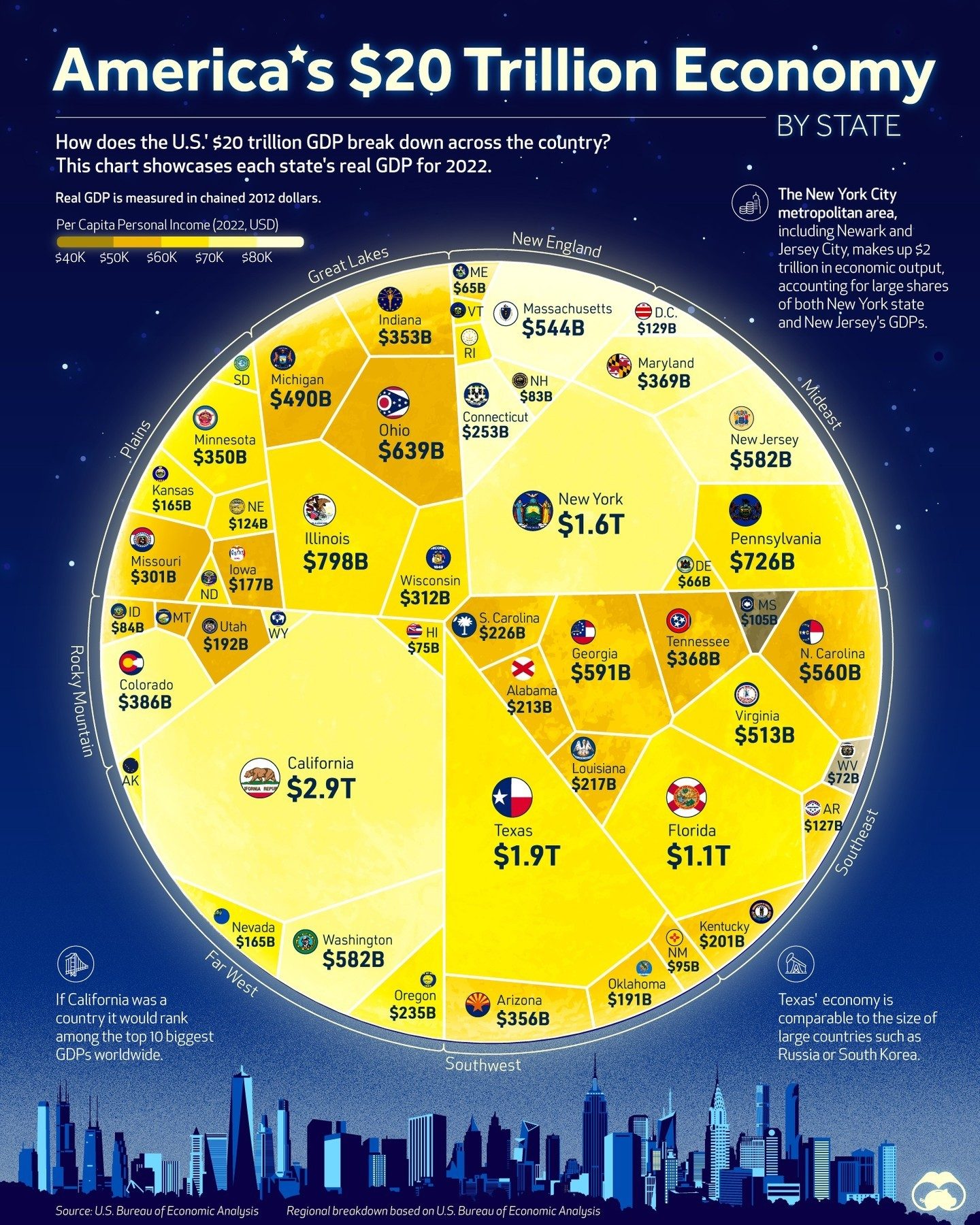
America's $20 Trillion Economy: A State-by-State Breakdown
The United States economy is a complex, multi-faceted system with each state contributing significantly to the overall national output. With a total GDP of $20 trillion, the U.S. economy is not only the world’s largest but also one of the most diverse. This breakdown provides a detailed look at how this massive economic output is distributed across the country.
Why This Matters
Understanding the economic contributions of each state is crucial for various reasons. It helps policymakers allocate resources effectively, businesses identify growth opportunities, and individuals grasp the economic dynamics of their regions. Each state's economic output is a testament to its unique industries, workforce, and economic policies.
The Economic Powerhouses
California: The Largest Contributor
California leads the nation with a GDP of $2.9 trillion. This is not surprising given the state's dominance in technology, entertainment, and agriculture. Silicon Valley alone is a global hub for innovation, housing some of the world's most valuable companies. The state's diverse economy makes it a significant driver of the national GDP.
Texas: Comparable to South Korea
Texas follows closely with a GDP of $1.9 trillion, making its economic output comparable to that of South Korea. The state's economy is fueled by industries such as energy, technology, and healthcare. Texas is also a major player in the global energy market, with a significant contribution from the oil and gas sector.
New York: The Financial Capital
New York’s GDP stands at $1.6 trillion. Known as the financial capital of the world, New York City is home to Wall Street and some of the largest financial institutions globally. The state's economy also benefits from sectors like media, fashion, and tourism, making it a major economic force.
Florida: The Sunshine State
Florida, with a GDP of $1.1 trillion, is another economic powerhouse. Its economy is driven by tourism, aerospace, and international trade. Florida's warm climate and beautiful beaches attract millions of tourists annually, contributing significantly to its economic output.
Regional Economic Contributions
The Northeast
The Northeast, including states like Massachusetts, New Jersey, and Connecticut, is a hub for technology, healthcare, and finance. Massachusetts, with a GDP of $544 billion, is particularly notable for its biotechnology and research institutions. New Jersey, with $582 billion, benefits from its proximity to New York City, while Connecticut's GDP of $253 billion is bolstered by its strong financial and insurance sectors.
The Midwest
The Midwest, encompassing states like Illinois, Ohio, and Michigan, is known for its manufacturing prowess. Illinois, with a GDP of $798 billion, is a leader in manufacturing, agriculture, and services. Ohio, with $312 billion, contributes significantly to the automotive and aerospace industries. Michigan, another manufacturing hub, has a GDP of $639 billion, driven by the automotive sector.
The South
The Southern states, including Texas, Florida, and Georgia, are crucial to the national economy. Texas, as mentioned, is a leader in energy and technology, while Florida’s economy is driven by tourism and aerospace. Georgia, with a GDP of $591 billion, benefits from its strong logistics and automotive sectors.
The West
The Western states, such as California, Washington, and Colorado, are known for their technology and outdoor recreation industries. Washington, with a GDP of $490 billion, is a hub for technology and aerospace. Colorado, with $386 billion, benefits from its thriving tech sector and outdoor recreation industry.
Personal Income Per Capita
Per capita personal income varies widely across the states. High-income states like Connecticut ($80K), New Jersey ($80K), and Massachusetts ($70K) reflect their strong economies and high cost of living. Conversely, states like Mississippi ($40K) and Arkansas ($40K) have lower per capita incomes, indicating a need for economic development and job growth.
Key Economic Indicators
GDP
Gross Domestic Product (GDP) is a crucial indicator of a state's economic health. Measured in chained 2012 dollars, it provides a standardized way to compare economic output over time. States with higher GDPs typically have robust economies, diverse industries, and a strong workforce.
Per Capita Personal Income
Per capita personal income is another vital metric. It measures the average income earned by individuals in a state, providing insight into the economic well-being of its residents. States with higher per capita incomes often have better economic opportunities and a higher standard of living.
Practical Tips
For those looking to understand the economic landscape better, here are some practical tips:
For Businesses
- Identify Growth Opportunities: Understand the economic strengths of different regions to identify growth opportunities. For example, the Midwest’s manufacturing hubs and the Northeast’s financial sector offer unique business advantages.
- Leverage Regional Strengths: Tailor your business strategies to leverage the unique strengths of each region. For instance, consider the technology and aerospace sectors in California and Washington.
For Individuals
- Evaluate Job Opportunities: Look at states with higher per capita incomes for better job opportunities and higher wages. States like Connecticut, New Jersey, and Massachusetts offer robust economic opportunities.
- Invest Wisely: Consider investing in states with strong economies and diverse industries. States like California, Texas, and New York provide ample investment opportunities across various sectors.
Important Takeaways
Each state in the U.S. contributes uniquely to the nation’s economy. Understanding these contributions helps in making informed decisions, whether you are a business owner, investor, or individual looking to relocate. The economic diversity of the U.S. is a strength, providing opportunities across various sectors and regions.
Conclusion
The U.S. economy is a complex web of interrelated states, each contributing significantly to the national GDP. From the economic powerhouses of California and Texas to the manufacturing hubs of the Midwest and the technology centers of the West, every region plays a crucial role. By understanding the economic dynamics of each state, one can gain valuable insights into the broader economic landscape of the United States.
Watch the Reel
Questions readers ask
Which states have the largest economies in the US?
California, Texas, and New York have the largest economies. Together, they contribute a combined $6.4 trillion to the total $20 trillion US GDP. These states are known for their diverse and robust economic sectors, including technology, finance, and energy.
How does the US economy compare to other countries?
The US economy is the world's largest, with a GDP of $20 trillion. This makes it significantly larger than the economies of other major countries, such as China and Japan. The US economy's size and diversity are driven by the varied contributions of each state, reflecting the nation's economic strengths and resilience.
Why is it important to understand the economic contributions of each state?
Knowing the economic contributions of each state provides valuable insights into the overall health and dynamics of the US economy. It helps in effective resource allocation, identifies growth opportunities, and helps individuals and businesses understand the economic landscape of their regions. Additionally, it highlights the importance of each state's unique industries and workforce.
How do state economies contribute to the overall US economic power?
Each state's economy brings unique strengths to the table, from agriculture and manufacturing to technology and finance. These diverse contributions collectively drive the US economy, making it a global powerhouse. For instance, California’s tech industry, Texas’s energy sector, and New York’s financial capabilities are critical to the nation’s economic performance.
How does the economic performance of states vary across the US?
The economic performance of states varies widely. Some states, like California and New York, have high GDPs due to their large populations and diverse economic activities. Others, such as Wyoming or North Dakota, have smaller economies but significant contributions from specific sectors, like energy. Understanding these variations is key to grasping the full picture of the US economy.
Related deep dives
Similar reads based on topic and creator.

Recent articles
Fresh deep dives from the latest Reels we unpacked.




Comments
Be the first to comment.