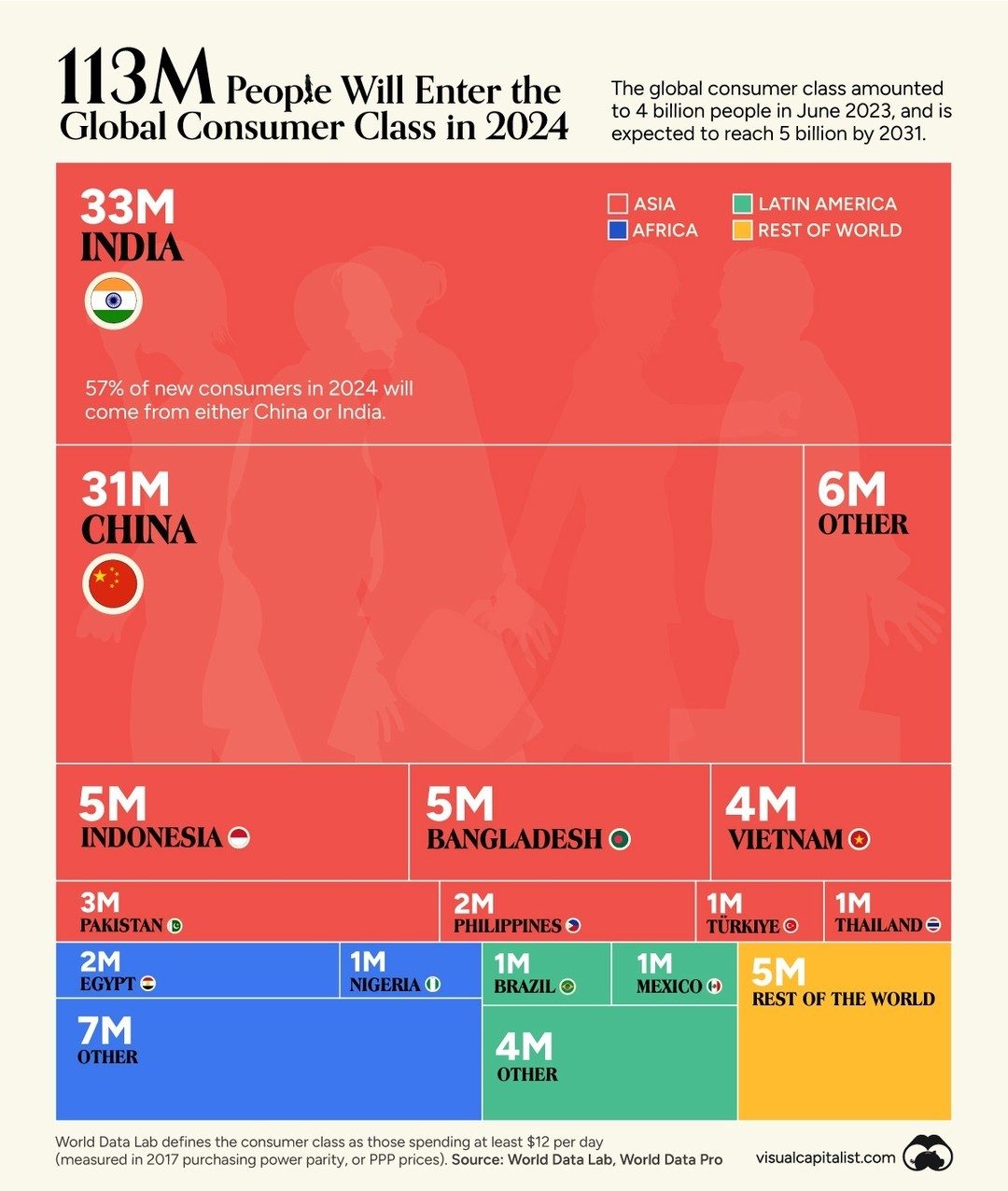
Global Consumer Class Growth
The global consumer class is poised for significant growth, with projections indicating that over 113 million people will enter this economic bracket by 2024. This influx is primarily driven by individuals in developing regions, particularly in Asia and Africa, who are achieving a daily spending power of at least $12, as measured by 2017 purchasing power parity (PPP) standards.
Why This Matters
The expansion of the global consumer class is a critical indicator of economic development and global wealth distribution. As more people enter the middle class, they gain increased purchasing power, which can drive economic growth, foster innovation, and improve standards of living. Understanding where and how this growth is occurring provides valuable insights into future market trends and economic opportunities.
Main Discussion
Defining the Consumer Class
The World Data Lab defines the consumer class as individuals who spend at least $12 per day, adjusted for 2017 PPP. This threshold helps identify those who have enough disposable income to participate in the global economy as consumers. This definition is crucial for understanding the economic landscape and the potential for market growth in various regions.
Key Contributors to Consumer Class Growth
India and China
India and China are set to be the primary contributors to the global consumer class in 2024, accounting for 57% of the new consumers. India alone is expected to add 33 million new consumers, while China will contribute 31 million. This significant growth in both countries is driven by rapid urbanization, economic reforms, and technological advancements that have improved living standards and increased disposable incomes.
Southeast Asia
Southeast Asia, particularly countries like Indonesia, Bangladesh, and the Philippines, will also see substantial growth. Indonesia is projected to add 5 million new consumers, Bangladesh 5 million, and the Philippines 2 million. These countries have been experiencing robust economic growth, driven by sectors such as manufacturing, services, and technology. Additionally, initiatives aimed at reducing poverty and enhancing access to education and healthcare have contributed to the rising number of consumers.
Other Significant Contributors
Other regions, including Vietnam, Egypt, Nigeria, Brazil, Mexico, Turkey, and Thailand, will also experience notable growth. Vietnam is expected to add 4 million new consumers, Egypt 7 million, Nigeria 1 million, Brazil 1 million, Mexico 1 million, Turkey 1 million, and Thailand 1 million. These countries represent a diverse range of economic landscapes, from emerging markets to developing economies, each with unique growth drivers.
Regional Insights
Asia
Asia remains the epicenter of global consumer class growth. The region's vast population and rapid economic development make it a hotbed for new consumers. Countries like India and China are leading the charge, but the momentum extends to smaller economies in Southeast Asia. This growth is supported by government policies aimed at fostering economic development, improving infrastructure, and providing better access to education and healthcare.
Africa
Africa is also witnessing a significant rise in its consumer class. Countries like Nigeria and Egypt are expected to contribute to this growth. While Africa faces unique challenges, including political instability and infrastructure deficiencies, it also has a vast potential for economic growth. Initiatives to improve governance, reduce corruption, and enhance economic policies can further accelerate the region's consumer class expansion.
Latin America
Latin America, with countries like Brazil and Mexico, is also expected to see growth in its consumer class. While the region has faced economic challenges, including high levels of inequality and political instability, it has made strides in improving living standards. Economic reforms, improved access to education, and technological advancements are contributing to the growth of the consumer class in the region.
Practical Tips
For businesses and investors looking to capitalize on the growth of the global consumer class, here are some practical tips:
-
Market Research: Conduct thorough market research to understand the unique needs and preferences of consumers in different regions. This includes analyzing local economic trends, consumer behavior, and cultural preferences.
-
Product Localization: Adapt products and services to meet the local needs and preferences. This might involve modifying product features, packaging, or marketing strategies to better resonate with local consumers.
-
Distribution Channels: Establish efficient and cost-effective distribution channels. This might involve partnering with local businesses, leveraging e-commerce platforms, or setting up physical retail outlets in key markets.
-
Invest in Infrastructure: Support the development of infrastructure, such as transportation, telecommunications, and energy, as this can significantly impact the ease of doing business and consumer access to products and services.
-
Community Engagement: Engage with local communities to build trust and goodwill. This might involve supporting local initiatives, participating in community events, or implementing corporate social responsibility (CSR) programs.
Important Takeaways
The growth of the global consumer class is a multifaceted phenomenon driven by economic development, technological advancements, and policy initiatives. Asia, particularly India and China, will be the leading contributors, but significant growth is also expected in Africa and Latin America. Understanding the dynamics of this growth provides valuable insights for businesses, investors, and policymakers looking to capitalize on the opportunities presented by the expanding consumer base.
Conclusion
The projected entry of 113 million people into the global consumer class by 2024 represents a significant economic shift with far-reaching implications. This growth is concentrated in developing regions, particularly Asia and Africa, and is driven by a combination of economic development, urbanization, and policy reforms. For businesses and investors, understanding and adapting to these changes is crucial for capitalizing on the opportunities presented by the expanding consumer base.
Watch the Reel
Questions readers ask
Which regions are primarily driving the growth of the global middle class?
The primary drivers of global middle class growth are developing regions, particularly Asia and Africa. These areas are expected to contribute significantly to the over 113 million people joining the global middle class by 2024, propelled by robust economic growth.
What defines someone as part of the global consumer class?
An individual is considered part of the global consumer class if they have a daily spending power of at least $12, as measured by 2017 purchasing power parity (PPP) standards. This threshold indicates a level of economic stability and purchasing capability that defines middle class status.
How will the expansion of the global middle class impact economic trends?
The expansion of the global middle class will likely drive economic growth, fostering innovation and improving standards of living. As more people gain increased purchasing power, new market opportunities will emerge, reshaping consumer trends and economic opportunities worldwide.
Which countries in Asia are expected to see significant middle class growth?
Countries like India and China are expected to see significant middle class growth. These nations are experiencing rapid economic development, leading to a substantial increase in the number of individuals with the daily spending power that defines middle class status.
What role do least developed countries play in the growth of the global middle class?
Least developed countries, particularly in Africa, are also contributing to the growth of the global middle class. Economic growth in these regions is enabling more people to achieve the daily spending power required to be considered part of the middle class, thus reshaping global economic trends.
How does the growth of the middle class in developing regions compare to other parts of the world?
The growth of the middle class in developing regions, such as Asia and Africa, is outpacing growth in more developed areas. This shift is driven by rapid economic development and increased purchasing power in these regions, making them key players in the global middle class expansion.
What are the key indicators to watch for when analyzing global consumer trends?
Key indicators include daily spending power as measured by PPP standards, economic growth rates in developing regions, and the number of new middle class consumers. These factors provide insight into how the global consumer class is evolving and where new market opportunities may arise.
Recent articles
Fresh deep dives from the latest Reels we unpacked.




Comments
Be the first to comment.